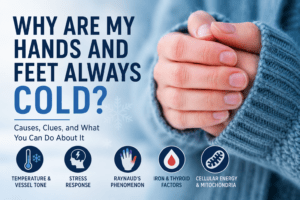
Are you one of those people who always feels cold?
It might be a normal afternoon, the room is set to a reasonable temperature, everyone else seems fine, and you are quietly negotiating with your sweater. If that sounds familiar, you’re not alone, and you’re not imagining it.
Feeling cold all the time isn’t necessarily about the readout on the thermostat. Instead, it can be a reflection of how your body is regulating heat. Your body is constantly managing heat like it manages blood sugar, hydration, and blood pressure. Heat regulation is a dynamic system.
Cold isn’t just a feeling, it’s a regulation problem
When people say “I feel cold,” they are describing a sensation that comes from skin temperature, blood flow, and nervous system signaling. Your core temperature is tightly protected and your body will make strategic choices to keep it stable. That is why you can feel cold in your hands and feet while your core temperature stays normal. (Mayo Clinic Proceedings)
Here’s the key idea. If you are persistently cold, one or more parts of your heat system may be operating at a lower baseline than it used to. That can happen for simple reasons and it can also be a clue that you should get checked.
The three levers your body uses to stay warm
Think of thermoregulation as three levers your body can pull throughout the day.
1) Heat production
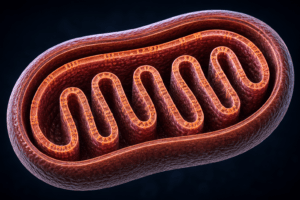
A large portion of your resting heat comes from metabolism in organs like the liver, brain, and muscles. At the cellular level, mitochondria convert fuel into ATP. Heat is a natural byproduct of that process, and under some conditions, the body can increase heat production through shivering or non-shivering pathways. (Physiology Journals)
2) Heat loss
Heat escapes through the skin. Body size, body composition, clothing, humidity, wind, and even how much blood is flowing near your skin all change how quickly you lose warmth. Some people, often those with low body fat, tolerate cold poorly because they have less insulation.
3) Heat distribution via blood flow
Your nervous system can constrict blood vessels near the surface to keep warm blood in the core. It is a protective move, but it can leave fingers, toes, ears, and the tip of your nose feeling cold.
Most “always cold” type of experiences are a blend of these levers, not a single cause.
Quick recap
- Heat is made, conserved, and distributed.
- Cold hands and feet often reflect your body’s blood flow decisions.
- Persistent cold is a pattern worth decoding, not dismissing.
What can shift those levers over time
Like your energy levels, your “warmth baseline” can drift. The shift is rarely limited to just one switch. It is usually a set of small changes that have added up.
1) Low energy availability, your body downshifts to conserve
If your body is not getting enough energy relative to demand, it adapts. A common adaptation is lowering energy expenditure where it can, including heat production. In sports science, this broader state is often discussed as low energy availability, when dietary intake is insufficient to cover exercise and basic physiological needs. (PMC)
In real life, this can look like:
- feeling chilled at rest
- being “fine” while moving, but cold when sitting
- flatter mood and less drive
- poorer recovery and more fatigue
This is one reason people often feel colder during dieting, heavy training blocks, or weeks when meals are inconsistent. It is not weakness. It is a conservation strategy.
2) Thyroid signaling, the metabolic dial
Thyroid hormones influence metabolic rate and how the body responds to cold. Increased sensitivity to cold is a commonly listed symptom of hypothyroidism, along with fatigue, constipation, dry skin, and weight gain for some people. (Mayo Clinic)
Not everyone has the same symptom set and many symptoms overlap with other issues. That is why, when thyroid is suspected, testing is the path to clarity.
3) Iron status and oxygen delivery, the “quiet limiter”
Iron is central to hemoglobin, which carries oxygen in red blood cells. Iron deficiency anemia can include symptoms like fatigue, shortness of breath with exertion, dizziness, and cold intolerance.
What’s tricky is that people may feel “off” before anemia is obvious on basic labs. That is one reason clinicians often look beyond hemoglobin alone and consider iron studies like ferritin when symptoms and risk factors line up. This is a medical conversation, but it is a common and fixable piece of the puzzle in the real world. (American Society of Hematology)
4) Raynaud’s phenomenon and exaggerated vessel spasm
Some people do not just have cold hands, they have episodic attacks. Raynaud’s phenomenon is a condition where blood vessels in the extremities narrow, restricting blood flow, often triggered by cold temperatures or emotional stress. Attacks most commonly affect fingers and toes.
A classic clue is color change. The skin may turn white or blue during an episode, then red as it warms. If you notice this pattern, it is worth discussing with a clinician rather than writing it off as “bad circulation.” (NIAMS)
5) Brown fat and non-shivering thermogenesis, the hidden heater
Adults can have metabolically active brown adipose tissue, sometimes called brown fat. Brown fat contributes to non-shivering thermogenesis, heat production without muscle shivering, and is activated by cold exposure. (PubMed)
Preclinical studies suggest that (−)-epicatechin may promote browning, also called beiging, of white adipose tissue, increasing markers linked to mitochondrial biogenesis and thermogenic programming. (European Journal of Pharmacology)
6) Recovery load, sleep debt, and stress tone
Thermoregulation is tied to the nervous system. When sleep is inconsistent and stress load is high, some people shift toward more peripheral vasoconstriction, meaning less warm blood at the skin. The result can feel like cold hands and feet that show up most at desks, in bed, or during downtime.
Why this matters
If you are always cold, it is often a signal about energy availability, hormone signaling, blood composition, circulation patterns, or recovery strain. Those are all modifiable, at least partly, once you know which lever is moving.
The most common patterns people miss
To make this practical, here are a few “pattern matches” that show up again and again.
Pattern A: Whole-body cold plus fatigue drift
This combination often overlaps with low energy availability, iron deficiency or anemia, or hypothyroidism, especially if it is new for you. (Mayo Clinic)
Pattern B: Mostly hands and feet, worse with stress
That is often blood-flow regulation. If you also see clear color changes or pain, Raynaud’s becomes more likely. (NIAMS)
Pattern C: Cold only when dieting, skipping meals, or training hard
This frequently tracks with an energy budget mismatch. Your system is downshifting heat production to conserve. (PMC)
Pattern D: “I’ve always run cold,” but it’s not getting worse
Sometimes this reflects stable body composition, environment, and vessel tone. Even then, it can be worth optimizing basics like fueling, movement, and sleep to see how much your baseline shifts.
When it’s worth getting checked
Cold intolerance can be normal at times, like in a cold room, after being outside, or after a poor night of sleep. It becomes more important when it is persistent, out of proportion, or paired with other symptoms.
It is reasonable to consider medical evaluation if:
- cold intolerance is new, worsening, or interfering with daily life
- you have unusual fatigue, weakness, shortness of breath, dizziness, or heart pounding
- you notice finger or toe color changes, numbness, or pain with cold or stress
- you have symptoms suggestive of hypothyroidism, like constipation, dry skin, slowed feeling, or weight change
Clinicians often consider tests based on your history, such as a complete blood count, iron studies, and thyroid testing. This is not about self-diagnosing. It is about giving your clinician a clear pattern to evaluate.
What can help in real life
The goal here is not to try to treat cold intolerance at home. It’s to support the system levers you can influence safely, while you get more clarity if needed. Read more about how to improve mitochondrial health.
Fuel consistently
If your eating has been irregular, or you have been dieting or training hard, start by stabilizing energy intake. Many people notice within days that they are less chilled at rest when they stop running an energy deficit. Over a few weeks, the effect is often more noticeable.
Build heat capacity through movement
Muscle is a heat-producing tissue. Regular aerobic movement and resistance training can shift baseline metabolic demand and improve circulation. You do not need extreme workouts. You need consistency.
A helpful mindset:
Think in weeks, not hours. Thermoregulation can shift quickly in the moment, but your baseline is shaped by habits, energy availability, and physiology over time.
Protect sleep and recovery
If you are cold mostly at night or during downtime, recovery load may be part of your pattern. A steadier sleep schedule and stress decompression can change vessel tone and thermal comfort over time.
Use practical warmth strategically
Warm socks, layers, and warm meals are not “cheating.” They reduce heat loss while you work on upstream factors. If your hands are the issue, warming your core first can help, the body often relaxes peripheral constriction when it feels the core is safe.
Where Mitozz can fit in
At FMG Health Sciences, we think in terms of systems. Heat production depends on fuel availability, oxygen delivery, hormones, blood flow regulation, and cellular energy conversion, with mitochondria acting as one hub in that network.
Thermal comfort reflects a mix of heat production, circulation, and nervous system signaling, and all of it is energy-dependent. At the cellular level, mitochondria sit beneath that system by producing ATP, with heat as a normal byproduct of metabolism, and by supporting the energy demands of muscle and vascular function.
Mitozz s a nutraceutical developed by FMG Health Sciences containing 98% pure (−)-epicatechin, a compound studied in cellular signaling pathways related to mitochondrial function and vascular physiology.
The bottom line
Feeling cold all the time is often your body telling you that the balance between heat production, heat loss, and blood flow distribution has shifted.
Sometimes the shift is straightforward, low energy availability, reduced movement, sleep debt, or stress tone. Sometimes it points toward thyroid function, iron status, or a circulation pattern like Raynaud’s that deserves evaluation.
Instead of asking, “Why am I always cold?”
Ask, “Which lever is my body pulling, and what signals am I giving it to rebuild a warmer baseline?”
Share this blog article
References
- American Society of Hematology. (n.d.). Iron-Deficiency Anemia. (American Society of Hematology)
- Areta, J. L., & Hopkins, W. G. (2020). Low energy availability: History, definition and evidence of its endocrine, metabolic and physiological effects in humans. Sports Medicine. (PMC)
- Varela, C. E., et al. (2017), “Browning effects of (−)-epicatechin on adipocytes and white adipose tissue”, European Journal of Pharmacology
- Hachemi, I., et al. (2023). Brown adipose tissue: Activation and metabolism in humans. Endocrinology and Metabolism. (E-ENM)
- Mayo Clinic. (2022). Hypothyroidism (underactive thyroid): Symptoms and causes. (Mayo Clinic)
- Mayo Clinic. (2024). Raynaud’s disease: Symptoms and causes. (Mayo Clinic)
- MedlinePlus. (2024). Cold intolerance. (MedlinePlus)
- National Institute of Arthritis and Musculoskeletal and Skin Diseases. (2024). Raynaud’s phenomenon. (NIAMS)
- van Marken Lichtenbelt, W. (2012). Brown adipose tissue and the regulation of nonshivering thermogenesis. Current Opinion in Clinical Nutrition and Metabolic Care. (PubMed)
- Tansey, E. A., & Johnson, C. D. (2015). Recent advances in thermoregulation. Advances in Physiology Education. (Physiology Journals)
Understanding mitochondrial health is a long-term process. That’s why we created the Mitozz Newsletter: a free way to keep learning about cellular energy, mitochondrial health, and the lifestyle signals that support your body over time. You’ll receive science-based educational content, practical guidance, and updates from Mitozz, all at your own pace.
Sign up for the Mitozz Newsletter
Get science-based education on mitochondrial health, cellular energy, and lifestyle signals that support your body over time.
Medical Disclaimer: The information provided in this article is for educational and informational purposes only and is not intended as medical advice. It is not a substitute for professional medical diagnosis, treatment, or guidance. Always consult with a qualified healthcare professional before making changes to your diet, exercise routine, fasting practices, or supplement use, especially if you have a medical condition, are pregnant or nursing, or are taking medications.
FDA Disclaimer: These statements have not been evaluated by the Food and Drug Administration. They are not not intended to diagnose, treat, cure, or prevent any disease.