Key Takeaways
- Your retina is built for speed, not rest. It’s one of the body’s most energy-demanding tissues because it has to process light changes in real time.
- Photoreceptors spend ATP even in the dark. A large share of retinal energy goes to staying “ready,” not just responding to bright light.
- Mitochondria are positioned like on-site generators. In photoreceptors, they cluster close to the machinery that needs constant power, so energy arrives fast.
- High energy throughput creates extra oxidative load. The same system that powers vision also requires strong cellular maintenance and repair over time.
- Visual resilience is whole-body resilience. Sleep, movement, and nutrition shape the metabolic environment your eyes depend on, supplementation can complement the basics.
When you step from a dim hallway into bright sunlight, your eyes adjust in a fraction of a second. This seamless transition feels automatic, but beneath the surface, it is a feat of extreme biological engineering. Your retina, the thin layer of tissue at the back of your eye, is one of the most metabolically active tissues in your entire body. To keep your world in focus, it requires a constant, massive supply of cellular energy.
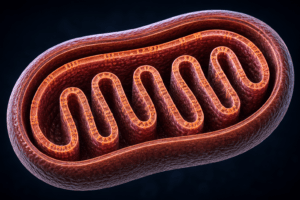
At the heart of this process are mitochondria. Often called the powerhouses of the cell, these organelles are particularly dense in the retina containing billions of mitochondria, with as much as 5,000 per cell in certain layers, to provide the massive, constant supply of energy required for high-fidelity vision.
But they are not just passive batteries, they are dynamic engines that must respond instantly to every flash of light and every shift in contrast. Understanding how vision works requires us to look at the bioenergetics of the eye.
Why does the retina need so much energy?
It might be surprising to learn that your eyes consume more energy per gram of tissue than even your brain or your heart! This high demand comes from the constant work of phototransduction, the process of converting light into electrical signals. Every time a photon hits a photoreceptor cell, it triggers a chemical cascade that eventually resets.
Most of this energy is used to maintain what scientists call the “dark current.” In total darkness, your photoreceptors are actually in a state of high activity, constantly pumping ions across their membranes to stay ready for the next flash of light.
This “always-on” readiness is why your eyes are so sensitive but it comes at a steep metabolic price. Most of this work is fueled by ATP, which is generated in high volumes by mitochondrial clusters located just millimeters from where light is captured.
The unique architecture of eye power
In most cells, mitochondria are scattered throughout the cytoplasm of the cell. In the photoreceptors of your retina, however, they are packed into a specialized region called the ellipsoid. This creates a concentrated “power plant” of mitochondria directly adjacent to the machinery that detects light, ensuring that energy is available exactly where it is needed most.
However, this proximity is a double-edged sword. Because the retina has to be transparent in order to allow vision, these mitochondrial clusters are regularly exposed to high-energy visible light. This constant light exposure, combined with the extreme levels of oxygen required for aerobic respiration, creates a high-stakes environment for oxidative stress. Maintaining the health of these mitochondria is not just about sustaining their power output, it is about protecting the delicate structures of the eye from both the external stress of light and the internal byproducts of their own intense energy production.
Why this matters: Your visual clarity depends on a “just-in-time” delivery system of energy. When this system is efficient, your eyes can handle the stress of light exposure and rapid signals with ease.
Mitochondrial dynamics and the visual cycle
Your eyes do not just use energy, they also manage it through a process of constant renewal. Because the metabolic load is so high, retinal mitochondria undergo frequent cycles of repair and turnover. This is part of a broader “visual cycle” where the retinal pigment epithelium (RPE) works alongside photoreceptors to recycle nutrients and clear out cellular debris.
When mitochondria are healthy, they maintain a high Mitochondrial Membrane Potential, which allows them to produce ATP efficiently. However, as we age or face environmental stressors like prolonged screen use, this efficiency can dip. The body’s ability to initiate mitophagy, the process of clearing out damaged mitochondria, is essential for keeping the visual system resilient.
Supporting long-term visual resilience
Building visual resilience is about more than just taking “eye vitamins.” It is about supporting the systemic foundations of mitochondrial health. Research suggests that the same lifestyle factors that benefit your heart and muscles, such as balanced nutrition, consistent sleep, and managing oxidative load, also play a role in maintaining retinal energy capacity.
Emerging studies have looked at compounds like (-)-epicatechin for their potential to support mitochondrial biogenesis. By encouraging the body to maintain a robust population of healthy mitochondria, we may help the retina stay better equipped for its daily energy-intensive tasks.
Why this matters: You can think of your visual health as a “bank account” of energy. The more resilient your mitochondria are, the better your eyes can handle the “withdrawals” caused by light exposure and aging.
For those interested in investigating strategies for supporting mitochondrial health, read our article.
Conclusion
At FMG Health Sciences, we focus on the intersection of cellular biology and daily performance. We developed Mitozz as a targeted nutritional support for mitochondrial function. Containing 98% pure (-)-epicatechin, Mitozz is designed to complement a healthy lifestyle by supporting the pathways that maintain cellular energy capacity. While no supplement is a replacement for foundational health habits, Mitozz offers a way to support the “engines” that power your most vital systems, including your vision.
To learn more about the science of cellular energy, explore our Mitochondria and Disease page or Mitochondria and Longevity.
Share this blog article
References
- Nogueira, L., et al. (2011). (-)-Epicatechin enhances fatigue resistance and oxidative capacity. The Journal of Physiology.
- Joyal, J. S., Gantner, M. L., Smith, L. E. H., et al. (2017). Retinal energy demands control vascular supply of the retina in development and disease: The role of neuronal lipid and glucose metabolism. Progress in Retinal and Eye Research.
- Liu, H., & Prokosch, V. (2021). Energy Metabolism in the Inner Retina in Health and Glaucoma. International Journal of Molecular Sciences.
- Pan, W. W., Wubben, T. J., et al. (2021). Photoreceptor metabolic reprogramming: current understanding and therapeutic implications. Nature.
- Linton, J. D., Holzhausen, L. C., et al. (2010). Flow of energy in the outer retina in darkness and in light. PNAS.
- Wong-Riley, M. T. (2010). Energy metabolism of the visual system. Eye and Brain.
- Jarrett, S. G., & Boulton, M. E. (2012). Consequences of oxidative stress in age-related macular degeneration. Molecular Aspects of Medicine.
- Muench, et al. (2021). The Influence of Mitochondrial Dynamics and Function on Retinal Ganglion Cell Susceptibility in Optic Nerve Disease. Cells.
Understanding mitochondrial health is a long-term process. That’s why we created the Mitozz Newsletter: a free way to keep learning about cellular energy, mitochondrial health, and the lifestyle signals that support your body over time. You’ll receive science-based educational content, practical guidance, and updates from Mitozz, all at your own pace.
Sign up for the Mitozz Newsletter
Get science-based education on mitochondrial health, cellular energy, and lifestyle signals that support your body over time.
Medical Disclaimer: The information provided in this article is for educational and informational purposes only and is not intended as medical advice. It is not a substitute for professional medical diagnosis, treatment, or guidance. Always consult with a qualified healthcare professional before making changes to your diet, exercise routine, fasting practices, or supplement use, especially if you have a medical condition, are pregnant or nursing, or are taking medications.
FDA Disclaimer: These statements have not been evaluated by the Food and Drug Administration. They are not not intended to diagnose, treat, cure, or prevent any disease.