
How Does Mitochondrial Health Define Your Body? The Real Story of Energy from Within

We often hear that “food gives us energy,” but the truth is a little more complex and a lot more fascinating. The real powerhouses behind your energy are tiny structures inside your cells called mitochondria.
Flavonoids from dark chocolate and (−)-epicatechin ameliorate high-fat diet-induced decreases in mobility and muscle damage in aging mice
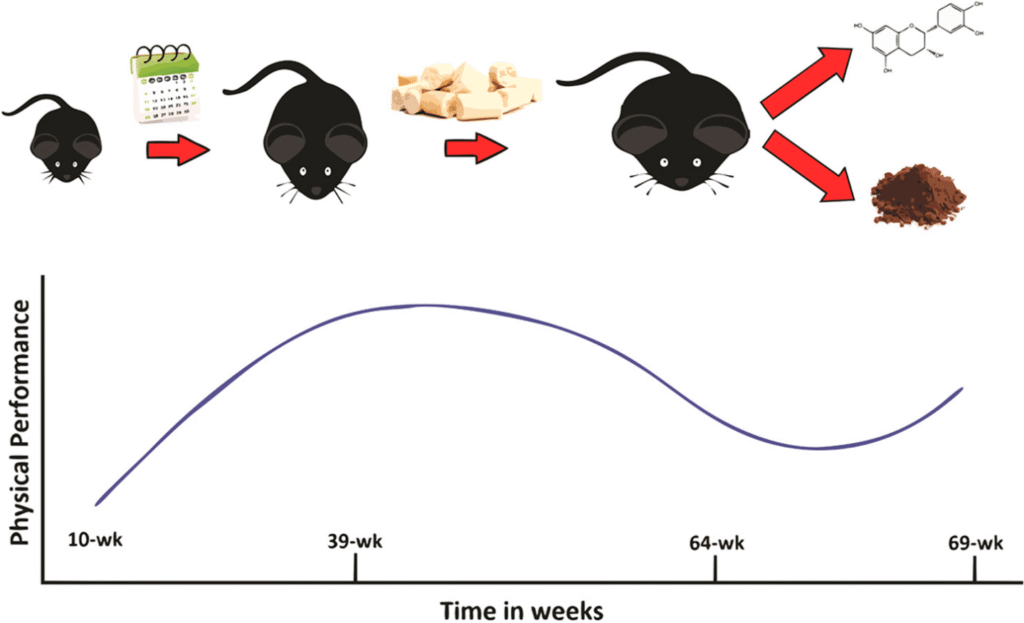
Age-related muscle decline, when associated with obesity, leads to adverse outcomes with increased risks for falling, loss of independence, disability and risk of premature mortality. The aim of this study was to assess the potential beneficial effects of flavonoids in improving the age-/high-fat-diet-induced decrease in physical activity/capacity related to the onset of skeletal muscle decline. The effects of the administration of a cocoa beverage enriched with flavanols or pure (−)-epicatechin for 5 wk in a model of physical activity decline induced by the ingestion of a high-fat diet (60% fat) in middle-age mice were evaluated. The results showed that both products, the cocoa beverage enriched with flavanols and pure (−)-epicatechin, improved physical performance evaluated with the hang-wire, inverted-screen, and weight-lifting tests and dynamometry compared with the performance of the controls. The beverage and (−)-epicatechin increased the follistatin/myostatin ratio and increased the expression of myocyte enhancer factor 2A (MEF2A), suggesting an effect on molecular modulators of growth differentiation. Furthermore, the beverage and (−)-epicatechin decreased the expression of O-type fork-head transcription factor (FOXO1A) and muscle ring finger 1 (MURF1) markers of the skeletal muscle ubiquitin-proteasome degradation pathway.
Recovery of Indicators of Mitochondrial Biogenesis, Oxidative Stress, and Aging With (-)-Epicatechin in Senile Mice

In senile mice, (-)-epicatechin restored markers linked to mitochondrial biogenesis and improved oxidative-stress and aging-related indicators.
(−)-Epicatechin induced reversal of endothelial cell aging and improved vascular function: underlying mechanisms
This paper reports that (-)-epicatechin reversed several features of endothelial cell aging and improved vascular function, while also exploring the mechanisms behind those changes.
Arginase inhibition by (−)-Epicatechin reverses endothelial cell aging
This study identifies arginase inhibition as a key mechanism by which (-)-epicatechin reverses endothelial cell aging, tying vascular anti-aging effects to a defined enzymatic pathway.
Effects of (−)-epicatechin on neuroinflammation and hyperphosphorylation of tau in the hippocampus of aged mice
In aged mice, (-)-epicatechin reduced oxidative stress, neuroinflammation, and tau hyperphosphorylation in the hippocampus, while also improving several behavioral and inflammatory measures.