Points clés à retenir
- Recovery is an active biological process, not simply the absence of work.
- Physical and mental demands affect the body differently, but both require recovery before full capacity returns.
- Physical recovery can involve restoring fuel reserves, while cellular recovery also includes rebalancing signaling and maintaining mitochondrial quality.
- Feeling less tired does not always mean every system is fully recovered.
- Repeatedly adding new demands before recovery is complete can gradually reduce the capacity available for the next challenge.
A demanding day can take many forms. It might be a hard workout, hours of concentrated decision-making, a stressful deadline, extensive travel, or some combination of all four.
Once the demand stops, we tend to call whatever happens next “rest.” Biologically, however, recovery involves much more than simply stopping the activity.
The body has to restore resources, re-establish internal balance, maintain cellular machinery, and prepare itself to respond effectively the next time demand rises.
Recovery is really about restoring capacity
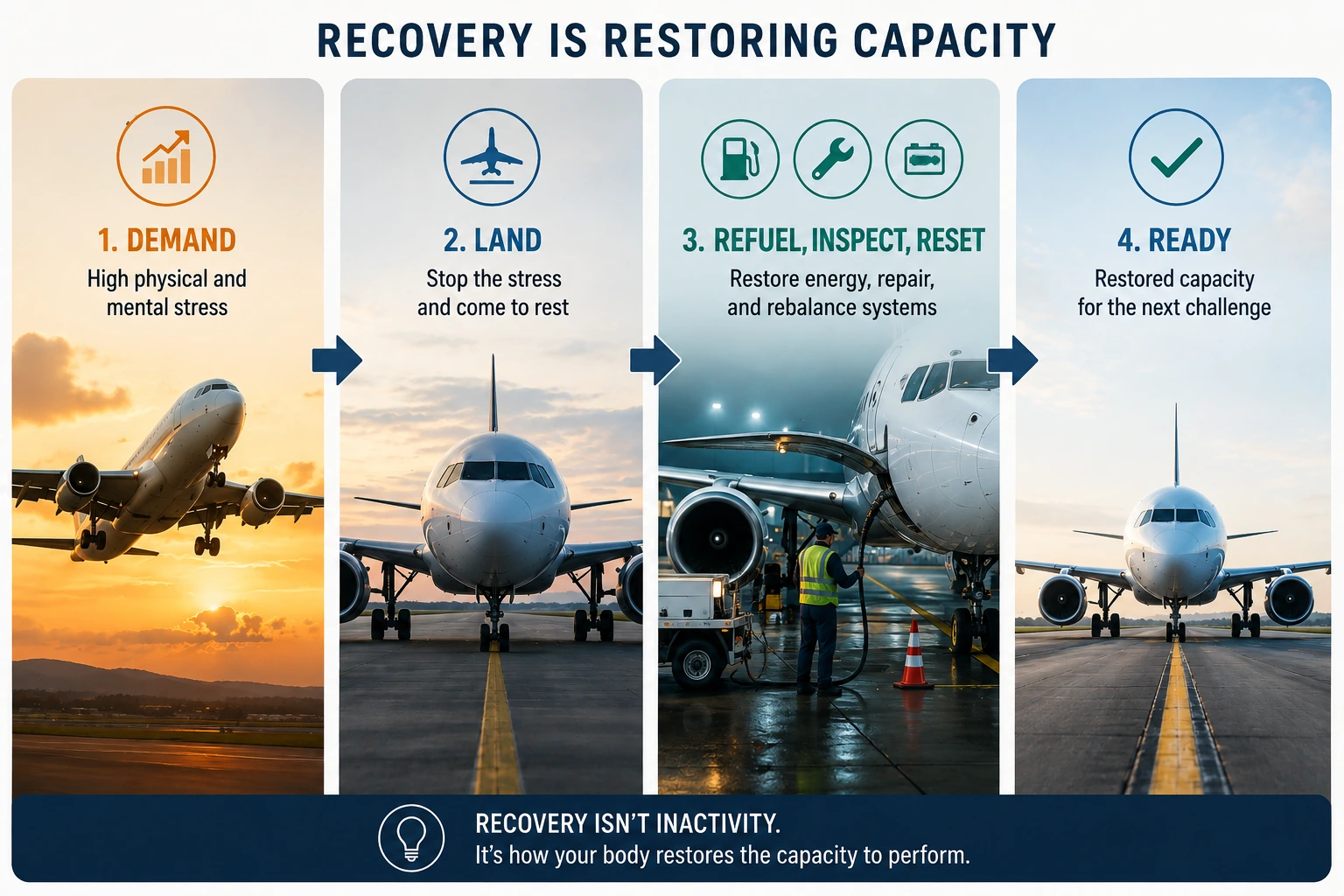
Think of recovery less like switching off a machine and more like turning around an aircraft between flights.
When a plane lands, parking it at the gate does not automatically make it ready to fly again. It has to be refueled, inspected, resupplied, and given enough time for the systems and crew to prepare for the next departure.
Your body works in a similar way.
A stressful episode uses part of your available capacity. Once the demand stops, recovery begins the biological equivalent of the turnaround: restoring energy reserves, rebalancing signaling, maintaining cellular machinery, and allowing the stress response to settle.
None of this means that stressful demand is harmful. Just as an aircraft is built to fly, the body is built to respond to challenge. In fact, challenge is one of the signals that allows biological systems to adapt.
The important question is whether enough recovery happens before the next major demand arrives.
A useful way to think about the cycle is:
Demand → Disturbance → Recovery → Adaptation → Renewed Capacity
The alternative looks more like:
Demand → Partial Recovery → New Demand → Partial Recovery
In the second pattern, the body may still be able to perform. But it is starting the next challenge with less reserve available.
Over time, the issue is not necessarily that the system suddenly fails. It is that the operating margin gets smaller.
Recovery, then, is not simply being back at the gate. It is completing the turnaround so the system is truly ready for the next flight.
Physical recovery requires restoring energy and fuel
During intense physical activity, energy demand increases dramatically.
ATP is the immediate energy currency cells use to perform work. Because muscles store only small amounts of ATP, they constantly regenerate it from other energy systems.
During short, intense efforts, phosphocreatine helps rapidly regenerate ATP. Longer activity increasingly relies on carbohydrates and fats, with muscle glycogen serving as an important stored source of carbohydrate.
After demanding exercise, some of these reserves have to be restored.
Phosphocreatine begins recovering relatively quickly. Glycogen replenishment takes longer and depends on factors such as how much was depleted, what is eaten afterward, and how much time is available before the next demanding session.
This is one reason recovery cannot always be reduced to “taking a break.” The biological resources used during exercise may still be rebuilding even after soreness and immediate fatigue have started to fade.
Our article Muscle Recovery Has Phases: Immediate, 24–48 Hours, and Long-Term Adaptation looks more closely at how physical recovery unfolds over time, from the first hours after exercise through longer-term adaptation.
The practical point is straightforward: nutrition, hydration, sleep, and adequate time between difficult sessions are part of training, not separate from it.
Mental fatigue is not simply the brain running out of fuel
The same fuel-tank explanation does not translate neatly to cognitive work.
After several hours of demanding concentration, people may experience reduced motivation, slower decision-making, increased distractibility, or the sense that another difficult task requires more effort than it normally would.
That does not appear to mean the brain has simply “used up” its energy supply.
Research on prolonged cognitive effort suggests a more complicated interaction between neural activity, metabolic regulation, and the way the brain weighs the cost of continued effort.
A 2022 study published in Current Biology, for example, reported changes in glutamate measures within the lateral prefrontal cortex following prolonged high-demand cognitive work. The researchers proposed a neuro-metabolic explanation for why sustained mental effort may affect subsequent decision-making.
The broader point is that cognitive demand also changes the state of the system, even if the underlying biology is not identical to what happens during strenuous exercise.
For a deeper look at this distinction, see Cognitive Fatigue in High Performers: A Mitochondrial Lens, which explores why sustained mental performance depends not only on drive or discipline, but also on the capacity to recover and repeat the effort.
This has practical consequences.
Closing a difficult spreadsheet and immediately opening email, social media, financial news, or another stream of decisions may feel like a change of activity without providing much reduction in cognitive demand.
Mental recovery may require periods in which fewer decisions need to be made, less information has to be processed, and attention is not constantly being redirected.
Cells have to rebalance and maintain their machinery
Energy replacement is only one part of recovery.
Exercise and other biological stressors temporarily alter the internal environment of cells. Energy-sensing pathways become active, calcium signaling changes, reactive oxygen species participate in signaling, and genes involved in adaptation can become more active.
These changes are not necessarily signs of damage. Many are part of the normal signaling system through which cells detect that demand has increased.
Mitochondria are closely involved in this response.
They help meet rising ATP demand, but they also participate in the signals that influence how cells adapt afterward.
Recovery therefore involves more than replacing what was used. Cells also have to maintain the quality of the machinery responsible for producing and managing energy.
Two important processes are mitochondrial biogenesis, which helps renew or expand mitochondrial capacity, and mitophagy, which helps remove and recycle mitochondrial components that are no longer functioning effectively.
These processes work as part of a broader mitochondrial quality-control system.
Our article Mitochondrial Biogenesis and Mitophagy: Build More, Clear Better explores this relationship in more detail.
The key point for recovery is simpler: the goal is not merely to have more mitochondria. The body needs a responsive mitochondrial network with enough capacity to meet demand while also maintaining the quality of the machinery producing that energy.
This is one reason adaptation occurs after the challenge as well as during it.
The workout, stressful event, or high-demand period creates the disturbance. Recovery gives biological systems the opportunity to rebuild, reorganize, and adapt.
The stress response also needs an opportunity to downshift
High demand does not affect only individual cells or muscles. The nervous and endocrine systems help coordinate the response across the entire body.
During acute stress, sympathetic nervous system activity can increase. Stress hormones help mobilize energy, sharpen attention, and prepare the body to respond.
For a limited period, this is useful.
Problems are more likely to emerge when the body repeatedly receives the message that the demand is still continuing.
Recovery therefore includes allowing these systems to move away from a continuously activated state.
Sleep plays an important role, but recovery also happens during waking hours. Lower-demand periods, relaxed movement, adequate nutrition, social interaction, and genuine psychological disengagement can help create conditions in which the body no longer has to behave as though another immediate challenge is approaching.
This is also where chronic stress and incomplete recovery begin to overlap.
Our article Cellular Health and Stress Management: How to Protect Your Energy, Recovery, and Resilience examines how persistent stress can influence energy allocation, sleep, cellular repair, and long-term resilience.
The important distinction is that stress itself is not always the problem.
The combination of high demand plus insufficient recovery is often more important than either one considered alone.
Feeling recovered and being fully recovered are not always the same thing
One challenge is that the body does not have a single recovery gauge.
Feeling less sore or more motivated does not necessarily mean every system has fully recovered. A better question may be:
“How much capacity do I have available for the next demand?”
You cannot measure that with one number, but you can estimate it by looking at a few signals together:
- sleep quality,
- energy,
- mental clarity,
- physical readiness, and
- whether normal tasks feel unusually difficult.
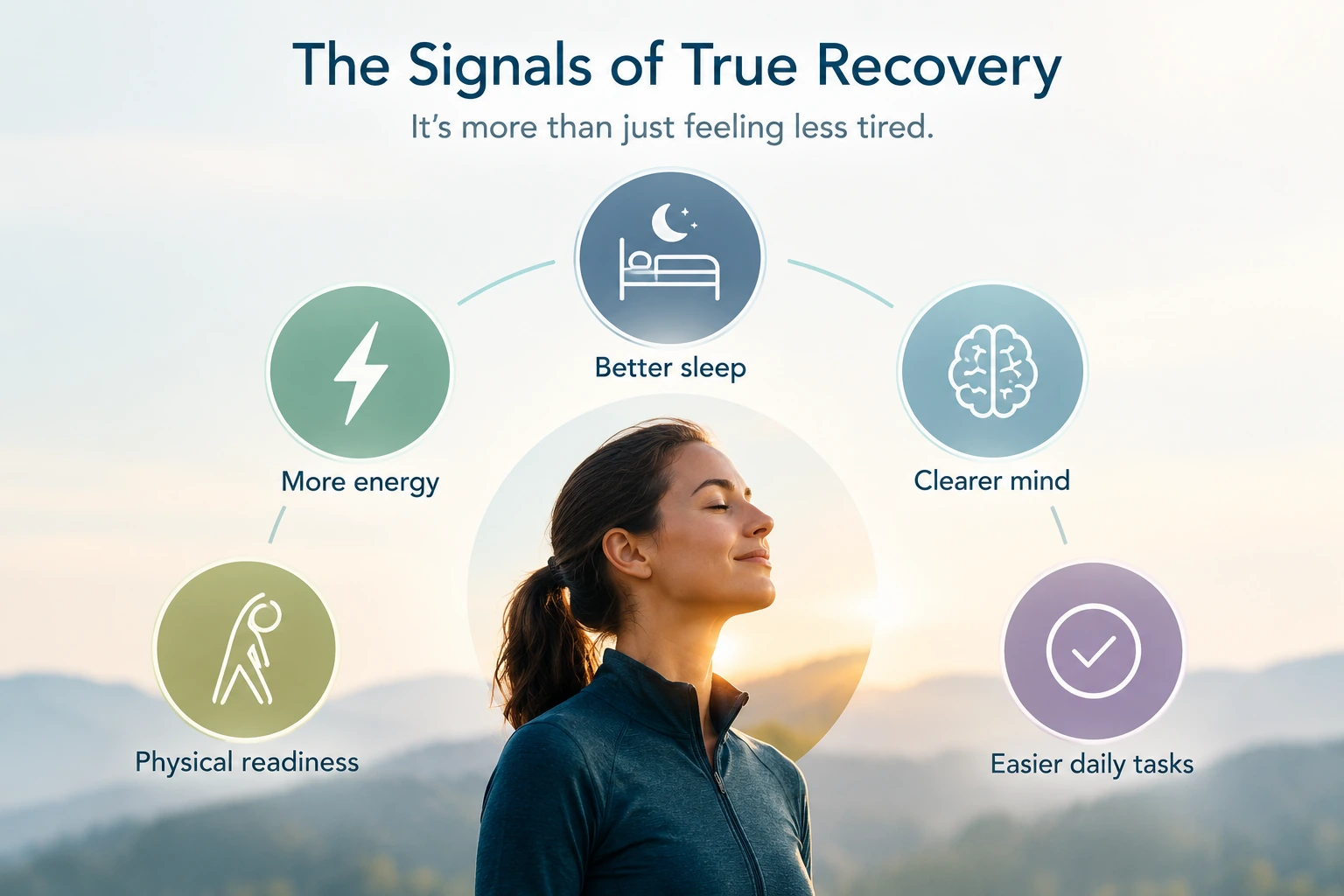
The most useful comparison is with your own baseline. If several of those signals are off at the same time, your available capacity may still be reduced.
You may still be able to complete the next task. The more important question is whether you are starting it with a full operating margin or a reduced one.
Good recovery should match the type of demand
There is no single recovery protocol that works equally well after every challenge.
After strenuous physical activity, recovery may require fluids, carbohydrates, protein, sleep, and sufficient time before another demanding training session.
After prolonged cognitive effort, more food alone is unlikely to solve the problem. Reducing information load, stepping away from decision-making, moving, changing environments, or sleeping may be more useful.
After psychological stress, recovery often requires a genuine drop in mental pressure, not just switching from one demanding activity to another. If work stress is immediately replaced by constant messages, upsetting news, difficult decisions, or other stimulation, the sense of demand may still continue. Recovery is more likely when there is a period with fewer decisions, less urgency, and less competition for your attention. Mindfulness, meditation, slow breathing, or simply spending a few quiet minutes without new input can help create that shift.
What these situations share is the need to reduce the load on the systems that were heavily used.
Recovery does not necessarily mean doing nothing.
A walk can support recovery. Preparing a nutritious meal can support recovery. Going to bed earlier can support recovery. Spending time outside without another objective to accomplish can support recovery.
The defining question is whether the activity is restoring capacity or consuming more of it.
La place Mitozz
Recovery depends on several fundamentals working together, including sleep, nutrition, hydration, movement, and enough time between periods of high demand.
Mitozz is formulated with 98% pure (−)-epicatechin, a green tea-derived flavanol studied in relation to mitochondrial, vascular, and cellular signaling. Those pathways are relevant to how cells produce energy, respond to stress, and adapt over time.
Mitozz can though of as targeted nutritional support for the cellular systems involved in energy, resilience, and adaptation, alongside the daily habits that help restore capacity.
Conclusion
Stress and effort are not the enemy.
Without challenge, many of the signals that promote adaptation would never occur. The goal is to create a repeatable cycle in which periods of high demand are followed by enough restoration for the body to respond effectively again.
Like an aircraft between flights, the body needs more than a stop at the gate. It needs enough time to refuel, reset, and prepare its systems for what comes next. Recovery is what restores that operating margin, so the next departure begins with capacity in reserve rather than capacity already spent.
Partager cet article de blog
Références
- McMahon S, Jenkins D. Factors affecting the rate of phosphocreatine resynthesis following intense exercise. Sports Medicine, 2002.
- Burke LM, van Loon LJC, Hawley JA. Postexercise muscle glycogen resynthesis in humans. Journal of Applied Physiology, 2017.
- Wiehler A, Branzoli F, Adanyeguh I, Mochel F, Pessiglione M. A neuro-metabolic account of why daylong cognitive work alters the control of economic decisions. Current Biology, 2022.
- Reisman EG, Hawley JA, Hoffman NJ. Exercise-regulated mitochondrial and nuclear signalling networks in skeletal muscle. Sports Medicine, 2024.
- Slavin MB, Memme JM, Oliveira AN, Moradi N, Hood DA. Regulatory networks coordinating mitochondrial quality control in skeletal muscle. American Journal of Physiology-Cell Physiology, 2022.
- Picard M, McEwen BS. Psychological stress and mitochondria: A systematic review. Psychosomatic Medicine, 2018.
- Zhu B, Shi C, Park CG, Zhao X, Reutrakul S. Effects of sleep restriction on metabolism-related parameters in healthy adults: A comprehensive review and meta-analysis of randomized controlled trials. Sleep Medicine Reviews, 2019.
- Rajan A, Kumar M, Raj PP. Effects of mindfulness-based interventions on perceived stress among non-clinical adults: A systematic review and meta-analysis. npj Mental Health Research, 2026.
- Fincham GW, Strauss C, Montero-Marin J, Cavanagh K. Effect of breathwork on stress and mental health: A meta-analysis of randomised-controlled trials. Scientific Reports, 2023.
- Daussin FN, Heyman E, Burelle Y. Effects of (−)-epicatechin on mitochondria. Nutrition Reviews, 2021.
- Ramírez-Sánchez I, Maya L, Ceballos G, Villarreal F. (−)-Epicatechin activation of endothelial cell endothelial nitric oxide synthase, nitric oxide, and related signaling pathways. Hypertension, 2010.
Comprendre la santé mitochondriale est un processus de longue haleine. C’est pourquoi nous avons créé la Mitozz : un moyen gratuit de continuer à vous informer sur l’énergie cellulaire, la santé mitochondriale et les choix de mode de vie qui favorisent le bien-être de votre corps au fil du temps. Vous recevrez du contenu éducatif fondé sur des données scientifiques, des conseils pratiques et les dernières actualités de Mitozz, le tout à votre rythme.
Inscrivez-vous à la Mitozz
Bénéficiez d'une formation fondée sur des données scientifiques concernant la santé mitochondriale, l'énergie cellulaire et les choix de mode de vie qui favorisent le bien-être de votre corps à long terme.
Avertissement médical : Les informations fournies dans cet article sont uniquement à titre éducatif et informatif et ne constituent en aucun cas un avis médical. Elles ne sauraient se substituer à un diagnostic, un traitement ou des conseils médicaux professionnels. Consultez toujours un professionnel de santé qualifié avant de modifier votre régime alimentaire, votre programme d'activité physique, vos pratiques de jeûne ou votre consommation de compléments alimentaires, en particulier si vous souffrez d'une affection médicale, si vous êtes enceinte ou si vous allaitez, ou si vous prenez des médicaments.
Avertissement de la FDA : Ces allégations n'ont pas été évaluées par la Food and Drug Administration. Elles ne visent pas à diagnostiquer, traiter, guérir ou prévenir une quelconque maladie.