Points clés à retenir
- Ordinary tiredness usually follows a recognizable demand and improves when sleep, food, hydration, or recovery catch up.
- The term “mitochondrial fatigue” describes a pattern of symptoms. It does not identify the medical cause of those symptoms.
- Disproportionate effort, poor recovery, reduced exercise tolerance, and mental fog may justify a closer look at overall energy capacity.
- These symptoms are not specific to mitochondria and can have many medical, psychological, sleep-related, and lifestyle causes.
- Persistent, worsening, or unexplained fatigue should be discussed with a healthcare professional rather than self-diagnosed.
You stay up late, work through a difficult week, or train harder than usual. The next day, you feel tired. That is ordinary physiology signaling that demand has temporarily exceeded recovery.
But some fatigue follows a different pattern. It feels out of proportion to the effort that came before it. A normal workout creates an unusually long recovery. A full night of sleep does not restore your usual capacity. Mental effort and physical activity seem to draw from the same limited reserve.
People often call this “mitochondrial fatigue.” The phrase can be useful, but only if it is handled carefully. You cannot determine how well your mitochondria are working from symptoms alone, and mitochondrial fatigue is not a recognized standalone diagnosis. It is better understood as a possible pattern of reduced energy capacity that deserves context, observation, and, when persistent, medical evaluation.
Ordinary Tiredness Usually Has an Understandable Cause
Ordinary tiredness is commonly linked to something you can identify: too little sleep, a long day, emotional stress, travel, an intense workout, illness, dehydration, or inadequate food intake. Fatigue can be a normal response to these types of stressors but it often improves after the missing recovery input is restored.
Recovery does not have to be immediate. After hard exercise, muscle strength and coordination may remain temporarily reduced, and full recovery can take anywhere from several hours to several days, depending on the activity. What matters is that the response is proportional to the effort and that your usual capacity eventually returns.
It also helps to separate tiredness from sleepiness. Sleepiness is the tendency to fall asleep. Fatigue is more often experienced as low energy, reduced endurance, or difficulty sustaining effort. The two can occur together, but they are not identical.
What People Mean by “Mitochondrial Fatigue”
Mitochondria help cells convert nutrients from the food we eat and oxygen from the air we breath into ATP, the usable energy that supports muscle contraction, nerve signaling, repair, and other cellular work. When researchers study fatigue, mitochondrial energy metabolism is one of several biological systems they might examine.
A review of the fatigue literature found associations between fatigue and changes in mitochondrial structure, enzymes, energy metabolism, oxidative stress, immune activity, and genetics. The evidence did not point to a single mitochondrial cause of fatigue. Instead, it suggested that fatigue can arise through different biological pathways, with mitochondrial dysfunction playing a role in some people and conditions.
In confirmed mitochondrial diseases, muscle fatigue, weakness, and exercise intolerance are well-recognized symptoms. Yet these disorders are uncommon and often involve additional muscular, neurological, sensory, cardiac, or multisystem findings. Everyday fatigue should not be equated with a primary mitochondrial disease.
Patterns That May Deserve a Closer Look
No single sensation identifies reduced mitochondrial function. What matters more is the pattern across effort, recovery, and daily capacity.
1. The Effort Feels Disproportionate to the Task
Ordinary tasks may start to feel unusually costly. Stairs feel steeper. A familiar walk requires more breaks. A workout that once felt moderate now reaches your limit early.
This is sometimes called exercise intolerance. It is associated with mitochondrial myopathies, but it is also nonspecific and can result from cardiopulmonary conditions, medication effects, deconditioning, inadequate nutrition, and many other factors.
2. Recovery Takes Longer Than Expected
The most useful clue may be what happens after activity. You may complete the task, then notice that physical heaviness or reduced mental clarity carries into the next day.
Prolonged recovery appears in descriptions of fatigue associated with altered bioenergetics. Still, there is no universal recovery time that separates “normal” from “mitochondrial” fatigue. Training level, age, sleep, illness, nutrition, stress, and activity intensity all change the recovery curve.
A delayed crash after minor physical, mental, or emotional activity is different from routine post-workout tiredness. In ME/CFS, post-exertional malaise can appear 12 to 48 hours after activity and last for days or weeks. That pattern warrants medical attention and should not be treated as a sign that someone simply needs to exercise harder.
3. Mental and Physical Fatigue Travel Together
The brain is highly energy dependent, but brain fog is not a direct measurement of mitochondrial function. Difficulty concentrating and reduced mental stamina can arise from sleep loss, stress, medications, mood disorders, infection, hormonal changes, and other influences.
The pattern becomes more informative when mental fatigue appears alongside reduced physical endurance and poor recovery. Even then, it is a reason to investigate the broader system, not proof of one mechanism.
4. Rest Reduces the Feeling, but Not the Limitation
With ordinary tiredness, rest usually restores a meaningful part of normal capacity. With persistent fatigue, a person may feel somewhat better while resting but still cannot resume normal activity without quickly reaching the same limit.
Unrefreshing sleep is also important. It can occur with sleep apnea, insomnia, circadian disruption, ME/CFS, pain, and other conditions. Sleeping eight hours does not guarantee restorative sleep, so “I slept enough” should not automatically lead to a mitochondrial explanation.
A Practical Comparison
More Consistent With Temporary Tiredness
- There is an obvious trigger.
- The fatigue is proportionate to the demand.
- Sleep, food, hydration, or a lighter day produce clear improvement.
- Your usual tolerance returns within a familiar recovery window.
- The pattern is occasional.
A Pattern Worth Investigating
- Fatigue persists without a clear reason.
- Familiar activities require noticeably more effort.
- Recovery is repeatedly longer than expected.
- Physical and cognitive stamina decline together.
- Sleep is consistently unrefreshing.
- Activity causes delayed or prolonged worsening.
- Daily activities are becoming harder to maintain.
These are not diagnostic checklists. They are prompts for observing what has changed and deciding whether further evaluation is appropriate.
Turn What You Notice Into a Clearer Baseline
Recognizing a fatigue pattern is easier when you look beyond one unusually difficult day. Consider whether your energy remains steady, how much activity you can tolerate, and how reliably you recover over several weeks.
The Mitozz Mitochondrial Vitality Self-Assessment is a short educational tool that helps organize those observations. It asks about daily energy, stamina, recovery, and muscle performance, then provides a personal Vitality Score that you can use as a reference point.
The assessment does not measure mitochondrial function or determine the cause of fatigue. Its purpose is to help you identify patterns and establish a clearer personal baseline.
Take the 90-Second Mitochondrial Vitality Self-Assessment
Want to understand how mitochondrial health may be evaluated beyond symptoms? Read the free Biomarkers for Mitochondrial Health guide, which explains functional observations and more advanced biomarkers that can be discussed with a qualified healthcare professional.
Why Fatigue Cannot Be Reduced to ATP Alone
It is tempting to think of fatigue as an empty cellular battery, but human physiology is more complex. Fatigue can be influenced by muscle metabolism, oxygen delivery, nervous-system activity, immune signaling, hormones, sleep, mood, pain, and how the body perceives effort.
Even during exercise, fatigue can develop both within the muscles and within the nervous system that activates them. Mitochondria are essential for sustained aerobic activity and recovery, but they are only one part of the process.
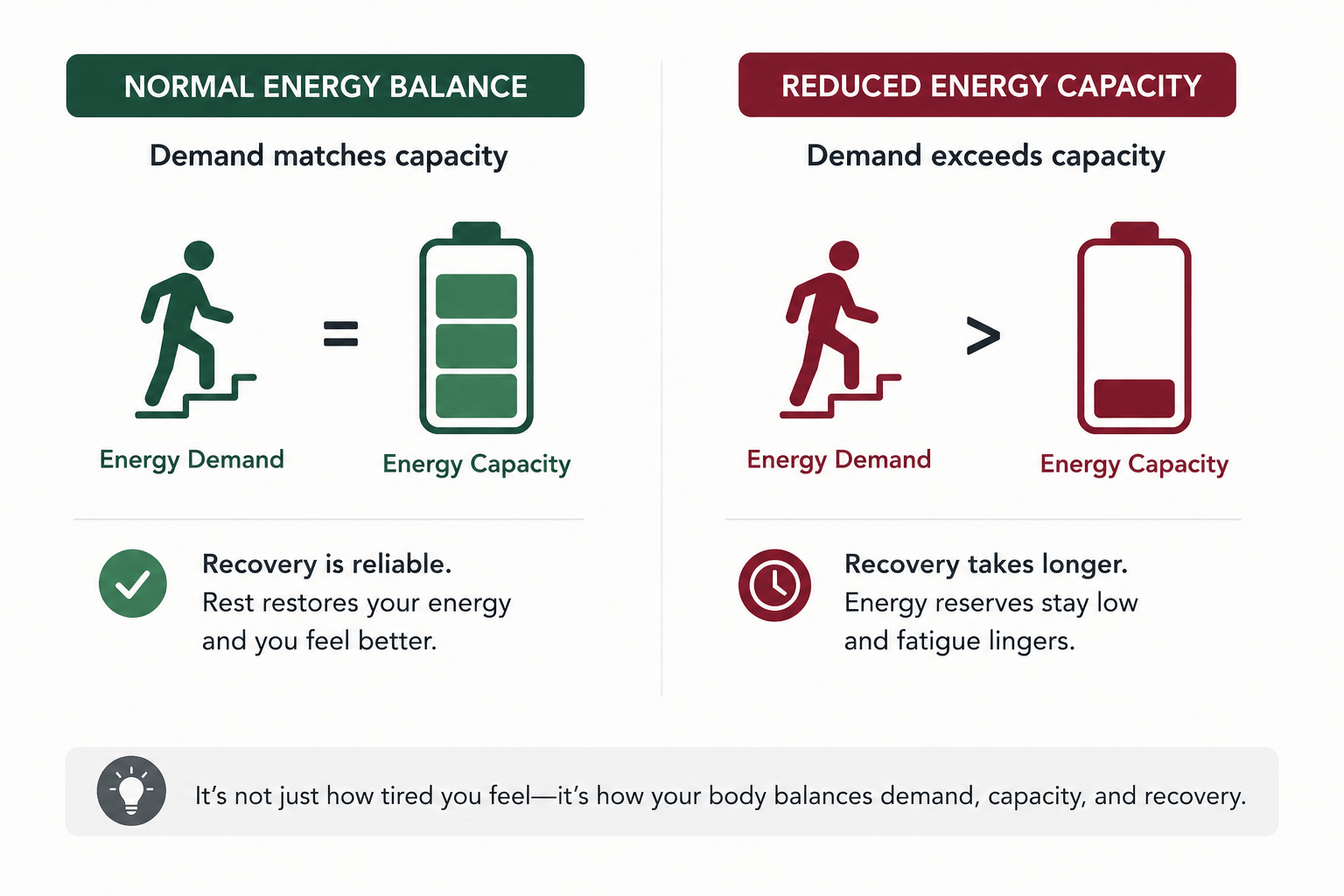
This broader perspective is more useful than looking for a single explanation. It considers whether energy demand, energy production, oxygen delivery, recovery, and the body’s overall workload remain in balance.
When Fatigue Deserves Medical Attention
Persistent fatigue can have many causes, including anemia, thyroid disorders, sleep apnea, infection, medication effects, depression, anxiety, nutritional deficiencies, and heart or lung conditions. If fatigue continues for several weeks, is getting worse, or is interfering with normal daily activities, discuss it with a qualified healthcare professional.
Seek prompt medical care when fatigue occurs with chest pain, difficulty breathing, fainting, unusual bleeding, sudden weakness, confusion, or other new neurological symptoms.
The appropriate activity level also depends on the pattern. Someone recovering from ordinary overwork may benefit from gradually returning to normal activity. Someone who experiences delayed or prolonged worsening after minor exertion should seek clinical guidance rather than repeatedly pushing through the symptoms.
La place Mitozz
Mitozz is designed to support normal mitochondrial function and cellular energy, whether someone is just beginning to focus on their energy health or already has established habits around sleep, nutrition, movement, and recovery.
It contains 98% pure (−)-epicatechin. Learn more about the science connecting (−)-epicatechin with mitochondrial health and cellular energy. Unlike caffeine or other stimulants, Mitozz is not intended to create a temporary surge in alertness. Its role is to support the underlying cellular systems involved in producing and using energy.
Conclusion
The difference between ordinary tiredness and a more persistent fatigue pattern is not simply how exhausted you feel. It is how closely the fatigue matches the demand, how reliably you recover, and whether your normal capacity returns.
Mitochondria are one part of the systems that shape energy, stamina, and recovery. When those patterns begin to change, the most useful response is to pay attention to what your body can do, how it responds to effort, and whether the change is temporary or becoming part of everyday life. That clearer understanding creates a better foundation for supporting your cellular energy and deciding when further evaluation is appropriate.
Partager cet article de blog
Références
- MedlinePlus. Fatigue. U.S. National Library of Medicine.
- Shen, J., Barbera, J., and Shapiro, C. M. (2006). Distinguishing sleepiness and fatigue: Focus on definition and measurement. Sleep Medicine Reviews, 10(1), 63–76.
- Filler, K., Lyon, D., Bennett, J., McCain, N., Elswick, R., Lukkahatai, N., and Saligan, L. N. (2014). Association of mitochondrial dysfunction and fatigue: A review of the literature. BBA Clinical, 1, 12–23.
- Mancuso, M., et al. (2012). Fatigue and exercise intolerance in mitochondrial diseases: Literature revision and experience of the Italian Network of Mitochondrial Diseases. Neuromuscular Disorders, 22(Supplement 3), S226–S229.
- Carroll, T. J., Taylor, J. L., and Gandevia, S. C. (2017). Recovery of central and peripheral neuromuscular fatigue after exercise. Journal of Applied Physiology, 122(5), 1068–1076.
- Centers for Disease Control and Prevention. (2024). IOM 2015 diagnostic criteria for ME/CFS. Centers for Disease Control and Prevention.
- National Institute of Neurological Disorders and Stroke. Mitochondrial Disorders. National Institute of Neurological Disorders and Stroke.
- Daussin, F. N., Heyman, E., and Burelle, Y. (2021). Effects of (−)-epicatechin on mitochondria. Nutrition Reviews, 79(1), 25–41.
Comprendre la santé mitochondriale est un processus de longue haleine. C’est pourquoi nous avons créé la Mitozz : un moyen gratuit de continuer à vous informer sur l’énergie cellulaire, la santé mitochondriale et les choix de mode de vie qui favorisent le bien-être de votre corps au fil du temps. Vous recevrez du contenu éducatif fondé sur des données scientifiques, des conseils pratiques et les dernières actualités de Mitozz, le tout à votre rythme.
Inscrivez-vous à la Mitozz
Bénéficiez d'une formation fondée sur des données scientifiques concernant la santé mitochondriale, l'énergie cellulaire et les choix de mode de vie qui favorisent le bien-être de votre corps à long terme.
Avertissement médical : Les informations fournies dans cet article sont uniquement à titre éducatif et informatif et ne constituent en aucun cas un avis médical. Elles ne sauraient se substituer à un diagnostic, un traitement ou des conseils médicaux professionnels. Consultez toujours un professionnel de santé qualifié avant de modifier votre régime alimentaire, votre programme d'activité physique, vos pratiques de jeûne ou votre consommation de compléments alimentaires, en particulier si vous souffrez d'une affection médicale, si vous êtes enceinte ou si vous allaitez, ou si vous prenez des médicaments.
Avertissement de la FDA : Ces allégations n'ont pas été évaluées par la Food and Drug Administration. Elles ne visent pas à diagnostiquer, traiter, guérir ou prévenir une quelconque maladie.