主なポイント
- Skin firmness depends on the collagen-rich matrix of the dermis, not collagen alone.
- Fibroblasts help build and maintain the extracellular matrix that supports skin structure.
- Mitochondria help skin cells manage energy, stress signaling, and normal cellular function.
- Oxidative stress and collagen fragmentation are part of the biology of visible skin aging.
- Mitozz and Mitozz RS fit into this conversation carefully, as support products, not skin-aging treatments.
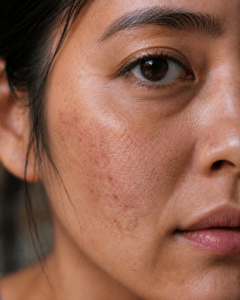
Most of us want skin that looks healthy, smooth, and resilient. Firmness and elasticity are part of that picture. As we age, skin can begin to look less firm, feel less smooth, or bounce back more slowly than it once did.
Those visible changes do not happen only at the surface. Beneath them is a living tissue system shaped by collagen, fibroblasts, hydration, blood flow, inflammation, oxidative stress, and cellular energy.
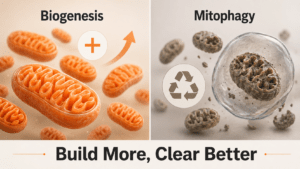
This is where mitochondria enter the picture. They do not control skin aging by themselves, and they are not a magic switch for firmness. But they are part of the biological environment in which skin cells function, respond to stress, and help maintain the structure beneath healthy-looking skin.
Firm skin begins in the dermis
The skin has multiple layers, but the structure people associate with firmness and elasticity is largely connected to the dermis. This deeper layer contains fibroblasts, blood vessels, immune cells, nerves, and an extracellular matrix rich in collagen and elastin.
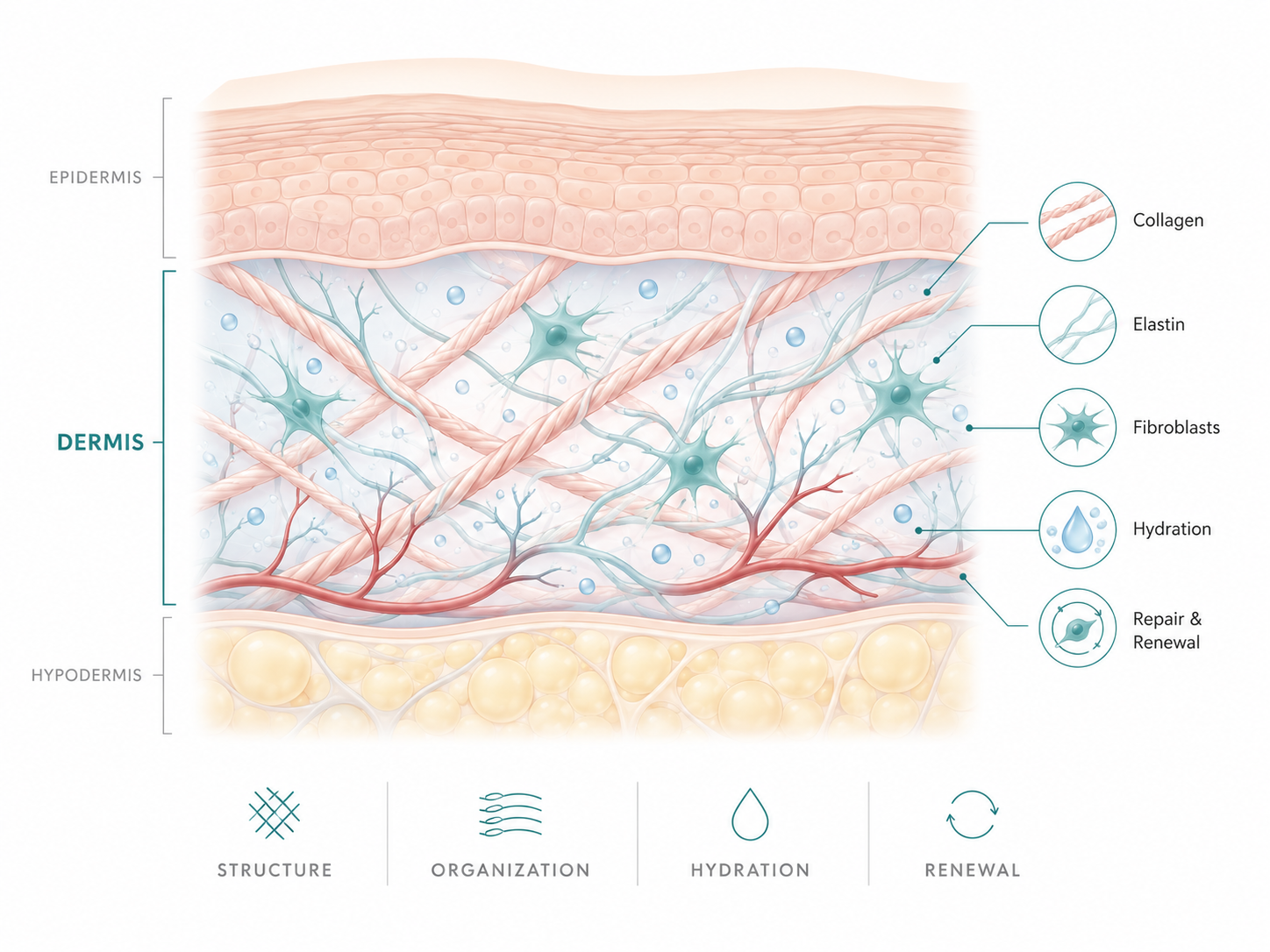
Collagen helps provide tensile strength. Elastin helps skin return toward its original shape after being stretched. Hyaluronic acid and other matrix molecules help hold water and support tissue hydration. Together, these components form a dynamic structure.
Skin structure is not just about “how much collagen you have.” It also depends on how organized the collagen matrix is, how fibroblasts behave inside that matrix, how much oxidative stress is present, and how well the tissue environment supports normal repair and renewal.
Fibroblasts are the cells behind much of the structure
Fibroblasts are the main support cells of the dermis. They help produce and remodel the extracellular matrix, including collagen, which gives skin much of its structure and strength.
However, they do not work in isolation. They respond to the condition of the matrix around them. When collagen is well organized, fibroblasts receive one set of physical and biochemical signals. When the collagen network becomes fragmented or disorganized, those signals can change.
Research in aged human skin suggests that collagen fragmentation is more than a structural change. It can influence fibroblast behavior, increase oxidative stress, and raise levels of matrix metalloproteinase-1, or MMP-1, an enzyme involved in collagen breakdown.
This helps explain why visible skin aging can become self-reinforcing. As the collagen matrix becomes more fragmented, fibroblasts may function in a less supportive environment. Over time, that can affect the tissue structure that helps skin look firm, smooth, and elastic.
Where mitochondria fit into collagen biology
Mitochondria help cells convert nutrients and oxygen into ATP, the usable energy cells rely on for normal work. In skin, that work includes cell turnover, barrier maintenance, fibroblast activity, stress responses, and cellular signaling.
Mitochondria are also involved in reactive oxygen species, or ROS, signaling. ROS are often described as damaging, but that is only part of the story. In small amounts, they help cells communicate and adapt. Problems arise when oxidative burden becomes greater than the cell’s ability to manage it.
In skin-aging research, mitochondrial dysfunction, mitochondrial DNA changes, UV-related stress, and oxidative stress are all studied as part of the biology behind visible aging and photoaging. This does not mean mitochondria explain every skin change, but it does that they are an important part of the equation.
Oxidative stress connects energy biology and matrix remodeling
Oxidative stress matters for skin structure because it affects both skin cells and the extracellular matrix around them. Repeated environmental stress, including intense or repeated UV exposure, can increase oxidative burden in skin cells.
Sunlight also has real benefits, including its role in circadian rhythm and vitamin D biology. So the goal is not to fear the sun. The goal is to avoid unnecessary UV stress through shade, protective clothing, smart timing, and sunscreen when exposure is prolonged or intense.
Oxidative stress can influence fibroblast signaling, matrix-remodeling enzymes, and the cellular environment that maintains collagen-rich tissue. In the collagen fragmentation study cited below, fibroblasts cultured in fragmented collagen showed higher oxidant levels and increased MMP-1 expression, suggesting a feedback loop between matrix damage and oxidative stress.
This is why skin firmness is not only a cosmetic topic. It is also a biology topic. What we see at the surface reflects deeper factors, including hydration, collagen organization, cellular energy, redox balance, and environmental exposure.
Elasticity is not the same as hydration, but hydration still matters
Firmness and elasticity are often discussed together, but they are not the same thing. Firmness is closely tied to dermal structure and the organization of the collagen-rich matrix. Elasticity describes how well skin returns after being stretched or compressed. Hydration affects something slightly different: how smooth, supple, and comfortable the skin surface looks and feels.
Topical hydration does not rebuild the deeper collagen architecture of the dermis. Still, it can make skin look and feel better by supporting the surface environment. Humectants such as glycerin are widely used in skin care because they help support water balance in the stratum corneum, the outermost layer of the skin.
This distinction is important for setting realistic expectations. A good daily skin-care routine can support hydration, comfort, and cosmetic appearance. But it should not be presented as rebuilding collagen structure, reversing skin aging, or changing the deeper biology of firmness unless there is direct evidence for that specific product and claim.
What human flavanol research can and cannot tell us
What human flavanol research can and cannot tell us
Some human research has looked at cocoa flavanol preparations and skin outcomes. In one 24-week randomized, double-blind, placebo-controlled trial in women with moderately photo-aged skin, cocoa flavanol supplementation was associated with improvements in wrinkle roughness and elasticity compared with placebo.
This is useful research, but it has to be interpreted carefully. Cocoa flavanol preparations are not the same thing as purified (−)-epicatechin, and they are not the same thing as Mitozz. The study should not be treated as proof that Mitozz improves wrinkles, increases collagen, or changes skin firmness.
What the research does support is a broader biological point: skin appearance is influenced by processes beneath the surface, including oxidative stress, vascular factors, and the cellular environment. That makes mitochondrial and redox biology relevant to the conversation, while keeping product-specific claims appropriately limited.
What this means in real life
IfIf you want to support healthy-looking firmness and elasticity, it helps to think in layers.
The first layer is protection: reducing unnecessary UV stress, avoiding smoking, and limiting repeated environmental strain.
The second layer is recovery: sleep, balanced nutrition, and enough protein to support normal tissue maintenance.
The third layer is topical care: hydration, conditioning, and consistent use of well-formulated products.
Beneath all of these is the cellular environment. Skin cells need energy, signaling control, and stress-management capacity to do their normal work. That is where mitochondrial biology becomes relevant as part of the deeper system that supports healthy skin function.
In practical terms, the best skin strategy is not only about chasing collagen. It is about supporting the environment in which collagen-rich tissue is maintained: steady habits, appropriate UV protection, hydration, movement, good sleep, balanced nutrition, and realistic skin care.
Where Mitozz and Mitozz RS Fit In
Mitozz belongs to the broader internal mitochondrial health conversation because it is built around 98% pure (−)-epicatechin and designed to support normal mitochondrial function and cellular energy.
Mitozz RS is the more directly skin-facing product. It is a topical cosmetic serum formulated for daily skin care with 98% pure (−)-epicatechin and supporting cosmetic ingredients for hydration and conditioning. It is designed to support the appearance, hydration, and feel of skin as part of a daily routine.
結論
Skin firmness and elasticity are not controlled by one pathway, one ingredient, or one type of cell. They reflect the condition of a living tissue system where fibroblasts, collagen organization, hydration, oxidative balance, blood flow, environmental exposure, and cellular energy all matter.
Mitochondria belong in this conversation because skin cells need energy and stress-management capacity to do their normal work. They help shape the biological environment in which fibroblasts maintain the collagen-rich matrix that supports skin structure.
The best approach is to support skin from several angles: protect it from excessive or unnecessary UV stress, maintain hydration, eat enough protein and nutrient-dense foods, support recovery, sleep well, move regularly, and use cosmetic skin care consistently.
Firmness and elasticity are built on the biology beneath the surface. Good skin care starts with respecting the whole system.
このブログ記事をシェアする
参考文献
- Natarelli, N., Gahoonia, N., Aflatooni, S., Bhatia, S., & Sivamani, R. K. (2024). Dermatologic manifestations of mitochondrial dysfunction: A review of the literature. International Journal of Molecular Sciences.
- Fisher, G. J., et al. (2009). Collagen fragmentation promotes oxidative stress and elevates matrix metalloproteinase-1 in fibroblasts in aged human skin. The American Journal of Pathology.
- Yoon, H. S., et al. (2016). Cocoa flavanol supplementation influences skin conditions of photo-aged women: A 24-week double-blind, randomized, controlled trial. The Journal of Nutrition.
- Daussin, F. N., Heyman, E., & Burelle, Y. (2021). Effects of (−)-epicatechin on mitochondria. Nutrition Reviews.
- Fluhr, J. W., Darlenski, R., & Surber, C. (2008). Glycerol and the skin: Holistic approach to its origin and functions. British Journal of Dermatology.
Understanding mitochondrial health is a long-term process. That’s why we created the Mitozz Newsletter: a free way to keep learning about cellular energy, mitochondrial health, and the lifestyle signals that support your body over time. You’ll receive science-based educational content, practical guidance, and updates from Mitozz, all at your own pace.
Sign up for the Mitozz Newsletter
Get science-based education on mitochondrial health, cellular energy, and lifestyle signals that support your body over time.
医療に関する免責事項:本記事で提供される情報は、教育および情報提供のみを目的としており、医学的アドバイスを意図したものではありません。専門的な医学的診断、治療、または指導に代わるものではありません。 食事、運動習慣、断食、またはサプリメントの使用を変更する前には、必ず資格を持つ医療専門家に相談してください。特に、持病がある方、妊娠中または授乳中の方、あるいは薬を服用中の方は注意が必要です。
FDA免責事項:これらの記述は、米国食品医薬品局(FDA)による評価を受けたものではありません。これらは、いかなる疾患の診断、治療、治癒、または予防を目的としたものではありません。