
主なポイント
- Mitochondria power daily energy. They help convert nutrients and oxygen into ATP, the body’s usable energy.
- Energy production changes with age. Mitochondrial output can decline over time, affecting stamina and recovery.
- Cellular quality control slows down. Aging can reduce the body’s ability to clear damaged mitochondria and build new ones.
- Lifestyle can influence the curve. Exercise, sleep, nutrition, and stress management all matter for mitochondrial health.
- Mitozz supports the bigger strategy. Its 98% pure (-)-epicatechin is positioned as a tool alongside healthy lifestyle foundations.
As we age, energy feels different when we reach our forties and fifties than it did in our twenties. Something is shifting, something that happens at a scale far below what we can observe directly.
Research is increasingly pointing to the biology of how our cells produce energy, and why that process becomes less efficient over time. This transition from youthful vitality to a more measured pace reflects changes in our fundamental physiological capacity. Understanding this shift is the first step toward supporting long-term vitality and resilience.
Your Cells Are Running an Energy Factory, and They Change With Age
Every time you climb a flight of stairs, think through a problem, or simply breathe, your cells are converting fuel into a molecule called ATP, the energy currency your body runs on. Nearly all of it is made inside mitochondria.
Think of mitochondria as compact power plants, drawing on oxygen and nutrients to generate the energy your body needs to function. A healthy cell in an active tissue, like heart muscle or working skeletal muscle, may contain hundreds or even thousands of these organelles. Their output is continuous, responsive, and tightly regulated.
What changes with age is not any single dramatic failure but a gradual erosion across several interconnected systems. These shifts together reduce our cells’ capacity to produce energy reliably and efficiently.
Key idea: Aging-related fatigue is not necessarily a motivation problem or a lifestyle issue. It reflects real biological changes in how efficiently cells convert fuel into functional energy that emerge as we age.
The Mitochondria Themselves Begin to Decline
1. Reduced ATP Production Rate
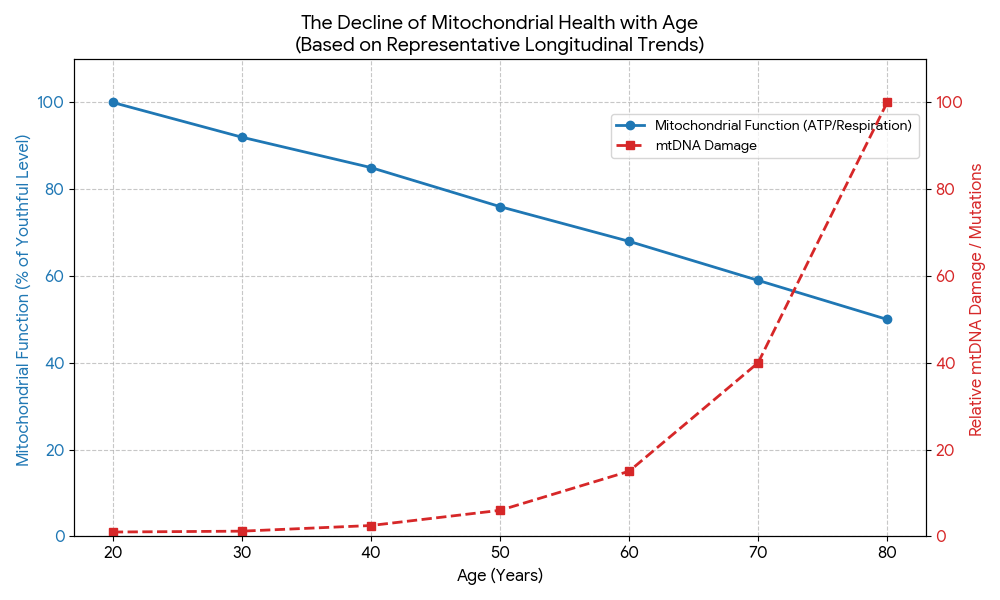
A landmark study demonstrated that the Mitochondrial ATP Production Rate (MAPR) in human skeletal muscle declines significantly as we age. Their data showed approximately a 50% decrease in the capacity to generate energy between the ages of 20 and 80. This decline is a primary driver of age-related fatigue and muscle loss (sarcopenia).
2. Accumulation of Mitochondrial DNA (mtDNA) Mutations
Unlike nuclear DNA, mtDNA is not protected by histones and is located in close proximity to the site of reactive oxygen species (ROS) production. Research highlights that mutations and large-scale deletions in mtDNA accumulate exponentially over time. These mutations impair the assembly of the electron transport chain, further reducing respiratory efficiency.
3. Impaired Mitophagy (Quality Control)
Cells do not simply tolerate damaged mitochondria. They have a dedicated system for identifying and removing them, a process called mitophagy. Think of it as cellular housekeeping, a well-functioning cell regularly flags dysfunctional mitochondria for recycling and replaces them with new, healthier ones.
Mitochondrial health depends on “mitophagy,” the process of identifying and recycling damaged mitochondria. Scientific reviews indicate that aging impairs these quality control pathways. As a result, the cell becomes cluttered with “zombie” mitochondria that produce little energy but high amounts of toxic ROS.
4. Decreased Mitochondrial Density and Volume
Cells also have a mechanism for building new mitochondria from scratch, a process called mitochondrial biogenesis. It is driven in large part by a protein called PGC-1α, which acts as a master regulator of mitochondrial renewal. When energy demand rises, as it does during exercise, PGC-1α signaling ramps up, prompting the cell to produce more mitochondria to meet the load.
Morphological studies have observed that both the number and the total volume of mitochondria within cells (particularly in high-energy tissues like the heart and brain) decrease with age. This reduction in “mitochondrial mass” means the cell has fewer power plants available to meet its metabolic demands.
Visualizing the Bioenergetic Decline
| Age (Years) | Mitochondrial Function (ATP Output) | Relative mtDNA Damage |
|---|---|---|
| 20 | 100% (Full Capacity) | Baseline (1x) |
| 40 | ~85% | 2.5x Increase |
| 60 | ~68% | 15x Increase |
| 80 | ~50% (Half Capacity) | 100x Increase |
All of this means that the normal turnover of the mitochondrial population, the ongoing cycle of clearing old mitochondria and building new ones, slows down on both ends. Mitophagy clears less. Biogenesis builds less. The net result is a smaller, less capable mitochondrial network.
What This Means in Real Life
If that afternoon energy dip feels more pronounced than it did a decade ago, or if recovery from a long day or a hard workout takes noticeably longer, the biology above offers a partial explanation. It is not that your motivation has changed or that you need more coffee! The cells doing the work of keeping you going are operating with reduced capacity.
This is a normal feature of biological aging. It is also not fixed or binary. The degree to which these changes manifest varies considerably between individuals, and research consistently points to lifestyle factors as being among the most meaningful influences on how quickly or slowly this decline progresses.
- Mitochondrial function tends to be better preserved in physically active older adults
- Sleep quality influences cellular repair processes, including mitochondrial maintenance
- Chronic stress and poor nutrition accelerate oxidative burden, compounding mitochondrial wear
- Poor diet
Where Mitozz Fits In
Beyond lifestyle foundations, researchers have been investigating whether specific compounds might support mitochondrial signaling pathways. One area of interest is (-)-epicatechin, a flavanol found naturally in dark chocolate and certain plants.
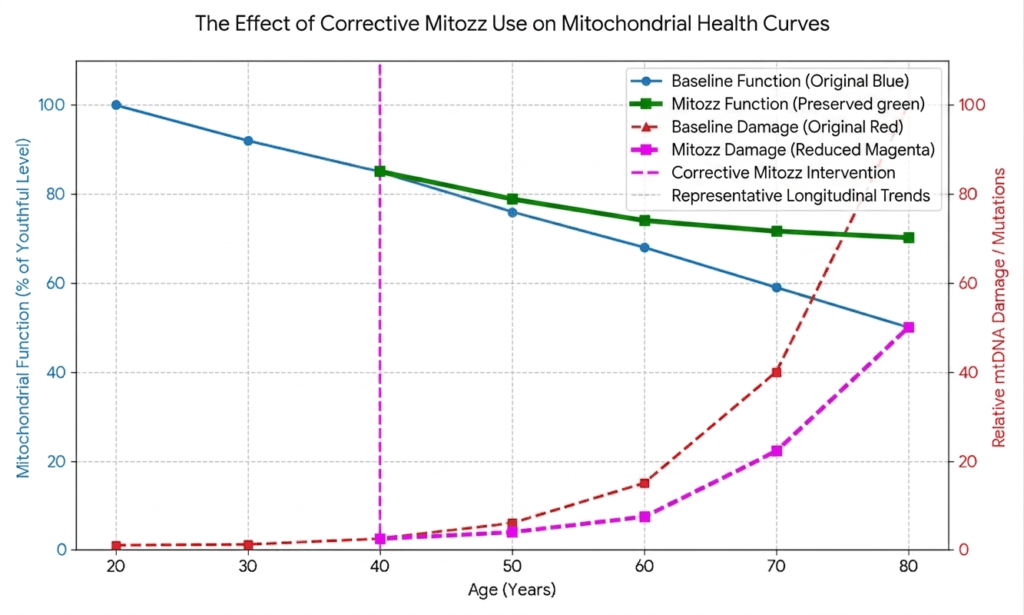
Mitozz, developed by FMG Health Sciences, contains 98% pure (-)-epicatechin as its primary active compound. It is designed to support mitochondrial health and works particularly well alongside the lifestyle foundations that most robustly support mitochondrial health.
Related: Read our article detailing all the things you can do to repair and maintain your mitochondria.
結論
Aging is mandatory but the energy ‘cliff’ is optional.
The 50% drop in mitochondrial function often seen in longitudinal data doesn’t have to be your story. As we have explored, your cells are remarkably resilient and remain responsive to corrective signals well into your later decades. The “afternoon slump” and the slow fade of physical reserve are not character flaws—they are biological signals that your cellular power plants need a new protocol.
Understanding the mechanisms of PGC-1α and mitophagy means you no longer have to accept decline as an inevitability. It means recognizing that the choices you make to support your cellular foundation matter at a level far deeper than how you feel on any given afternoon.
The science is clear: your body is responsive, and it rewards investment at any age. By re-activating the signals to build, clean, and renew, you have the power to “shift the curve” and rewrite your energy trajectory from the inside out.
このブログ記事をシェアする
参考文献
- Lesnefsky, E. J., Chen, Q., & Hoppel, C. L. (2016). Mitochondrial metabolism in aging heart. Circulation Research, 118(10), 1593–1611.
- Bratic, A., & Larsson, N. G. (2013). The role of mitochondria in aging. Journal of Clinical Investigation, 123(3), 951–957.
- Jia, X., et al. (2025). Mitochondrial dysfunction in aging: Future therapies and precision medicine approaches. MedComm – Future Medicine, 4(1).
- Zhu, X., et al. (2025). Mitochondrial dysfunction in the regulation of aging and aging-related diseases. Cell Communication and Signaling, 23(1).
- Lanza, I. R., & Sreekumaran Nair, K. (2010). Mitochondrial function as a determinant of life span. Pflügers Archiv – European Journal of Physiology, 459(2), 277–289.
- Broskey, N. T., et al. (2023). Impaired age-associated mitochondrial translation is mitigated by exercise and PGC-1α.Proceedings of the National Academy of Sciences, 120(36).
- Broskey, N. T., et al. (2014). Skeletal muscle mitochondria in the elderly: effects of physical fitness and exercise training. Journal of Clinical Endocrinology & Metabolism, 99(5), 1852–1861.
- Ramirez-Sanchez, I., et al. (2015). Recovery of indicators of mitochondrial biogenesis, oxidative stress, and aging with (-)-epicatechin in senile mice. Journals of Gerontology: Series A, 70(11), 1370–1378.
- McDonald, C. M., et al. (2021). (-)-Epicatechin induces mitochondrial biogenesis and markers of muscle regeneration in adults with Becker muscular dystrophy. Muscle & Nerve, 63(2), 239–249.
Understanding mitochondrial health is a long-term process. That’s why we created the Mitozz Newsletter: a free way to keep learning about cellular energy, mitochondrial health, and the lifestyle signals that support your body over time. You’ll receive science-based educational content, practical guidance, and updates from Mitozz, all at your own pace.
Sign up for the Mitozz Newsletter
Get science-based education on mitochondrial health, cellular energy, and lifestyle signals that support your body over time.
医療に関する免責事項:本記事で提供される情報は、教育および情報提供のみを目的としており、医学的アドバイスを意図したものではありません。専門的な医学的診断、治療、または指導に代わるものではありません。 食事、運動習慣、断食、またはサプリメントの使用を変更する前には、必ず資格を持つ医療専門家に相談してください。特に、持病がある方、妊娠中または授乳中の方、あるいは薬を服用中の方は注意が必要です。
FDA免責事項:これらの記述は、米国食品医薬品局(FDA)による評価を受けたものではありません。これらは、いかなる疾患の診断、治療、治癒、または予防を目的としたものではありません。