
主なポイント
- The brain is one of the most energy-intensive organs, consuming roughly 20% of the body’s total energy despite making up only 2% of its weight.
- Mitochondrial dysfunction is increasingly associated with the pathophysiology of Major Depressive Disorder (MDD).
- Mitochondria influence mood not just through energy (ATP) production, but also by regulating neuroplasticity, inflammation, and cellular stress responses.
- New research, termed the “Mito-Mood Hypothesis,” positions mitochondria as active modulators of how the brain responds to chronic stress.
- Navigating the heavy emotional burdens of depression requires comprehensive professional medical care alongside daily biological support.
For decades, the conversation around depression has focused almost exclusively on neurotransmitters like serotonin and dopamine. While these chemical messengers are vital, scientists are increasingly looking deeper, at the cellular engines that power the brain’s ability to process those signals.
This emerging field, often called “bioenergetic psychiatry,” suggests that the health of our mitochondria may be a fundamental pillar of emotional and mental resilience.
A Note on Mental Health and Immediate Support
While exploring the biological frameworks of mood and energy can offer valuable insights, depression is a serious, multifaceted condition that requires comprehensive care. If you or someone you know is struggling with depression, feeling overwhelmed, or experiencing thoughts of self-harm, please know that you do not have to carry this weight alone. Professional, compassionate, and confidential support is available right now:
- In the US and Canada: Call or text 988 to reach the Suicide & Crisis Lifeline (Available 24/7).
- Text Support (US & Canada): Text HOME to 741741 to connect with the Crisis Text Line.
- In the UK: Call 111 for NHS mental health services, or call the Samaritans at 116 123.
- International: Please visit findahelpline.com to find free, immediate crisis support services available in your specific country.
Please consider reaching out to a medical professional, a mental health counselor, or a trusted person in your life.
The Mito-Mood Hypothesis
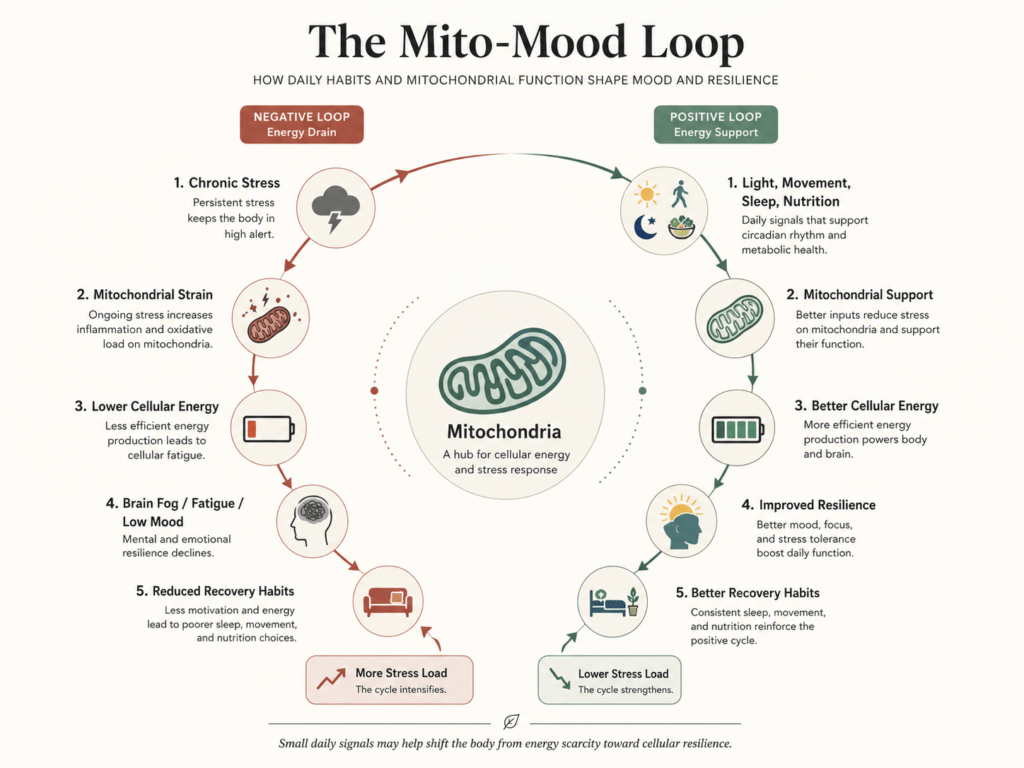
The “Mito-Mood Hypothesis” proposes that mitochondria act as dynamic hubs linking our metabolism to our emotions. Rather than being passive “batteries,” mitochondria are sensory organelles. They detect environmental stressors, like lack of sleep or chronic psychological pressure, and adjust cellular signaling accordingly.
When mitochondrial function is robust, the brain maintains high cellular resilience, the ability to adapt to and recover from stress. However, when mitochondria are overworked or inefficient, the resulting “bioenergetic failure” can manifest as the fatigue, cognitive fog, and low mood often associated with depression.
Mechanisms: Beyond the “Powerhouse”
While mitochondria are famous for producing ATP, their role in mental health involves several more complex pathways:
- Synaptic Plasticity: Neurons require massive amounts of energy to form new connections. Mitochondria must travel to the ends of long neurons (synapses) to provide the fuel for these connections. If mitochondria are dysfunctional, this process of “neuroplasticity” slows down, which is a hallmark of depressive states.
- Redox Balance: Mitochondria are the primary source of reactive oxygen species (ROS). In a healthy state, these are kept in balance. In depressed patients, researchers often observe an “oxidative stress” imbalance where excess ROS damage cellular structures, further impairing energy production.
- Neuroinflammation: Mitochondria help regulate the body’s inflammatory response. Dysfunctional mitochondria can leak mitochondrial DNA, which the body may mistake for a viral threat, triggering a low-grade inflammatory state in the brain that correlates with mood disorders.
Research Evidence
Human clinical data consistently show a link between mitochondrial health and mood. Studies have observed:
- Lower ATP levels: Brain tissue and muscle biopsies in patients with depression often show significantly reduced ATP production rates compared to healthy controls.
- Genetic Markers: Alterations in mitochondrial DNA (mtDNA) and the expression of genes responsible for mitochondrial biogenesis (the creation of new mitochondria) have been documented in patients with MDD.
- Biomarkers: Reduced mitochondrial respiration in blood platelets has been identified as a potential biological marker for the severity of depressive symptoms.
Bioenergetic Strategies: Supporting the Mind from the Cell Up
If depression is viewed through a bioenergetic lens, the goal becomes clear: increase the capacity of the brain’s “power plants” while reducing the “internal friction” (oxidative stress) that slows them down. Here is how to support mitochondrial function in a practical, bioenergetic way:
1. Strategic Movement and the PGC-1α Signal
Physical activity is perhaps the most potent signal for mitochondrial biogenesis, the creation of new mitochondria. Even low-intensity movement, such as walking, activates the protein PGC-1α. This protein acts as a master regulator, telling your cells to build more energy capacity. For someone with low mental energy, the goal is not “exercise” for weight loss, but “movement” for mitochondrial signaling.
2. Light Hygiene and Circadian Rhythm
Mitochondria follow their own daily rhythms, responding to signals such as light exposure, meal timing, sleep, movement, stress, and nutrient availability. These mitochondrial rhythms are closely linked to the body’s circadian system, which helps coordinate when cells produce energy, repair themselves, manage oxidative stress, and adapt to daily demands.
3. Temperature Stress (Hormesis)
Brief exposure to cold (like a cold shower) or heat (like a sauna) creates a mild, healthy stressor known as hormesis. This triggers the cell to strengthen its antioxidant defenses and improves the efficiency of the electron transport chain, the specific part of the mitochondria where ATP is made.
4. Nutritional Signaling and Flavanols
Specific nutrients can act as “molecular keys” that turn on mitochondrial pathways. Polyphenols, specifically 98% pure (−)-epicatechin, have been studied for their ability to influence the signaling pathways that maintain mitochondrial structure and function. By reducing the “leakage” of electrons (which causes oxidative stress), these compounds help ensure more fuel is successfully converted into ATP.
For readers seeking a deeper dive into these and other strategies, read our article on how to improve mitochondrial health.
What This Means in Real Life
When you are struggling with mood, large lifestyle changes can feel impossible. The bioenergetic approach focuses on small, high-leverage signals that can help. One walk in the sun or one cold rinse at the end of a shower isn’t a “cure,” but it is a biological signal. Over time, these signals collectively help shift the cellular environment from one of energy scarcity to one of energy resilience.
Where Mitozz Fits In
Mitozz is formulated around 98% pure (−)-epicatechin, a flavanol derived from green tea because of its relationship with cellular signaling pathways involved in mitochondrial biology.
While Mitozz is not a treatment for depression, it is designed to support the very mitochondrial pathways that provide the foundation for cellular energy. By reinforcing these pathways, Mitozz acts as a partner to the lifestyle habits, like movement and light hygiene, that build long-term bioenergetic resilience.
FAQ
Can mitochondrial health affect my daily mood?
Yes. Because the brain is so energy-dependent, even subtle shifts in how efficiently your mitochondria produce ATP can influence mental clarity, energy levels, and your ability to bounce back from daily stress.
What is “mitochondrial biogenesis” and why does it matter for the brain?
Mitochondrial biogenesis is the process where cells create new mitochondria. In the brain, having a fresh, efficient population of mitochondria is essential for maintaining neuroplasticity, the brain’s ability to learn, adapt, and regulate emotions.
How do antioxidants relate to mitochondria and mood?
Mitochondria produce oxidative stress as a byproduct of making energy. If the body’s natural antioxidant defenses are overwhelmed, it can damage the mitochondria. Supporting the body’s “redox balance” helps protect these organelles so they can continue to power brain function effectively.
結論
True mental vitality is inseparable from cellular vitality. While the psychology of mood is complex, the biology is grounded in the efficient conversion of fuel into energy. By viewing depression through the lens of the “Mito-Mood Hypothesis,” we can see that supporting our mitochondria isn’t just about physical performance, it’s a foundational step in building the cellular resilience required for a balanced and vibrant life.
このブログ記事をシェアする
参考文献
- Bansal, Y., & Kuhad, A. (2016). Mitochondrial Dysfunction in Depression. Current Neuropharmacology, 14(6), 610-618.
- Caruso, G., Benatti, C., Blom, J. M. C., Caraci, F., & Tascedda, F. (2019). The Many Faces of Mitochondrial Dysfunction in Depression: From Pathology to Treatment. Frontiers in Pharmacology, 10.
- Larrea, A., et al. (2024). Mitochondrial Metabolism in Major Depressive Disorder: From Early Diagnosis to Emerging Treatment Options. Journal of Clinical Medicine, 13(6), 1727. Cited by: 24
- Allen, J., et al. (2018). Mitochondria and Mood: Mitochondrial Dysfunction as a Key Player in the Manifestation of Depression. Frontiers in Neuroscience, 12.
- Panneerselvam, et al. (2013). Epicatechin regulation of mitochondrial structure and function is opioid receptor dependent. Molecular Nutrition & Food Research, 57(6), 1007-1014.
- Fields, M., et al. (2023). Mitochondria-Targeted Antioxidants, an Innovative Class of Antioxidant Compounds for Neurodegenerative Diseases: Perspectives and Limitations. International Journal of Molecular Sciences, 24(4), 3739.
ミトコンドリアの健康を理解するには長い時間がかかります。だからこそ、私たちは「Mitozz を立ち上げました。ここは、細胞エネルギーの科学を探求し、生活習慣がミトコンドリアにどのような影響を与えるかを学び、専門家によるディスカッションや教育コンテンツ、ライブQ&Aを通じて最新情報を入手できる、自由な場です。ご自身のペースでご利用いただけます。
Mitozz に参加しましょう
細胞エネルギーとミトコンドリアの健康に焦点を当てた、会員や専門家によるディスカッション、教育コンテンツ、ライブQ&Aセッションをご利用いただけます。
医療に関する免責事項:本記事で提供される情報は、教育および情報提供のみを目的としており、医学的アドバイスを意図したものではありません。専門的な医学的診断、治療、または指導に代わるものではありません。 食事、運動習慣、断食、またはサプリメントの使用を変更する前には、必ず資格を持つ医療専門家に相談してください。特に、持病がある方、妊娠中または授乳中の方、あるいは薬を服用中の方は注意が必要です。
FDA免責事項:これらの記述は、米国食品医薬品局(FDA)による評価を受けたものではありません。これらは、いかなる疾患の診断、治療、治癒、または予防を目的としたものではありません。