Key Takeaways
- Mitochondrial biogenesis helps cells renew energy-producing capacity.
- Mitophagy helps recycle damaged or inefficient mitochondria.
- Healthy mitochondrial function depends on coordination, not just quantity.
- Exercise is one of the best-studied lifestyle signals for mitochondrial adaptation.
- Mitozz fits as one possible support tool within a broader mitochondrial health routine.
Mitochondria are often described as the energy centers of the cell, but mitochondrial health is more than just making more energy. It’s also about renewal, maintenance, and quality control.
Two biological processes sit at the center of that story: mitochondrial biogenesis and mitophagy.
Mitochondrial biogenesis is the process of building or renewing mitochondrial capacity.
Mitophagy is the selective cleanup and recycling of mitochondria that are damaged, inefficient, or no longer serving the cell well.
A good way to think about the relationship between the two is this: build more, clear better. Cells need enough mitochondrial capacity to meet energy demand, but they also need quality control so the network remains efficient over time.
This build-and-clear concept is one part of a larger mitochondrial strategy. To see how mitochondrial renewal fits alongside exercise, food timing, fasting, sleep, stress recovery, heat, cold, and targeted nutrient support, read the full guide to bio-hacking mitochondria.
Why Mitochondrial Renewal Matters
Your cells constantly adjust to changing demand. A muscle cell during exercise, a heart cell during daily circulation, and a brain cell during focused thinking all need cellular energy in the form of ATP.
ATP, or adenosine triphosphate, is the main energy currency cells use to power work. Mitochondria help generate much of that ATP through pathways that use nutrients and oxygen.
When energy demand rises repeatedly, cells can respond by changing mitochondrial structure, enzyme activity, fuel use, and signaling. Over time, those signals may support a more capable mitochondrial network. Exercise training is one of the clearest examples of this adaptive process, with research showing that physical activity can influence mitochondrial biogenesis pathways in skeletal muscle, especially markers such as PGC-1α.
But capacity alone is not the whole story. A larger mitochondrial network is not automatically healthier if parts of that network are damaged or poorly regulated. That is where mitophagy becomes essential.
Build More: What Mitochondrial Biogenesis Means
Mitochondrial biogenesis is the process through which cells produce new mitochondrial components and expand or renew mitochondrial capacity. It involves coordination between nuclear DNA, mitochondrial DNA, transcription factors, and proteins that help assemble functioning mitochondria.
One of the most discussed regulators is PGC-1α. It’s is not a mitochondrion itself. It is a signaling coactivator that helps regulate gene programs involved in mitochondrial biogenesis, oxidative metabolism, and energy adaptation.
Reviews describe PGC-1α as a central regulator of mitochondrial biogenesis and broader mitochondrial quality control. PGC-1α interacts with cellular pathways involved in energy metabolism, antioxidant defense, mitochondrial dynamics, and mitochondrial turnover.
Biogenesis can be influenced by repeated energy stressors, especially exercise. During endurance activity, skeletal muscle experiences changes in calcium signaling, AMP-to-ATP balance, reactive oxygen species signaling, and other cellular cues. These signals can help activate gene programs involved in mitochondrial adaptation.
This does not mean that one workout instantly “creates more mitochondria” in a simple way. The process is gradual and coordinated. Signals may rise quickly, but measurable structural and functional adaptation usually depends on repeated input over time.
The practical point is that mitochondrial biogenesis is less like flipping a switch and more like training a system. Consistent movement, adequate recovery, nutrition, and sleep all shape whether adaptive signals can translate into durable change.
Clear Better: What Mitophagy Means
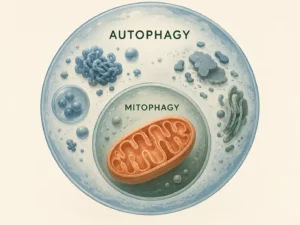
Mitophagy is a selective form of autophagy, the cell’s recycling system. Mitophagy focuses on mitochondria that need to be removed or recycled.
This matters because mitochondria are dynamic. They generate energy, participate in signaling, handle stress, and interact with other cellular systems. Over time, some mitochondria may become less efficient or more vulnerable to stress. Mitophagy helps maintain the quality of the network by clearing mitochondria that are no longer functioning well.
One well-studied mitophagy pathway involves PINK1 and Parkin. In simplified terms, PINK1 can accumulate on damaged mitochondria, helping recruit Parkin and other machinery that marks the mitochondrion for cleanup. Reviews describe the PINK1/Parkin system as an important mitochondrial quality-control pathway, although mitophagy biology is broader than this single pathway.
Exercise research has also expanded the conversation. Regular exercise is associated not only with mitochondrial biogenesis but also with mitochondrial remodeling and selective mitochondrial cleanup. Reviews describe exercise-induced mitophagy as a potential contributor to healthier mitochondrial remodeling in skeletal muscle and heart.
The goal is not maximum mitophagy at all times. Too little cleanup may allow damaged mitochondria to accumulate. Too much removal without adequate rebuilding could reduce cellular capacity. Healthy mitochondrial maintenance depends on balance.
Why Biogenesis and Mitophagy Work Best Together
Mitochondrial biogenesis and mitophagy are often discussed separately, but cells do not treat them as isolated systems. They are part of mitochondrial quality control.
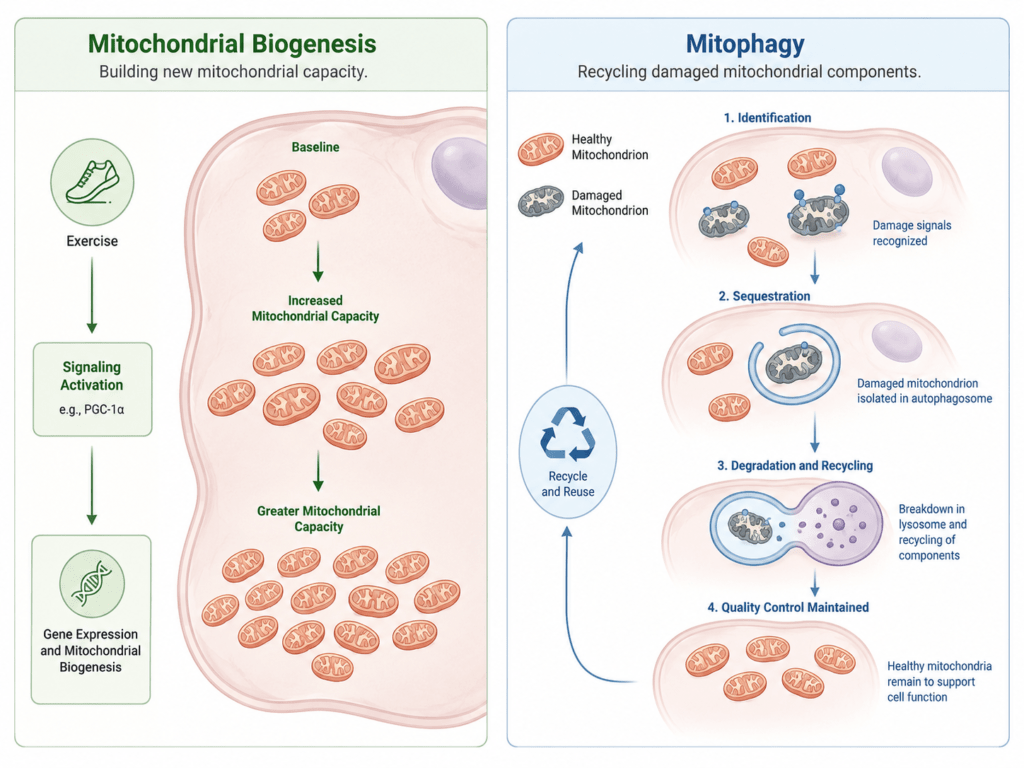
Biogenesis helps renew capacity. Mitophagy helps maintain quality. Mitochondrial dynamics, including fission and fusion, help organize the network so mitochondria can mix contents, separate damaged regions, and prepare parts of the network for recycling.
This coordination helps explain why “more mitochondria” is not always the best shorthand for mitochondrial health. A better goal is a responsive mitochondrial network that can meet demand, manage stress, recycle worn components, and adapt over time.
That is why mitochondrial health is often discussed through several linked pillars:
- Energy production, including ATP generation.
- Mitochondrial biogenesis, or renewal of capacity.
- Mitophagy, or targeted cleanup.
- Redox balance, or healthy regulation of reactive oxygen species.
- Mitochondrial dynamics, including fission and fusion.
When these systems work together, cells are better positioned to handle changing energy demands. When they are poorly coordinated, capacity and quality control can become mismatched.
What Research Says About Exercise, Mitophagy, and Adaptation
Exercise remains one of the best-studied ways to influence mitochondrial adaptation. Endurance exercise is strongly associated with mitochondrial biogenesis in skeletal muscle, and newer research continues to examine how different types of training affect mitochondrial markers.
A 2025 systematic review and meta-analysis of randomized trials reported that physical activity influences mitochondrial biogenesis pathways in skeletal muscle, with PGC-1α emerging as one of the most consistently reported markers.
Mitophagy research is more complex. Reviews suggest that exercise can promote mitochondrial remodeling through both anabolic processes, such as biogenesis, and catabolic processes, such as selective mitochondrial degradation. However, the timing, tissue-specific effects, and best measurement methods are still being studied.
This is important for how we talk about mitochondrial health. Exercise does not simply “add mitochondria.” It creates repeated biological signals that can support remodeling, adaptation, and quality control when paired with enough recovery.
What Research Says About (−)-Epicatechin
(−)-Epicatechin is a cacao-derived flavanol studied for its relationship with mitochondrial signaling pathways. Research in this area includes preclinical studies, cocoa flavanol research, mechanistic studies, and a smaller number of human studies specific to (−)-epicatechin.
A review in Nutrition Reviews summarized available data on acute and chronic (−)-epicatechin supplementation and mitochondrial function, including potential mechanisms related to mitochondrial biogenesis.
One human study, McDonald et al., examined (−)-epicatechin in adults with Becker muscular dystrophy and reported short-term changes in tissue biomarkers related to mitochondrial biogenesis and muscle regeneration. This was a specific clinical population, so it should not be generalized as proof of broad outcomes in healthy adults.
This distinction matters. Cocoa, dark chocolate, cocoa flavanols, isolated (−)-epicatechin, and Mitozz are not interchangeable. They can overlap scientifically, but they are different exposures with different compositions and contexts.
What This Means in Real Life
For most people, mitochondrial health is not about chasing one pathway. It is about creating a steady environment where cells can adapt, repair, and maintain quality control.
Movement is a major signal. Aerobic training, resistance training, walking, intervals, and general physical activity can all contribute in different ways. The best routine is the one a person can sustain and recover from.
Recovery also matters. Mitochondrial adaptation is energy-dependent. Sleep, protein adequacy, micronutrients, hydration, and stress regulation help determine whether the body can respond well to the signals created by training and daily life.
Nutrition matters because mitochondria rely on nutrients as fuel and as cofactors for energy metabolism. A balanced diet with adequate protein, fiber-rich carbohydrates, healthy fats, and micronutrient density supports the broader system.
The practical goal is not perfection. It is consistency. Build capacity through repeated healthy signals, and support cleanup through recovery and routine.
Where Mitozz Fits In
Mitozz is formulated around 98% pure (−)-epicatechin, a cacao-derived flavanol studied for its relationship with cellular signaling pathways involved in mitochondrial biology.
In the context of mitochondrial biogenesis and mitophagy, Mitozz should be understood as one possible support tool, not a replacement for movement, sleep, nutrition, recovery, or medical care. The strongest lifestyle signal for mitochondrial adaptation remains consistent physical activity, especially when paired with recovery.
For people building a mitochondrial health routine, Mitozz may fit as a structured daily option alongside the basics. Its role is best framed around supporting normal mitochondrial health, cellular energy, recovery, and resilience pathways, not as a treatment or shortcut.
Readers who want to go deeper can explore Mitochondria 101, the Cellular Energy Dictionary, and the related Mitozz article Mitochondria and Mitophagy: The Science of Cellular Recycling. The mitophagy article explains how mitochondrial biogenesis and mitophagy work together to support cellular energy and mitochondrial quality control.
FAQ
What is the difference between mitochondrial biogenesis and mitophagy?
Mitochondrial biogenesis helps cells build or renew mitochondrial capacity. Mitophagy helps cells selectively recycle mitochondria that are damaged, inefficient, or no longer needed.
Is more mitochondrial biogenesis always better?
Not necessarily. More capacity is useful only when it is coordinated with quality control. A healthy mitochondrial network depends on both renewal and cleanup.
Does exercise support both mitochondrial biogenesis and mitophagy?
Exercise is one of the best-studied signals for mitochondrial adaptation. Research supports its role in mitochondrial biogenesis, and reviews suggest exercise-induced mitophagy may also contribute to mitochondrial remodeling.
Is mitophagy the same as autophagy?
Mitophagy is a selective form of autophagy focused on mitochondria. Autophagy is the broader cellular recycling process.
Does Mitozz cause mitochondrial biogenesis?
Mitozz should not be described as causing or guaranteeing mitochondrial biogenesis. It is formulated around 98% pure (−)-epicatechin, which has been studied for its relationship with signaling pathways involved in mitochondrial biology.
Conclusion
Mitochondrial health depends on both building and clearing. Mitochondrial biogenesis helps renew energy-producing capacity, while mitophagy helps maintain quality by recycling mitochondria that are damaged or inefficient.
The most useful framework is not “more mitochondria at any cost.” It is a coordinated system: enough capacity, effective cleanup, balanced signaling, and consistent support from daily habits.
That is the deeper meaning of build more, clear better. Support the signals that help cells adapt, and respect the recovery processes that help the mitochondrial network stay clean, responsive, and resilient.
Learn more about Mitozz and 98% pure (−)-epicatechin as part of a broader daily approach to cellular energy, recovery, and mitochondrial health.
Share this blog article
References
- Chen, L., et al. (2022). PGC-1α-Mediated Mitochondrial Quality Control: Molecular Mechanisms and Implications for Heart Failure. Frontiers in Cell and Developmental Biology.
- Guan, Y., et al. (2019). Exercise-Induced Mitophagy in Skeletal Muscle and Heart. Exercise and Sport Sciences Reviews.
- McDonald, C. M., et al. (2021). (−)-Epicatechin induces mitochondrial biogenesis and markers of muscle regeneration in adults with Becker muscular dystrophy. Muscle & Nerve.
- Daussin, F. N., et al. (2021). Effects of (−)-epicatechin on mitochondria. Nutrition Reviews.
- Abrego-Guandique, D. M., et al. (2025). The impact of exercise on mitochondrial biogenesis in skeletal muscle: A systematic review and meta-analysis of randomized trials. Life Sciences.
- Gottlieb, R. A., et al. (2017). Mitophagy and Mitochondrial Quality Control Mechanisms in the Heart. Current Pathobiology Reports.
- Rüb, C., et al. (2017). Mitochondrial quality control by the Pink1/Parkin system. Cell and Tissue Research
Understanding mitochondrial health is a long-term process. That’s why we created the Mitozz Newsletter: a free way to keep learning about cellular energy, mitochondrial health, and the lifestyle signals that support your body over time. You’ll receive science-based educational content, practical guidance, and updates from Mitozz, all at your own pace.
Sign up for the Mitozz Newsletter
Get science-based education on mitochondrial health, cellular energy, and lifestyle signals that support your body over time.
Medical Disclaimer: The information provided in this article is for educational and informational purposes only and is not intended as medical advice. It is not a substitute for professional medical diagnosis, treatment, or guidance. Always consult with a qualified healthcare professional before making changes to your diet, exercise routine, fasting practices, or supplement use, especially if you have a medical condition, are pregnant or nursing, or are taking medications.
FDA Disclaimer: These statements have not been evaluated by the Food and Drug Administration. They are not not intended to diagnose, treat, cure, or prevent any disease.