Key Takeaways
- Mitochondria help turn nutrients and oxygen into ATP.
- Mitophagy is the selective recycling of damaged mitochondria.
- Mitochondrial health depends on both cleanup and renewal.
- Exercise, sleep, nutrition, and recovery influence this system.
- Mitozz may fit as one support tool within a broader mitochondrial health strategy.
Every second of every day, your cells are humming with metabolic activity to keep you moving, thinking, and thriving. At the center of this continuous activity are your mitochondria, the specialized structures responsible for generating the vast majority of your cellular energy.
But mitochondria are not static batteries. They are dynamic structures that can become stressed, fragmented, inefficient, or damaged over time. Cells need a way to identify the mitochondria that are no longer working well and recycle them before they create more stress than support.
That process is called mitophagy and it’s one of the cell’s most important mitochondrial quality control systems.
What Are Mitochondria?
Mitochondria are specialized structures that exist inside most cells. Their best-known job is energy production, but they also participate in calcium handling, redox signaling, stress responses, immune signaling, and cell survival decisions.
Inside mitochondria, fuel-derived molecules feed electrons into the electron transport chain. This helps build a proton gradient across the inner mitochondrial membrane, which ATP synthase uses to produce ATP. This is why mitochondrial function is so closely tied to endurance, tissue recovery, and the ability to meet energy demand.
Still, mitochondria don’t work in isolation. They constantly respond to demand. A muscle cell during exercise, a neuron during sustained attention, or a liver cell after a meal each ask mitochondria to adjust output, signaling, and maintenance.
What Is Mitophagy?
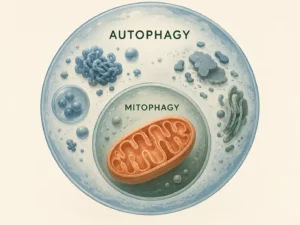
Mitophagy is a selective form of autophagy, the cell’s natural recycling process. Mitophagy focuses specifically on mitochondria that are damaged, dysfunctional, or no longer needed.
A simple way to think about it is that mitochondrial biogenesis helps build or expand the mitochondrial network, and mitophagy helps keep that network running clean.
One of the best-studied mitophagy pathways involves PINK1 and Parkin. In this pathway, PINK1 acts as a damage sensor when mitochondrial import or membrane potential is disrupted. Parkin then helps mark the damaged mitochondrion with ubiquitin, signaling that it should be processed through mitophagy and other quality-control mechanisms.
Why Cells Need Mitochondrial Quality Control
Mitochondria are exposed to constant biochemical pressure. Since they handle oxygen, electrons, fuel substrates, and membrane potential, they can become sources of reactive oxygen species when stressed. Reactive oxygen species are not automatically “bad.” At normal levels, they support adaptation signaling. In excess or in the wrong context, they can contribute to oxidative stress.
That is where mitochondrial quality control becomes important. A cell does not only need mitochondria that are numerous. It needs mitochondria that are functional, well integrated, and responsive.
If damaged mitochondria accumulate, several problems may follow.
- ATP production can become less efficient.
- Redox balance may shift.
- Mitochondrial DNA or damage-associated signals may affect inflammatory pathways.
As a result, cells may become less able to adapt to exercise, stress, or recovery demands.
This is why mitophagy is often discussed in relation to aging biology, neurobiology, cardiometabolic research, kidney biology, and other fields. That does not mean impaired mitophagy is the sole cause of these conditions but it does means mitochondrial maintenance is a recurring theme in how researchers understand cellular resilience.
Mitophagy and Biogenesis Work Together
Mitophagy is only half of the renewal story. By clearing mitochondria that are no longer working well, the cell can recover useful building blocks and make room for a healthier, better-coordinated mitochondrial network.
Clearing damaged mitochondria is useful only if the cell can also maintain the capacity it needs. That is where mitochondrial biogenesis comes in. Biogenesis is the process of creating new mitochondrial components and remodeling the mitochondrial network over time, helping the cell replace what was lost.
A central coordinator in this process is PGC-1α, a signaling regulator involved in mitochondrial biogenesis and oxidative metabolism. PGC-1α does not act alone but it is often discussed as a key node connecting exercise, metabolic demand, and mitochondrial adaptation.
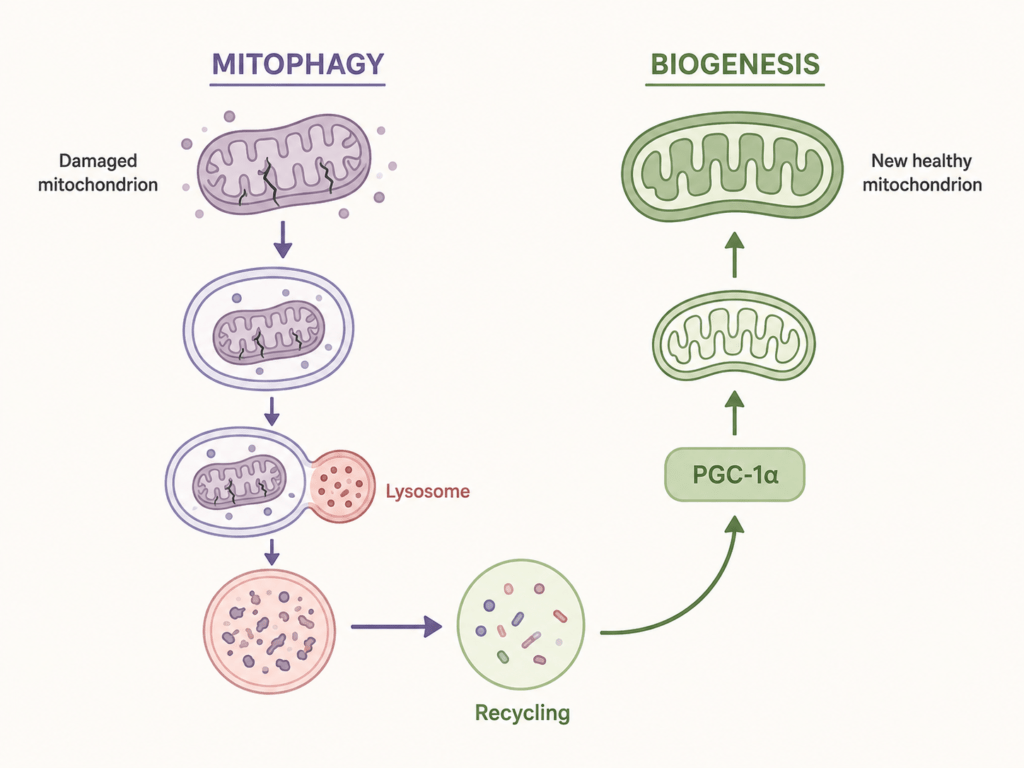
In a healthy adaptive scenario, the cell can remove mitochondria that are not functioning well and build or maintain the capacity it needs.
It’s about more than simply having more mitochondria. More mitochondria isn’t necessarily good if they are poorly functioning, damaged or poorly coordinated.
Key takeaway: The goal is to support both mitochondrial quantity and quality, so the cell can build the capacity it needs while at the same time keeping that network clean, coordinated, and responsive.
How Daily Life Influences Mitophagy
Mitophagy is not something you can feel directly. You can’t just wake up and sense that one mitochondrial network has been recycled overnight. What you may notice is the downstream pattern: how well you recover, how steady your energy feels, how training adaptations build, and how resilient your body feels under normal stress.
Several lifestyle signals are especially relevant:
Exercise is one of the strongest known mitochondrial signals. Endurance training and resistance training can influence mitochondrial biogenesis, oxidative capacity, and quality-control pathways. The exact mitophagy response depends on training type, intensity, duration, tissue, age, and measurement method.
Sleep and circadian rhythm matter because mitochondrial function is tied to daily biological timing. Mitochondria do not operate the same way at every hour of the day. Sleep loss, irregular timing, and circadian disruption can influence the environment in which mitochondria produce energy and recover.
Nutrition matters because mitochondria need fuel substrates, micronutrient support, and a metabolic environment that is not constantly overloaded. This does not require a perfect diet. It means steady protein, fiber-rich carbohydrates, healthy fats, and enough total energy to match demand can all influence the background conditions for mitochondrial maintenance.
Recovery matters because adaptation is energy-dependent. Training, work stress, travel, illness, and under-sleeping all create demand. Without recovery, the system may receive repeated stress signals without enough time to repair and reorganize.
For a practical companion article, read this related guide, How to Repair and Maintain Mitochondrial Health Naturally.
What This Means in Real Life
Mitochondria are built for demand. They respond when you move, think, work, train, recover, and adapt. But they also need regular opportunities for maintenance.
That is where mitophagy comes into play. It is one way the cell clears mitochondrial parts that are no longer working well, so the energy system can stay more efficient and responsive over time.
The goal is to give your body a rhythm of healthy challenge and recovery.
Mitochondrial health is not built on just one perfect habit. It is built on repeated signals that tell the body: produce energy, clean up what is not working, and rebuild the capacity to meet tomorrow’s demand.
Where Mitozz Fits In
Mitozz is formulated around 98% pure (−)-epicatechin, a plant-derived flavanol studied for its relationship with cellular signaling pathways involved in mitochondrial biology.
This matters because research on (−)-epicatechin has explored mitochondrial biogenesis, oxidative capacity, and related signaling pathways. In one open-label human study in adults with Becker muscular dystrophy, researchers evaluated (−)-epicatechin in relation to markers of mitochondrial biogenesis and muscle regeneration.
For readers interested in mitochondrial health, Mitozz may fit as one support tool alongside the foundations: movement, sleep, nutrition, stress management, and recovery. It should not be framed as a shortcut, cure, or replacement for the daily signals that shape mitochondrial quality control.
FAQ
What is the difference between autophagy and mitophagy?
Autophagy is the broad, generalized process by which a cell breaks down and recycles its own damaged proteins and worn out cellular structures. Mitophagy is a highly specialized subcategory of autophagy that focuses exclusively on the selective identification, isolation, and recycling of damaged mitochondria.
How do I know if my cellular recycling pathways are working?
Cellular recycling happens entirely behind the scenes at a microscopic level, so unfortunately, it cannot be directly felt or measured at home. Instead, the downstream effects of a well maintained cellular environment typically manifest as steady daily energy, efficient recovery after physical exertion, and reliable physical stamina.
Is the active ingredient in Mitozz the same as eating dark chocolate?
While dark chocolate does naturally contain epicatechin, the amounts can vary wildly based on processing, bean origin, and manufacturing methods. Mitozz provides a precise, standardized amount of 98% pure (−)-epicatechin, removing the sugar, fat, and variability associated with commercial chocolate products.
Does more mitophagy always mean better mitochondrial health?
Not necessarily. Mitochondrial health depends on balance. Too little cleanup may allow damaged mitochondria to accumulate, while excessive removal without adequate rebuilding could reduce capacity. The goal is coordinated quality control, mitochondrial biogenesis (quantity) + mitophagy (quality).
Conclusion
Mitochondria and mitophagy both belong in the same mitochondrial health conversation. Cellular energy is not just about having more mitochondria. It is also about mitochondrial maintenance.
Mitophagy helps remove mitochondria that are damaged or no longer serving the cell well. Mitochondrial biogenesis helps rebuild and renew capacity. When these systems work together, cells are better equipped to meet demand, recover, and adapt over time.
The most practical strategy to achieve this are the tried-and-true fundamentals of steady movement, sufficient sleep, nutrient adequacy, stress recovery, and targeted support with Mitozz where it fits.
Share this blog article
References
- Narendra, D. P., et al. (2024). The role of PINK1-Parkin in mitochondrial quality control. Nature Reviews Molecular Cell Biology.
- Ye, L., et al. (2025). Mitochondrial quality control in health and disease. MedComm.
- Nolfi-Donegan, D., et al. (2020). Mitochondrial electron transport chain: Oxidative phosphorylation, oxidant production, and methods of measurement. Redox Biology.
- McDonald, C. M., et al. (2021). (−)-Epicatechin induces mitochondrial biogenesis and markers of muscle regeneration in adults with Becker muscular dystrophy. Muscle & Nerve.
- Hüttemann, M., et al. (2013). (−)-Epicatechin is associated with increased angiogenic and mitochondrial signaling in the hindlimb of rats selectively bred for innate low running capacity. Clinical Science.
- Moreno-Ulloa, A., et al. (2015). Recovery of indicators of mitochondrial biogenesis, oxidative stress, and aging with (−)-epicatechin in senile mice. The Journals of Gerontology: Series A.
- Villarreal, F., et al. (2020). (-)-Epicatechin induces mitochondrial biogenesis and markers of muscle regeneration in adults with Becker muscular dystrophy. Muscle & Nerve.
- Youle, R. J., and Narendra, D. P. (2011). Mechanisms of mitophagy. Nature Reviews Molecular Cell Biology.
Understanding mitochondrial health is a long-term process. That’s why we created the Mitozz Newsletter: a free way to keep learning about cellular energy, mitochondrial health, and the lifestyle signals that support your body over time. You’ll receive science-based educational content, practical guidance, and updates from Mitozz, all at your own pace.
Sign up for the Mitozz Newsletter
Get science-based education on mitochondrial health, cellular energy, and lifestyle signals that support your body over time.
Medical Disclaimer: The information provided in this article is for educational and informational purposes only and is not intended as medical advice. It is not a substitute for professional medical diagnosis, treatment, or guidance. Always consult with a qualified healthcare professional before making changes to your diet, exercise routine, fasting practices, or supplement use, especially if you have a medical condition, are pregnant or nursing, or are taking medications.
FDA Disclaimer: These statements have not been evaluated by the Food and Drug Administration. They are not not intended to diagnose, treat, cure, or prevent any disease.