
The best choice for complete-mitochondrial support.
Real mitochondrial support is not built around one biological lever. Your cells must renew mitochondrial capacity, maintain quality control, respond to energy demand, coordinate with blood-flow signaling, and manage oxidative stress—all at the same time.
Mitozz takes a focused approach: one defined compound, 98% pure (-)-epicatechin, selected because the research connects it to each part of that broader mitochondrial support system.
This page discusses studied pathways and markers related to (-)-epicatechin. It does not make disease treatment claims.
Five systems.
One superior compound.
Other supplements focus on improving fragments of mitochondrial health. Mitozz is built around 98% pure (-)-epicatechin because it reaches the full mitochondrial support system.
Renewal
Build mitochondrial capacity.
Quality Control
Clear damaged or inefficient components.
Energy Demand
Respond when cellular energy needs rise.
Vascular Support
Support oxygen and nutrient delivery.
Redox Balance
Manage oxidative stress without blocking useful redox signaling.
(-)-Epicatechin acts across multiple reported biological pathways.
The pathway map below summarizes reported signaling and regulatory pathways associated with 98% pure (-)-epicatechin, including GPER-associated signaling, APLNR/APJ apelin receptor signaling, eNOS/NO biology, PXR transcriptional regulation, mitochondrial biogenesis, redox balance, energy metabolism, endothelial function, and skeletal muscle biology.
This is a scientific evidence map, not a disease-treatment claim. The evidence badges and model tags distinguish human, animal, cell-based, and mechanistic evidence, and the arrows should not be interpreted as proof that all pathways occur together in the same cell type.
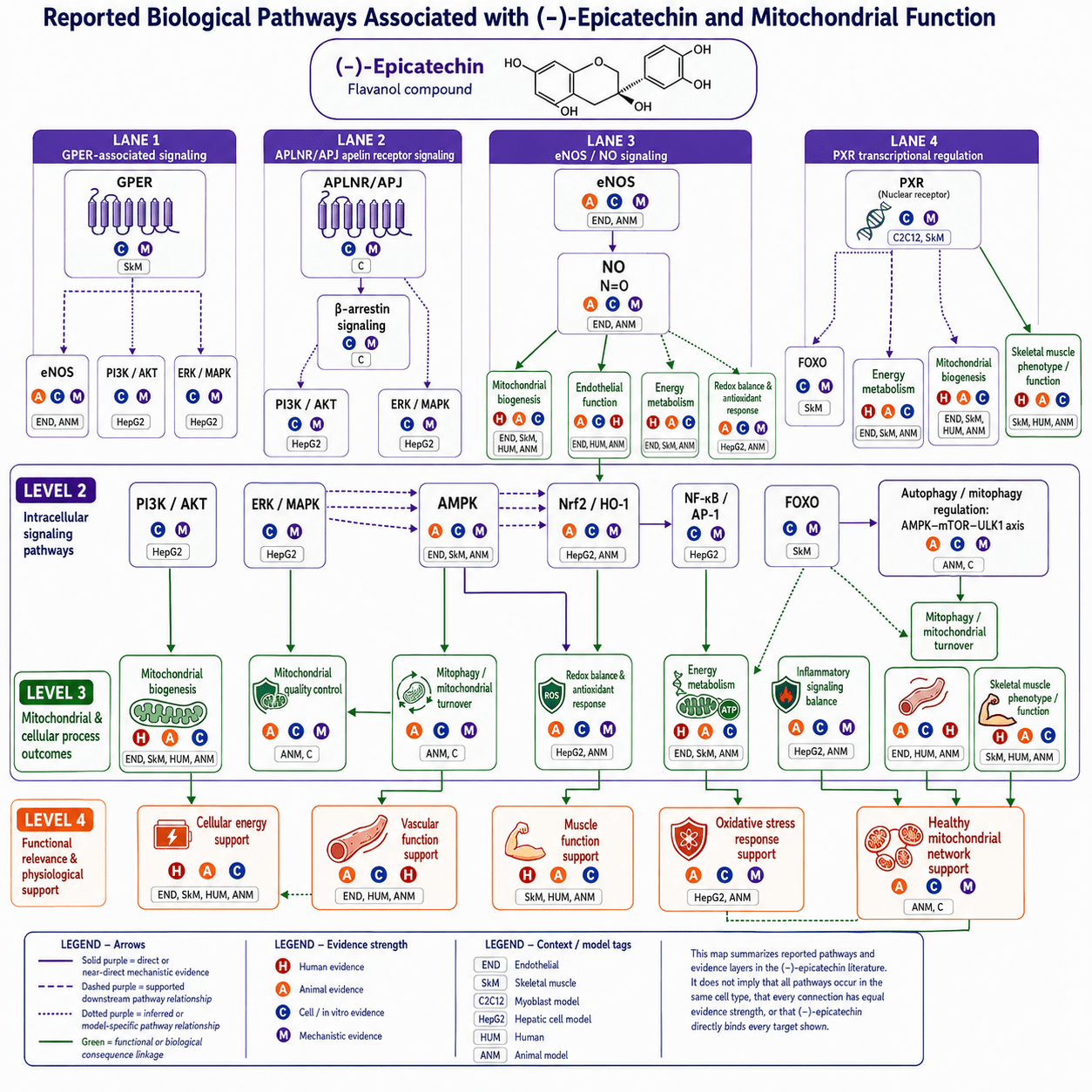
The science behind Mitozz is built on pathways, not hype.
The research around (-)-epicatechin does not fit into one simple claim. It spans receptor-associated signaling, endothelial nitric oxide biology, mitochondrial energy signaling, redox response, cellular stress pathways, skeletal muscle adaptation, and exploratory mitochondrial quality-control biology.
These tables separate pathway, model context, direction, evidence level, and claim boundary. The evidence is not equal across every pathway, and findings vary by model, tissue, study design, dose, and endpoint.
Reported early targets and regulatory entry points
Early receptor-associated, enzymatic, and transcriptional mechanisms reported in (-)-epicatechin research.
Reported early targets and regulatory entry points
Early receptor-associated, enzymatic, and transcriptional mechanisms reported in (-)-epicatechin research.
| Pathway / marker | Model / context | Direction | Evidence level | Interpretation / claim boundary |
|---|---|---|---|---|
| GPER-associated signaling | Endothelial / membrane-signaling models | Involved in eNOS / NO signaling | Cell-mechanistic | GPER appears involved in some (-)-epicatechin-associated endothelial signaling, especially eNOS / NO-related pathways. This should be framed as receptor-associated signaling, not proof that GPER explains all downstream mitochondrial effects. |
| APLNR / APJ apelin receptor | Mechanistic receptor study | β-arrestin-biased activation | Mechanistic / cell-based | A mechanistic study reported β-arrestin recruitment at the apelin receptor, supporting a receptor-level biased signaling interaction. This mechanism should remain tied to APLNR / APJ and should not be generalized to PXR or all GPCR signaling. |
| PXR | C2C12 / skeletal muscle model | Activated / nuclear translocation | Cell-mechanistic | C2C12 work suggests (-)-epicatechin can activate PXR signaling, including nuclear translocation and PXR-responsive gene expression. This belongs in a nuclear transcriptional-regulation lane, not a GPCR-like pathway. |
| eNOS / NO signaling | Endothelial cells / myocardium-related models | Activated / increased signaling | Cell / animal / mechanistic | eNOS mediates some (-)-epicatechin-associated mitochondrial biogenesis markers in endothelial and cardiac-related models. eNOS should be treated as an enzymatic mediator, not as a receptor. |
Cardiovascular and endothelial signaling
Pathways tied to endothelial function, nitric oxide signaling, vascular tone markers, and blood-flow-related biology.
Cardiovascular and endothelial signaling
Pathways tied to endothelial function, nitric oxide signaling, vascular tone markers, and blood-flow-related biology.
| Pathway / marker | Model / context | Direction | Evidence level | Interpretation / claim boundary |
|---|---|---|---|---|
| eNOS / NO signaling | Human coronary artery endothelial cells | Activated | Cell-mechanistic | This is one of the clearer mechanistic links between (-)-epicatechin and endothelial nitric oxide biology. It supports vascular biology framing, not disease-treatment language. |
| Nitric oxide products | Acute human flavonoid study | Increased in some work | Human biomarker, acute | Human work with pure dietary flavonoids has reported increased nitric oxide-related products after (-)-epicatechin exposure. This is acute biomarker evidence, not proof of long-term vascular benefit. |
| Endothelin-1 | Acute human flavonoid study | Reduced in some work | Human biomarker, acute | Lower endothelin-1 has been reported acutely in some human work. The claim should remain biomarker-level and should not become a blood-pressure or vascular-disease claim. |
| Vascular function markers | Animal stress models | Improved / normalized in some models | Preclinical | Preclinical models suggest favorable effects under vascular or metabolic stress conditions. This should be described as model-specific vascular signaling support. |
| Capillarity-associated markers | Skeletal muscle / limited human-associated data | Increased markers in some studies | Preclinical / limited human-associated | These findings are relevant to the mitochondrial-muscle story, but they should be framed as capillarity-associated markers, not guaranteed improved blood flow. |
Mitochondrial and energy signaling
Markers tied to mitochondrial biogenesis, energy sensing, oxidative phosphorylation, enzyme activity, and mitochondrial structure.
Mitochondrial and energy signaling
Markers tied to mitochondrial biogenesis, energy sensing, oxidative phosphorylation, enzyme activity, and mitochondrial structure.
| Pathway / marker | Model / context | Direction | Evidence level | Interpretation / claim boundary |
|---|---|---|---|---|
| Mitochondrial biogenesis markers | Human small study / animal / endothelial-cell models | Increased markers in some studies | Human biomarker / preclinical / cell | This is one of the central Mitozz-relevant areas. The claim should stay at the level of mitochondrial biogenesis markers, not guaranteed mitochondrial enhancement in every tissue. |
| eNOS-linked mitochondrial signaling | Endothelial cells / myocardium-related models | Increased biogenesis indicators | Cell / animal / mechanistic | eNOS appears to mediate some (-)-epicatechin-associated increases in mitochondrial biogenesis indicators. This is stronger than a vague antioxidant-only explanation. |
| AMPK | Animal / metabolic / skeletal muscle contexts | Increased or activated in some models | Preclinical / model-dependent | AMPK is relevant as an energy-sensing pathway, but the language should not imply it is always activated or that activation is proven in humans. |
| PGC-1α axis | Human-associated biomarkers / preclinical models | Increased markers in some studies | Human-associated / preclinical | PGC-1α is a biogenesis-related marker axis. It should be presented as mitochondrial biogenesis signaling, not proof of a direct target. |
| Citrate synthase activity | Cell / preclinical models | Increased in some models | Cell / preclinical | Citrate synthase supports mitochondrial enzyme-activity framing. Keep the interpretation model-specific. |
| Oxidative phosphorylation proteins | Cell / preclinical models | Increased in some models | Cell / preclinical | Reported increases in oxidative phosphorylation proteins are useful mechanistic markers, but they should not be translated into broad claims of increased whole-body energy production. |
| Mitochondrial structure / cristae markers | Skeletal muscle / animal / limited human-associated | Improved markers in some studies | Preclinical / limited human-associated | Skeletal-muscle studies report structural and functional markers consistent with mitochondrial remodeling. This should remain biomarker and structure-level language, not a broad performance claim. |
Antioxidant and redox signaling
Pathways involved in redox-response regulation, antioxidant enzyme activity, and oxidative stress signaling.
Antioxidant and redox signaling
Pathways involved in redox-response regulation, antioxidant enzyme activity, and oxidative stress signaling.
| Pathway / marker | Model / context | Direction | Evidence level | Interpretation / claim boundary |
|---|---|---|---|---|
| Nrf2 / ARE axis | HepG2 / animal models | Activated in some models | Cell / preclinical | Nrf2 belongs downstream in redox signaling, not in direct entry points. Reported activation should be interpreted as downstream antioxidant-response pathway regulation, not evidence of direct Nrf2 binding. |
| HO-1 | Cell / animal models | Increased in some models | Preclinical | HO-1 is commonly downstream of antioxidant-response signaling. Reported increases are consistent with Nrf2-linked biology, but the effect remains model-dependent. |
| ROS / oxidative stress markers | Stress models | Reduced or normalized in some models | Preclinical | Redox effects should be described as stress-model dependent. This should not be stated as a universal reduction in oxidative stress. |
| SOD / glutathione / antioxidant enzymes | Animal metabolic models | Increased in some models | Preclinical | These markers are relevant to antioxidant-response biology, but the claim should avoid implying simple direct free-radical scavenging. |
| ROS / RNS modulation | Cell / preclinical models | Modulated | Preclinical / mechanistic | These findings are best interpreted as redox signaling modulation rather than a generic antioxidant effect. |
Cellular stress and inflammatory signaling
Transcription factors, cytokine patterns, and downstream markers involved in cellular stress-response biology.
Cellular stress and inflammatory signaling
Transcription factors, cytokine patterns, and downstream markers involved in cellular stress-response biology.
| Pathway / marker | Model / context | Direction | Evidence level | Interpretation / claim boundary |
|---|---|---|---|---|
| NF-κB | HepG2 / inflammatory stress models | Context-dependent | Cell / preclinical | NF-κB is not simply beneficial or harmful. Some cell models report activation in an adaptive signaling context, while inflammatory-stress models may report reduced pathway activation. |
| AP-1 | HepG2 | Increased binding / activity | Cell evidence | AP-1 activity in HepG2 cells supports transcriptional stress-response signaling. Keep this claim cell-model specific. |
| Inflammatory cytokines | Preclinical inflammatory models | Reduced or normalized in some models | Preclinical | Use this as pathway-level inflammatory signaling support in experimental models, not as a disease-inflammation claim. |
| TNF-α / IL-6 / IL-1β | Preclinical inflammatory models | Model-dependent reduction | Preclinical | These cytokines are commonly measured markers of inflammatory signaling. Reported reductions support pathway-level effects in specific experimental models. |
| COX-2 / iNOS | Preclinical inflammatory / oxidative stress models | Model-dependent modulation | Preclinical | COX-2 and iNOS are downstream markers linked to inflammatory and oxidative stress signaling. Changes in these markers should remain in the cellular stress-response lane. |
Skeletal muscle signaling and adaptation
Markers connected to muscle regulation, differentiation, capillarity, structure, and adaptive remodeling.
Skeletal muscle signaling and adaptation
Markers connected to muscle regulation, differentiation, capillarity, structure, and adaptive remodeling.
| Pathway / marker | Model / context | Direction | Evidence level | Interpretation / claim boundary |
|---|---|---|---|---|
| Myostatin | Human / preclinical muscle contexts | Reduced in some contexts | Human-associated / preclinical | Some human and preclinical work suggests lower myostatin signaling in certain settings, but this is not universal across exercise studies. |
| Follistatin | Human / preclinical muscle contexts | Increased in some contexts | Human-associated / preclinical | Follistatin is relevant as a counter-regulator of myostatin. Keep the claim tied to measured study contexts. |
| MyoD | C2C12 myoblast model | Increased / differentiation-associated | Cell evidence | Cell studies suggest (-)-epicatechin may influence MyoD-dependent myoblast differentiation. This supports muscle-cell differentiation biology, not a direct consumer claim about muscle growth. |
| Myogenin | C2C12 / PXR model | Increased in some work | Cell-mechanistic | PXR-related C2C12 work reported myogenin-associated differentiation markers, supporting a muscle-cell differentiation pathway. |
| Muscle strength | Older adult / sarcopenia plus resistance training | Improved in one context | Human RCT, context-dependent | A human study evaluated (-)-epicatechin with resistance training in older adults and measured outcomes including strength, follistatin, and myostatin. This should not be generalized to all users. |
| Training adaptations | Human cycling exercise study | Mixed / possibly unfavorable for some aerobic markers | Human exercise study | Human exercise data are mixed. One study reported no effect on myostatin gene expression or anaerobic adaptations and possible interference with some aerobic or mitochondrial adaptation markers. |
Exploratory mitochondrial quality-control and cell-stress pathways
Preclinical and model-specific pathways related to mitochondrial quality control, autophagy regulation, apoptosis markers, and cellular stress-response biology.
Exploratory mitochondrial quality-control and cell-stress pathways
Preclinical and model-specific pathways related to mitochondrial quality control, autophagy regulation, apoptosis markers, and cellular stress-response biology.
| Pathway / marker | Model / context | Direction | Evidence level | Interpretation / claim boundary |
|---|---|---|---|---|
| Autophagy / mitophagy regulation | Preclinical / model-specific | Context-dependent | Exploratory preclinical | Best framed as a possible influence on mitochondrial quality-control pathways in specific experimental models, not as a proven human effect. |
| AMPK-mTOR-ULK1 axis | General pathway biology / selected preclinical contexts | Regulatory axis | Mechanistic / preclinical | This should be described as a regulatory axis. Do not imply that mTOR activation alone is inherently beneficial. |
| LC3 / mitophagy markers | Preclinical models | Model-dependent | Exploratory preclinical | Include these markers only when tied to specific studies. Otherwise, keep them as pathway-adjacent markers within mitochondrial quality-control biology. |
| BCL2 / BAX / caspase-3 | Injury or stress models | Protective modulation in some models | Preclinical | This belongs in preclinical stress biology. Avoid language that sounds like treatment of tissue injury or disease. |
| FOXO | Skeletal muscle / stress-response models | Context-dependent | Pathway-adjacent / model-dependent | FOXO can remain in the broader map, but current evidence does not support treating it as a primary direct target of (-)-epicatechin. |
| Inflammatory cytokine overlap | Preclinical stress models | Reduced or normalized in some models | Preclinical | This shows the overlap between inflammation, stress response, and cell-survival signaling, but it should not create a disease claim. |
Human studies add the next layer of evidence.
The pathway map explains how (-)-epicatechin connects to mitochondrial, vascular, redox, and muscle biology. Human studies help show where that biology has been observed in people, from safety and exposure to muscle-related biomarkers and cardiometabolic research.
The value of the human evidence is not any single headline result. It is the way different study types point back to the same biological themes: exposure, mitochondrial markers, vascular signaling, and flavanol biology.
Pure (-)-epicatechin has been studied directly in people.
What was studied
Researchers evaluated purified (-)-epicatechin in healthy volunteers, including pharmacokinetics, pharmacodynamics, safety, and tolerability.
Why it matters
This gives human context for how the compound is absorbed, handled, and tolerated.
Science perspective
This is foundational evidence. It supports the compound’s human research profile and helps ground the broader pathway discussion.
Human muscle research connects (-)-epicatechin to mitochondrial biogenesis markers.
What was studied
An 8-week open-label study in ambulatory adults with Becker muscular dystrophy used 50 mg of (-)-epicatechin twice daily.
Why it matters
The study reported increases in tissue biomarkers related to mitochondrial biogenesis and muscle regeneration.
Science perspective
This is one of the most relevant human signals for the Mitozz story because it connects directly to muscle and mitochondrial biology.
Human studies have examined the vascular side of cellular energy.
What was studied
Researchers have studied markers such as triglyceride/HDL-C ratio, blood pressure, vascular function, nitric oxide products, endothelin-1, and blood lipids.
Why it matters
Mitochondria do not work in isolation. Oxygen delivery, endothelial signaling, and vascular tone all influence how well cells can meet energy demand.
Science perspective
The human results are not uniform, but they help connect (-)-epicatechin to the vascular biology that supports cellular energy, especially through nitric oxide and endothelial signaling.
Large flavanol studies show why this biology deserves attention.
What was studied
COSMOS tested a cocoa extract supplement providing 500 mg per day of cocoa flavanols, including roughly 80 mg per day of (-)-epicatechin within a broader flavanol mixture.
What was found
The main analysis did not significantly reduce total cardiovascular events, but the study reported a 27% reduction in cardiovascular death.
Science perspective
COSMOS does not prove that isolated (-)-epicatechin alone produces the same outcome. What it does show is that cocoa flavanol biology has meaningful human evidence behind it.
The science continues to evolve.
Science is rapidly expanding the way we understand mitochondria in energy, aging, muscle function, and cellular resilience. As new research on (-)-epicatechin and mitochondrial biology emerges, we will continue updating this page to reflect the best available evidence.
Mitozz turns mitochondrial science into a product standard.
The research only matters if the supplement is specific enough to match it. Mitozz is built around a defined active compound, a controlled dose, and a formula designed for consistency from the first capsule.
Why that matters
Many mitochondrial supplements rely on broad ingredient categories: cocoa extract, plant polyphenols, antioxidant blends, or proprietary formulas. Those can be difficult to evaluate because the active compounds, purity, and dose may not be clear.
Mitozz takes the opposite approach. It centers the formula on one defined molecule, 98% pure (-)-epicatechin, so the product can be discussed with more scientific precision.
98% pure (-)-epicatechin
A defined compound, not a vague cocoa extract or mixed polyphenol blend.
50 mg per capsule
Each capsule provides a clear amount of (-)-epicatechin.
100 mg per day
Two capsules per day provide 100 mg of (-)-epicatechin.
No proprietary blend
The active compound and dose are visible, not hidden behind a formula name.
Built for transparency and consistency.
When a supplement is based on a defined compound and a clear dose, you can evaluate the ingredient, connect it to the science, and understand what you are actually taking.
Supplement Comparison
Want to compare Mitozz against other mitochondrial support supplements?
See our full mitochondrial supplement comparison, where we break down what pathway each supplement supports, how it works, its bioavailability, the strength of its evidence, safety considerations, and possible side effects.
Support the systems behind real, lasting energy.
Mitozz uses one defined compound, 98% pure (-)-epicatechin, to support key systems involved in mitochondrial biogenesis, quality control, vascular signaling, and redox balance.
Research behind this page.
The studies below are included to show the scientific basis for the pathway, human evidence, and compound-specific claims discussed on this page.
Human evidence
Pharmacokinetic, partial pharmacodynamic and initial safety analysis of (-)-epicatechin in healthy volunteers
Barnett et al., 2015 · Food & Function
Evaluated purified (-)-epicatechin in healthy volunteers, including pharmacokinetics, partial pharmacodynamics, safety, and tolerability.
View study summary(-)-Epicatechin induces mitochondrial biogenesis and markers of muscle regeneration in adults with Becker muscular dystrophy
McDonald et al., 2021 · Muscle & Nerve
Seven ambulatory adults received 50 mg of (-)-epicatechin twice daily for 8 weeks. The study reported changes in tissue biomarkers related to mitochondrial biogenesis and muscle regeneration.
View study summaryEffect of cocoa flavanol supplementation for the prevention of cardiovascular disease events: the COcoa Supplement and Multivitamin Outcomes Study randomized clinical trial
Sesso et al., 2022 · The American Journal of Clinical Nutrition
COSMOS tested a cocoa extract supplement providing 500 mg per day of cocoa flavanols, including approximately 80 mg per day of (-)-epicatechin. The trial did not significantly reduce total cardiovascular events in the main analysis, but reported a 27% reduction in cardiovascular death.
View study summaryA randomized, placebo-controlled, double-blind study on the effects of (−)-epicatechin on the triglyceride/HDLc ratio and cardiometabolic profile of subjects with hypertriglyceridemia
Gutiérrez-Salmeán et al., 2016 · International Journal of Cardiology
A human clinical study examining cardiometabolic markers, including triglyceride/HDL-C ratio, in subjects with hypertriglyceridemia.
View study summaryMitochondrial and muscle biology
(-)-Epicatechin stimulates mitochondrial biogenesis and cell growth in C2C12 myotubes via the G-protein coupled estrogen receptor
Moreno-Ulloa et al., 2018 · European Journal of Pharmacology
Cell-based skeletal muscle work examining mitochondrial biogenesis markers and GPER-related signaling in C2C12 myotubes.
View study summary(–)-Epicatechin enhances fatigue resistance and oxidative capacity in mouse muscle
Nogueira et al., 2011 · The Journal of Physiology
Preclinical muscle research examining fatigue resistance, oxidative capacity, and mitochondrial-related adaptations.
View study summaryPXR is a target of (-)-epicatechin in skeletal muscle
Ortiz-Flores et al., 2020 · Heliyon
Reported that (-)-epicatechin interacts with and activates PXR in skeletal muscle models, including effects related to C2C12 differentiation.
View study summary(-)-Epicatechin improves mitochondrial-related protein levels and ameliorates oxidative stress in dystrophic δ-sarcoglycan null mouse striated muscle
Ramirez-Sanchez et al., 2014 · FEBS Journal
Preclinical work examining mitochondrial-related protein levels and oxidative stress markers in dystrophic striated muscle.
View study summaryVascular and endothelial signaling
The effects of (−)-epicatechin on endothelial cells involve the G protein-coupled estrogen receptor (GPER)
Moreno-Ulloa et al., 2015 · Pharmacological Research
A mechanistic study examining how (-)-epicatechin affects endothelial signaling, including nitric oxide-related pathways.
View study summary(-)-Epicatechin activation of endothelial cell endothelial nitric oxide synthase, nitric oxide, and related signaling pathways
Ramírez-Sánchez et al., 2010 · Hypertension
Investigated intracellular pathways involved in (-)-epicatechin-induced effects on eNOS and nitric oxide production in human coronary artery endothelial cells.
View study summary(−)-Epicatechin induced reversal of endothelial cell aging and improved vascular function: underlying mechanisms
Ramírez-Sánchez et al., 2018 · Food & Function
Examined endothelial cell aging and vascular function mechanisms relevant to nitric oxide signaling and vascular biology.
View study summaryReceptor-level and redox signaling
(-)-Epicatechin Is a Biased Ligand of Apelin Receptor
Portilla-Martínez et al., 2022 · International Journal of Molecular Sciences
Mechanistic work reporting that (-)-epicatechin can recruit β-arrestin in the active conformation of the apelin receptor, acting as a biased agonist.
View study summaryEpicatechin induces NF-κB, AP-1, and Nrf2 via PI3K/Akt and ERK signaling in HepG2 cells
Granado-Serrano et al., 2010 · British Journal of Nutrition
Cell-based work examining time-dependent effects of epicatechin on transcription factors involved in antioxidant defense, survival, and proliferation pathways.
View study summaryThese references discuss studied compounds, pathways, biomarkers, and research contexts. They are provided for scientific transparency and should not be read as disease-treatment claims for Mitozz.
Want to go deeper? Explore the full Mitozz peer-reviewed paper library, organized by research area and scientific topic.
View Peer-Reviewed Papers