In the U.S., National Doctors’ Day, March 30, is a moment to recognize the people who show up, day after day, to diagnose, guide, and care, often in the hardest moments of people’s lives. But it’s also a good time to reflect on how health science is changing.
Modern medicine will always rely on diagnosis and treatment. But there’s growing emphasis on prevention and risk reduction, supporting the upstream biology that helps people maintain function and independence as they age.
One exciting, fast-moving area of focus is mitochondrial health, because mitochondria influence cellular energy production, stress signaling, and the quality-control systems that help tissues adapt and recover over time.
What “mitochondrial health” actually means
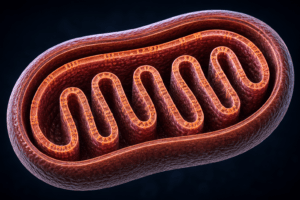
Mitochondria are often described as the cell’s “power plants” and that is correct. They are responsible for producing as much as 90% of the energy our bodies depend on but that’s not all they do. They also help cells sense stress, adapt to changing demands, and coordinate repair.
Energy, efficiency, and flexibility
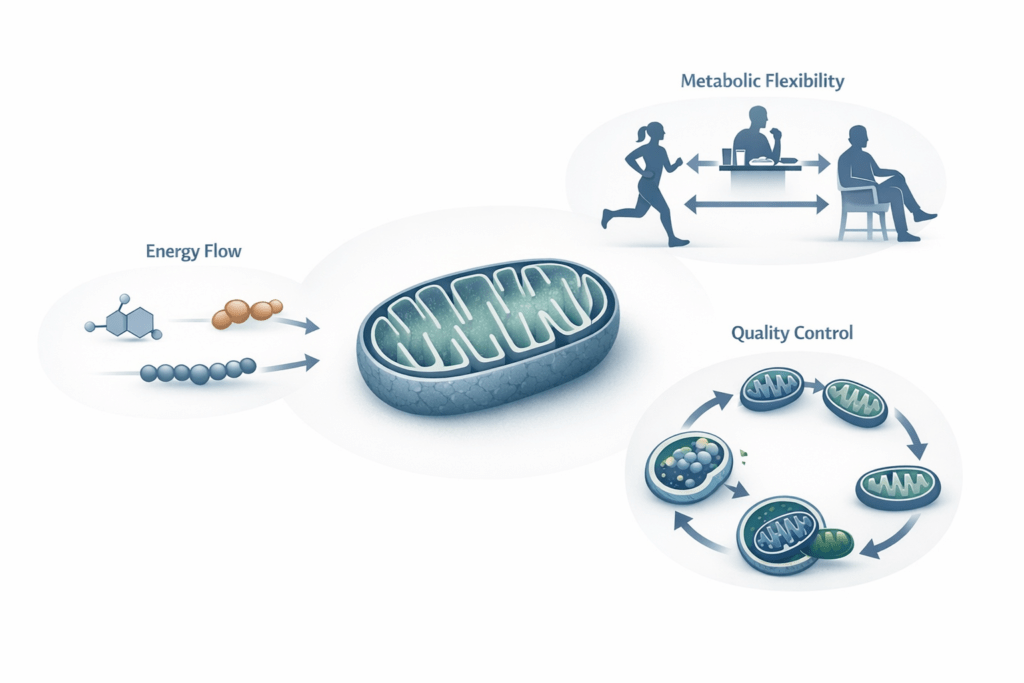
At the most basic level, mitochondria help convert nutrients into ATP, a usable energy currency. But real life isn’t a steady-state lab experiment. A healthy system needs mitochondria that can shift gears, supporting a hard workout, stabilizing blood sugar after a meal, or sustaining attention during a long day.
So mitochondrial function is less about having more energy and more about having energy availability and metabolic flexibility, the ability to meet demand without excessive strain.
Quality control: repair, recycling, and renewal
Mitochondria are dynamic: they fuse, divide, and are continually maintained through processes often grouped under mitochondrial quality control (MQC), including repair pathways and the recycling of damaged components (mitophagy). Reviews of mitochondrial biology in aging commonly emphasize that imbalances in these maintenance systems are linked with cellular aging processes. (ScienceDirect)
This is a key point is that mitochondrial health isn’t only about output. It’s also about maintenance capacity over time.
Why mitochondria are an emerging focus in healthy aging
Aging is not one simple mechanism. It’s a gradual shift in many systems, metabolism, inflammation, repair, and stress tolerance, shaped by genetics, environment, and cumulative exposures.
Mitochondria appear repeatedly in this conversation because they sit at a crossroads of energy production, oxidative balance, calcium handling, and cellular signaling. Reviews describing mitochondrial dysfunction in aging emphasize these broad roles and how mitochondrial changes can interact with other hallmarks of aging. (Frontiers)
It’s also why mitochondrial health has become a useful organizing concept for healthy aging:
- It helps unify why exercise, sleep, and nutrition matter biologically.
- It encourages a systems-level view (capacity and resilience), rather than chasing singular biomarkers.
- It supports a practical mindset: Focus on what reliably improves cellular function across many pathways, not just one.
What the research suggests can support mitochondrial function
If mitochondria sit at the center of adaptation, the key question becomes which signals support mitochondrial maintenance, turnover, and renewal. The most reliable levers come from foundational habits.

Movement and mitochondrial remodeling
Exercise is one of the most consistently studied stimuli for mitochondrial adaptation. A large body of research shows that physical activity can influence pathways involved in mitochondrial biogenesis (the process of building new mitochondrial components) and mitochondrial remodeling in skeletal muscle. (ScienceDirect)
You’ll often see PGC-1α discussed as a key signaling node associated with exercise-induced mitochondrial adaptations, although the biology is nuanced and not reducible to a single molecule. (PubMed) Regular movement appears to provide recurring “update signals” that help the system maintain capacity.
Conceptually, exercise works like a structured stressor. It creates a demand, then (with recovery) the body adapts. Over time, that can translate into improved ability to generate energy under load, one piece of what people mean by resilience.

Sleep as cellular recovery time
Sleep is not passive. It’s an active biological state tied to repair, metabolic regulation, and nervous system reset. Emerging research links sleep loss with changes in mitochondrial dynamics, redox balance, and oxidative stress, especially in energy-demanding tissues like the brain. (PMC)
The key message isn’t that one bad night will “break” your mitochondria. It’s that chronic sleep disruption may repeatedly push cells toward a more strained state, where repair and recovery processes don’t keep up as well.
If exercise is a stimulus for upgrading capacity, sleep is part of the part of the equation that allows those upgrades to get realized.
Nutrition patterns that reduce metabolic strain
Nutrition influences mitochondrial function partly by shaping the fuel environment cells live in all day. This involves glucose and fatty acid availability, insulin signaling, and oxidative balance. Researchers emphasize overall patterns that reduce repeated metabolic overload, steady protein intake, fiber-rich whole foods, and avoiding frequent large spikes in ultra-processed, high-sugar energy.
It’s not about creating dietary perfection. It’s about lowering cumulative strain so cellular maintenance systems can do their job.
Where targeted nutritional support may fit
The lifestyle foundations of, movement, sleep, nutrition, and stress recovery, do most of the heavy lifting. After those are in place, some people explore targeted nutritional support aimed at cellular energy pathways.
Mitozz is a nutraceutical developed by FMG Health Sciences containing 98% pure (-)-epicatechin, a compound that has been studied in relation to mitochondrial signaling and cellular function (an area of ongoing research). In the context of a strong foundation, targeted support is best viewed as complementary to the foundations, not a replacement.
If you are interested in exploring how supplementation can complement your lifestyle strategy, but you feel overwhelmed by all the noise in the supplement market, read our Mitochondrial Health Supplements Comparison for a clear, evidence-minded breakdown.
Conclusion
Doctors’ Day is ultimately about care, helping people live fuller lives with more capacity and less avoidable suffering. As the science of healthy aging evolves, mitochondrial health has emerged as a useful way to connect daily choices to the biology of resilience, especially as we age.
Mitochondria won’t solve health on their own. But as part of a systems-level picture, they help explain why the basics remain powerful:
- move consistently,
- protect sleep,
- eat in a way that reduces repeated metabolic strain,
- and respect recovery.
Suggested further reading: Mitozz: Wellness 1.1.
References
- Guo, Y., et al. (2023). Review on mitochondrial dysfunction and aging / mitochondrial homeostasis (MQC). (ScienceDirect)
- Xu, X., et al. (2025). Mitochondria in oxidative stress, inflammation and aging (review). (Nature)
- Somasundaram, I., et al. (2024). Mitochondrial dysfunction and its association with age-related changes (review). (Frontiers)
- Abrego-Guandique, D. M., et al. (2025). Systematic review/meta-analysis on physical activity and mitochondrial biogenesis pathways in skeletal muscle. (PubMed)
- Hood, D. A. (2007). Exercise-induced mitochondrial biogenesis in skeletal muscle (review). (ScienceDirect)
- Sarnataro, R., et al. (2025). Neurobiology of mitochondrial dynamics in sleep (review). (PMC)
- Sarnataro, R., et al. (2025). Mitochondrial origins of the pressure to sleep (Nature). (Nature)
- Hartmann, C. (2023). Mitochondrial control of sleep (overview/review). (ScienceDirect)
Share this blog article
Understanding mitochondrial health is a long-term process. That’s why we created the Mitozz Newsletter: a free way to keep learning about cellular energy, mitochondrial health, and the lifestyle signals that support your body over time. You’ll receive science-based educational content, practical guidance, and updates from Mitozz, all at your own pace.
Sign up for the Mitozz Newsletter
Get science-based education on mitochondrial health, cellular energy, and lifestyle signals that support your body over time.
Medical Disclaimer: The information provided in this article is for educational and informational purposes only and is not intended as medical advice. It is not a substitute for professional medical diagnosis, treatment, or guidance. Always consult with a qualified healthcare professional before making changes to your diet, exercise routine, fasting practices, or supplement use, especially if you have a medical condition, are pregnant or nursing, or are taking medications.
FDA Disclaimer: These statements have not been evaluated by the Food and Drug Administration. They are not not intended to diagnose, treat, cure, or prevent any disease.