Key Takeaways
- Signals for mitochondrial adaptation can rise within hours after exercise.
- Early measurable changes can appear within a couple of weeks.
- More durable changes in mitochondrial quantity and quality, accumulate over 6 to 12+ weeks of consistent effort.
- If training stops, some capacity can fade over weeks.
- Targeted mitochondrial support, with Mitozz may be worth considering.
“Mitochondrial health” has become one of the newer frontiers in health maintenance. You’ll see it in longevity conversations, performance coaching, recovery strategies, and everyday energy advice.
If you’re new to mitochondrial health, you might be wondering a very practical question:
How long does it take to improve my mitochondria?
In this article, we’ll define what improving mitochondria actually means, walk through a realistic timeline for improvement, and simple metrics you can use to track your progress.
What does “improving mitochondria” actually mean?
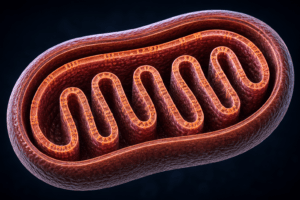
In plain terms, mitochondria help convert nutrients into usable cellular energy. They also act like signaling hubs that respond to stress, training, and nutrient availability. In skeletal muscle, better mitochondrial capacity means doing the same work but with less strain, and recovering better between efforts. (PMC)
But improving mitochondria isn’t about one simple measurement. Researchers may look at enzyme activity, mitochondrial respiration, mitochondrial volume density, or the proteins involved in remodeling and quality control, and those do not always change at the same speed. (MDPI)
A useful mindset is this. You are not trying to simply collect mitochondria. You are trying to build a system that can meet energy demand reliably, and keep its components in good working order.
Quantity vs quality, biogenesis vs mitophagy
A lot of confusion disappears when you understand the distinction between these two dimensions.
Quantity, sometimes called mitochondrial content, is the “how much machinery” side of the equation. In studies, this can show up as increases in mitochondrial proteins, oxidative phosphorylation proteins, citrate synthase activity, or mitochondrial volume density in muscle after training. (PMC)
Quality is the “how well the machinery works and is maintained” side. That includes respiration, the structure of the mitochondrial network, and the systems that repair, recycle, and replace damaged components. (Physiological Society)

Improvement comes from both biogenesis and mitophagy, building capacity and improving quality control.
Biogenesis is how we “add more machinery. Exercise can activate signaling and gene expression programs linked to mitochondrial biogenesis, with PGC-1α often discussed as a key regulator in that broader network. (Physiological Journals)
Mitophagy is the “machinery” cleanup and turned over. It is a selective form of autophagy that helps remove damaged mitochondria, supporting mitochondrial quality control and long-term efficiency. Exercise influences mitophagy-related processes, although the details depend on intensity, tissue, age, and how it is measured. (Exercise and Sport Sciences Reviews)
The timeline from hours to 12 weeks and beyond
Below is a realistic way to think about how fast mitochondrial improvement shows up, with the understanding that everyone is different and results can vary individual to individual.
Within hours: signals turn on
A single bout of exercise can increase expression of genes involved in mitochondrial remodeling in human skeletal muscle. Some studies show nuclear PGC-1α changes and mitochondrial gene expression rising within a few hours into recovery. (Physiological Journals)
This is the early “I need to adapt” message your body is giving. It does not mean you have already built more mitochondria, it is the start of the process.
What this can feel like is subtle. You might sleep a little better, feel a slight shift in mood, or simply feel that movement is less intimidating the next day. Those experiences are not proof of mitochondrial remodeling by themselves but they can help you stay consistent long enough for the deeper changes to take place.
Around 2 weeks: early measurable changes can appear
In research, short training blocks can produce measurable improvements in mitochondrial-related markers, especially in people starting from lower baseline fitness. For example, interval training studies have reported changes in muscle oxidative capacity markers over roughly two weeks of repeated sessions. (Physiological Journals)
This does not mean everyone should expect dramatic changes in 14 days. It means the system can move faster than most people assume when the stimulus is repeated and recoverable.
In real life, this is often when you notice early “proof.” Your breathing settles quicker, you recover faster between intervals, and the same workout feels slightly less taxing.
Around 6 weeks: remodeling becomes more dependable
By the 4 to 8 week range, training studies often show clearer shifts in mitochondrial content and function, and sometimes visible remodeling of the mitochondrial network in muscle. (Frontiers)
This is also where the quantity and quality idea becomes practical. Some of what improves is capacity, and some is coordination, meaning there is a better distribution and control of energy production inside the muscle fiber.
If you have ever had the experience of “suddenly feeling fitter,” it is often the compound interest of small adaptations finally adding up.
Around 12 weeks and beyond: durable capacity is built
Over a few months, many people are at point where they have built a more durable base. Studies of training and deconditioning describe how mitochondrial content and enzyme activity can increase with training, and also how these gains can regress if you stop training. (MDPI)
This is where the some of the other fundamentals become powerful. Training provides the signal. Sleep, fueling, and stress load influence whether your body can actually rebuild after training.
It is also where a “minimum effective dose” mindset matters. You do not have to train like an athlete to maintain the mitochondrial health you’ve worked so hard to build but you do need enough repetition to keep the remodeling process active.
Why your timeline may look different
The same plan performed by two different people can produce different timelines because the starting point and the context matter.
Your starting point matters. If you’ve been mostly sedentary, even a modest, consistent program can produce noticeable changes within a few weeks. If you already train regularly, improvements often come from more precise tweaks, like slightly more weekly volume, strategically placed intensity, or better recovery, rather than simply doing more.
Training dose matters but so does recoverability. More intensity won’t produce faster results if it disrupts sleep, appetite, or consistency.
Age also matters, although it does not mean adaptation is off the table. Reviews on exercise and mitochondrial function across age groups suggest older adults can still improve mitochondrial-related capacity but the size and speed can vary. (MDPI)
Lastly, your life outside the gym also matters. Poor sleep, chronic stress or not eating enough can blunt the adaptations your training is trying to build. So it helps to keep them in check, not perfectly, but consistently enough that your body can recover and actually build what you’re training for.
How you can track results without lab tests
In clinical and research settings, mitochondrial health is typically assessed with specialized tests like high-resolution respirometry, enzyme activity assays, or occasionally muscle biopsy-based analyses.
These tests are expensive, time-consuming, and usually limited to specialized clinics or research labs, so most people will never use them and that’s OK. Instead, you can track the everyday outputs mitochondria contribute to, like stamina, recovery, and energy stability.
Here are practical markers that move when mitochondrial capacity and aerobic fitness improve.
- Higher pace or power but at the same heart rate
- How long recovery takes between hard efforts
- How quickly your breathing settles after a hill or interval
- Repeatability, meaning how many good-quality sets or intervals you can do before form and pace collapse
- Energy stability across the day, assuming sleep and fueling are steady
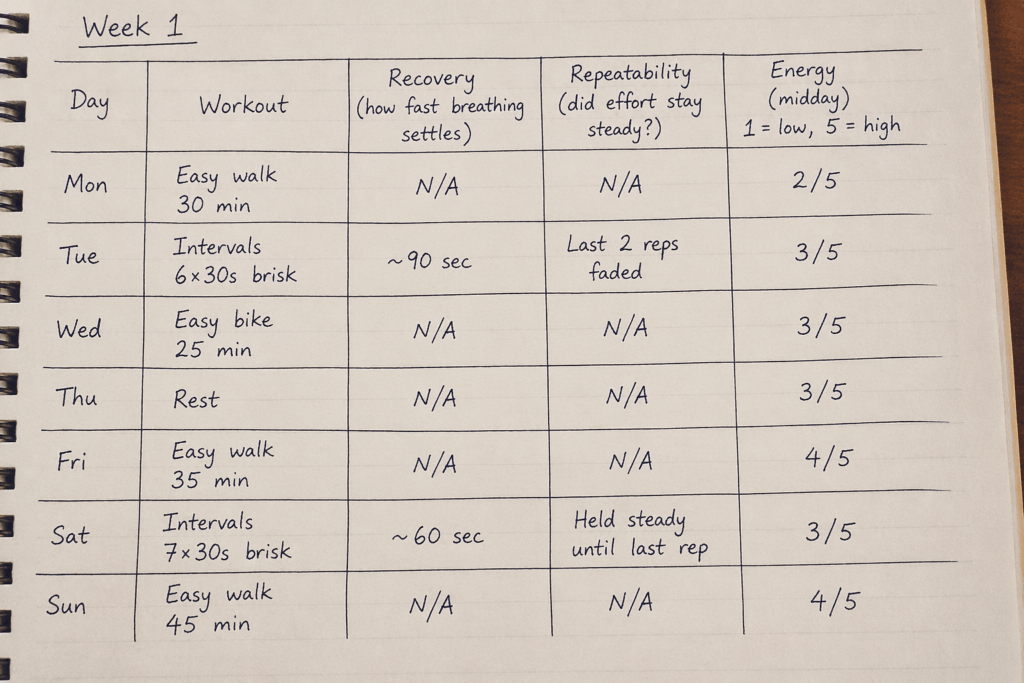
These are not mitochondria-only metrics. But they are what most people want from mitochondrial improvement anyway, better capacity, better recovery, and fewer moments where normal life feels like a heavy lift.
How to make your gains stick
Mitochondrial proteins turn over relatively quickly compared to many other tissues, which is one reason detraining can lead to measurable declines in mitochondrial function and capacity over weeks. (Frontiers)
That is not a reason to worry. It is a reason to aim for consistency over perfection.
A practical approach is to protect a baseline of movement even during busy seasons. Walking, cycling, or easy zone 2 style work can keep the signal alive, while one or two higher-intensity sessions per week can be added when recovery is strong.
The goal is not maximal stress. The goal is a repeatable pattern that your biology can adapt to.
Where targeted nutritional support may fit
Once lifestyle foundations are in place, you may consider targeted nutritional support as a complement.
FMG Health Sciences developed Mitozz, a nutraceutical containing 98% pure (-)-epicatechin, a compound that has been studied in relation to muscle physiology and mitochondrial-related signaling in various contexts. Needs citation for any specific human outcome claims tied directly to (-)-epicatechin and mitochondrial endpoints.
A grounded way to frame this is simple. Supplements should not be the engine. If they are used, they should be considered an add-on to training, sleep, nutrition, and recovery, which remain the main levers for mitochondrial adaptation.
Conclusion
If you are new to mitochondrial health, the timeline is simpler than the internet makes it.
Signals for adaptation can rise within hours after exercise. (Physiological Journals)
Early measurable changes can appear within a couple of weeks in some training contexts, especially for beginners. (Physiological Journals)
More durable changes in quantity and quality, including network remodeling, often accumulate over 6 to 12+ weeks of consistency. (Frontiers)
If training stops completely, some capacity can fade over weeks, which is why a minimum effective dose can be so valuable. (MDPI)
The most reliable plan is still the least glamorous one. Give your body a reason to adapt, give it enough recovery to rebuild, and keep the pattern going long enough for the slow biology to catch up.
If you want to go deeper, explore more FMG Health Sciences articles on mitochondrial science, training, recovery, and healthy aging, and if you are curious about adjunctive support, you can explore where Mitozz might fit within that bigger foundation-first approach.
Share this blog article
References
- Safdar, A., et al. (2011). Exercise increases mitochondrial PGC-1α content and promotes nuclear-mitochondrial cross-talk in human skeletal muscle. (PMC)
- Little, J. P., et al. (2011). Acute high-intensity interval training and early recovery changes in nuclear PGC-1α and mitochondrial gene expression in human skeletal muscle. (Physiological Journals)
- Wright, D. C., et al. (2007). Exercise-induced mitochondrial biogenesis begins before the increase in muscle PGC-1α expression. (ScienceDirect)
- Kuznyetsova, A., et al. Mitophagy in skeletal muscle, impact of ageing and exercise (review). (Physiological Society)
- Guan, Y., et al. (2019). Exercise-induced mitophagy in skeletal muscle and heart (review). (PubMed)
- Roberts, F. L., et al. (2021). Review focusing on mitochondrial biogenesis and exercise-related quality control pathways. (MDPI)
- Fritzen, A. M., et al. (2020). Aerobic exercise training and deconditioning effects on mitochondrial content and enzyme activity (review). (MDPI)
- Girardi, M., et al. (2020). Detraining effects and physiological declines, including mitochondrial considerations (review). (Frontiers)
- Li, Y., et al. (2025). Six weeks of HIIT vs moderate training, changes in mitochondrial volume density and remodeling (human study). (PMC)
Understanding mitochondrial health is a long-term process. That’s why we created the Mitozz Newsletter: a free way to keep learning about cellular energy, mitochondrial health, and the lifestyle signals that support your body over time. You’ll receive science-based educational content, practical guidance, and updates from Mitozz, all at your own pace.
Sign up for the Mitozz Newsletter
Get science-based education on mitochondrial health, cellular energy, and lifestyle signals that support your body over time.
Medical Disclaimer: The information provided in this article is for educational and informational purposes only and is not intended as medical advice. It is not a substitute for professional medical diagnosis, treatment, or guidance. Always consult with a qualified healthcare professional before making changes to your diet, exercise routine, fasting practices, or supplement use, especially if you have a medical condition, are pregnant or nursing, or are taking medications.
FDA Disclaimer: These statements have not been evaluated by the Food and Drug Administration. They are not not intended to diagnose, treat, cure, or prevent any disease.