Key Takeaways
- Fatty liver (MASLD) is often best understood as a chronic fuel overflow problem, tightly linked to insulin resistance and cardiometabolic context.
- Mitochondria matter because they regulate fat oxidation, redox balance, and stress signaling, systems that influence whether the liver adapts or becomes inflamed over time.
- The most evidence-supported ways to improve liver fat and metabolic resilience are still foundational: appropriate weight loss, exercise, and Mediterranean-style dietary patterns, plus sleep and recovery.
- Compounds like (-)-epicatechin are being studied for mitochondrial signaling, but evidence for direct MASLD outcomes is still evolving, so it belongs in the “supportive, complementary” category.
MASLD, NAFLD, MASH: What These Terms Mean
Fatty liver used to be discussed mostly as NAFLD (non-alcoholic fatty liver disease). More recently, many guidelines and scientific groups have shifted toward MASLD, metabolic dysfunction–associated steatotic liver disease, to better reflect what’s typically driving the condition: cardiometabolic risk factors like insulin resistance, excess adiposity, dyslipidemia, and hypertension. (Springer)
Within that spectrum, MASH (metabolic dysfunction–associated steatohepatitis) describes a more inflammatory form (historically called NASH), which can raise the risk of fibrosis over time. Importantly, not everyone with liver fat progresses to MASH or advanced fibrosis, progression depends on genetics, overall metabolic context, diet and activity patterns, sleep, alcohol exposure, and more. (ScienceDirect)
Why the Liver Is a Mitochondrial Powerhouse
Your liver is one of the most metabolically active organs in the body. It’s constantly:
- receiving incoming fuels from meals (glucose, fatty acids, amino acids),
- converting fuels into usable energy,
- packaging and exporting lipids,
- regulating blood sugar between meals,
- and processing metabolic byproducts.
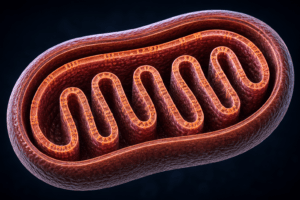
To do all that, liver cells, called hepatocytes, rely heavily on mitochondria, the organelles that coordinate energy production, fuel oxidation, redox balance, and metabolic signaling. When mitochondria are working well, they help the liver stay flexible: storing fuel when needed, burning it when demand rises, and keeping oxidative byproducts in check. (Journal of Hepatology)
The “Energy Overflow” Model of Fatty Liver
A helpful way to think of fatty liver is in terms of energy traffic.
When energy intake repeatedly exceeds energy use, the body has to put the surplus somewhere. Some of it is stored in adipose tissue, a relatively safe buffer when functioning well but when that buffer becomes overfilled or metabolically dysregulated, often alongside insulin resistance, more fatty acids circulate to the liver.
At the same time, insulin resistance tends to disrupt normal metabolic signaling. The liver may:
- keep producing glucose even when it’s not needed,
- ramp up de novo lipogenesis (turning carbohydrate into fat),
- receive more fatty acids from adipose tissue,
- and struggle to export all incoming fat efficiently.
The result can be hepatic triglyceride accumulation, what we see as “fatty liver.” This fat buildup can be partly protective at first (a way to package fatty acids into a less reactive form). The bigger issue is what happens when the system stays overloaded. Fat intermediates and oxidative stress signals can increase, especially in susceptible individuals. (PMC)
What Happens to Mitochondria in MASLD
Mitochondria are often described as “dysfunctional” in MASLD but it’s more accurate to say they are frequently overworked and stress-adapted.
Research syntheses describe several recurring patterns:
1) Increased fuel pressure on fat oxidation
With higher fatty-acid delivery to the liver, mitochondria are pushed to oxidize more fat. In early stages, this can look like compensation: higher oxidation capacity to handle excess. But persistent overload can strain the respiratory chain and increase reactive oxygen species (ROS) generation. (Journal of Hepatology)
2) Redox imbalance and oxidative byproducts
When electron flow through the respiratory chain is stressed, ROS generation can rise. ROS are not inherently “bad”, they’re normal signals in biology, but chronic excess can contribute to lipid peroxidation and cellular stress responses. Reviews in fatty liver diseases highlight oxidative stress as a key contributor to progression risk. (Journal of Hepatology)
3) Mitochondrial quality control gets challenged
Healthy mitochondrial networks rely on constant maintenance: fusion/fission dynamics, antioxidant defenses, and mitophagy (selective removal of damaged mitochondria). Under chronic metabolic stress, these quality-control systems can become impaired or insufficient, meaning damaged mitochondria persist and amplify stress signals. (Frontiers)
4) Metabolic inflexibility
A resilient liver shifts between fuel sources and storage/export pathways smoothly. In MASLD, the liver can become less flexible, less able to match fuel handling to real energy demand, creating a “stuck in overflow mode” problem. This is one reason MASLD is strongly tied to whole-body metabolic health, not just the liver in isolation. (ScienceDirect)
Why Mitochondrial Stress Can Escalate Fatty Liver Risk
Fatty liver is common, and many people remain stable. Progression risk tends to rise when steatosis intersects with:
- insulin resistance and chronic hyperinsulinemia,
- inflammatory signaling,
- oxidative stress and lipid peroxidation,
- and fibrotic remodeling.
Mitochondria influence several of these nodes, especially oxidative balance and stress signaling, so mitochondrial strain can be one pathway that helps explain why “fat in the liver” sometimes becomes “fat plus inflammation plus scarring.” The key word is sometimes: the presence of mitochondrial stress markers does not guarantee progression, and the strongest clinical levers still revolve around changing the upstream metabolic context. (Journal of Hepatology)
Practical Ways to Support Liver Mitochondria
If mitochondria help determine whether the liver adapts smoothly or struggles under overload, then the most practical question becomes: what supports mitochondrial capacity in real life?
1) Weight loss
In people with excess adiposity, modest weight loss can reduce liver fat, and larger losses are often associated with improved inflammatory features and fibrosis risk markers. One major practice guidance notes that roughly 3 – 5% weight loss can improve steatosis, while 10% is often associated with improvements in steatohepatitis and fibrosis (though achieving and sustaining that can be challenging). (PMC)
Why this matters for mitochondria: Reducing fuel overflow lowers the constant pressure on hepatic fat oxidation and redox systems.
2) Exercise: both aerobic and resistance training count
Exercise improves liver outcomes even when weight loss is modest. Meta-analyses generally find that structured exercise can reduce intrahepatic lipid and improve liver enzymes in many people with NAFLD/MASLD. (ScienceDirect)
Why this matters for mitochondria: Training increases whole-body fuel demand, improves insulin sensitivity, and supports mitochondrial biogenesis and efficiency, reducing the mismatch between incoming fuel and actual energy use.
3) A Mediterranean-style dietary pattern
A Mediterranean-style diet (and calorie restriction when appropriate) has evidence for improving liver fat and cardiometabolic risk factors in NAFLD, with good acceptability in many studies. (PubMed)
Why this matters for mitochondria: This diet works because it reduces highly processed energy overload while improving fatty-acid quality, fiber intake, and post-meal metabolic signaling.
4) Sleep and recovery as metabolic inputs
Sleep isn’t just “rest”, it’s metabolic regulation time. Emerging evidence links sleep patterns (including short sleep and sleep disorders) with fatty liver risk, although mechanisms and causality can vary across studies. (ScienceDirect)
Why this matters for mitochondria: Circadian disruption can alter substrate handling, oxidative balance, and insulin sensitivity, variables that shape mitochondrial workload.
5) Reduce compounding stressors (including alcohol context)
Even moderate alcohol intake can complicate liver stress in some individuals, especially when metabolic risk is already present. MASLD definitions explicitly consider alcohol intake when classifying steatotic liver disease categories. (diabetologia-journal.org)
Conclusion
Fatty liver is not just about fat, it reflects how the liver handles energy over time. When mitochondria are under strain, that system starts to break down. When they are supported, the liver is better able to process, adapt, and recover.
There is no single switch that fixes this. But understanding the role of mitochondrial function helps explain why consistent habits, and in some cases targeted support, can matter over the long term.
Where Mitozz Fits In
At Mitozz, we focus on mitochondrial health as one part of long-term metabolic resilience. Lifestyle foundations such as movement, nutrition quality, sleep, and stress management should remain central.
That said, scientific interest is growing around bioactive compounds that may influence mitochondrial signaling and adaptive capacity. (-)-Epicatechin, a flavanol found in cacao and other plants, has been studied in relation to mitochondrial biogenesis and antioxidant signaling in preclinical models, as well as in small human studies looking at muscle physiology and mitochondrial markers, though not specifically MASLD outcomes. (ScienceDirect)
Mitozz is a nutraceutical developed by FMG Health Sciences, formulated with 98% pure (-)-epicatechin. We designed to fit within a broader mitochondrial health strategy, whether you are just at the beginning of that process or looking to build further on the habits that support long-term metabolic resilience.
Share this blog article
References
- European Association for the Study of the Liver (EASL), European Association for the Study of Diabetes (EASD), & European Association for the Study of Obesity (EASO). (2024). EASL–EASD–EASO Clinical Practice Guidelines on the management of metabolic dysfunction-associated steatotic liver disease (MASLD). Journal of Hepatology. (ScienceDirect)
- Rinella, M. E., et al. (2023). AASLD Practice Guidance on the clinical assessment and management of NAFLD/MASLD. Hepatology. (PMC)
- Fromenty, B. (2023). Mitochondrial alterations in fatty liver diseases. Journal of Hepatology. (Journal of Hepatology)
- Deng, Y., et al. (2024). Targeting mitochondrial homeostasis in the treatment of NAFLD (review). Frontiers in Pharmacology. (Frontiers)
- Haigh, L., et al. (2022). The effectiveness and acceptability of Mediterranean diet and calorie restriction in NAFLD: A systematic review and meta-analysis. Clinical Nutrition. (PubMed)
- Nam, H., et al. (2023). Effect of exercise-based interventions in NAFLD: Meta-analysis. (ScienceDirect)
- McDonald, C. M., et al. (2020/2021). (−)-Epicatechin induces mitochondrial biogenesis and markers of muscle regeneration (human study). (PMC)
- Moreno-Ulloa, A., et al. (2018). (−)-Epicatechin stimulates mitochondrial biogenesis (preclinical/mechanistic). (ScienceDirect)
Understanding mitochondrial health is a long-term process. That’s why we created the Mitozz Newsletter: a free way to keep learning about cellular energy, mitochondrial health, and the lifestyle signals that support your body over time. You’ll receive science-based educational content, practical guidance, and updates from Mitozz, all at your own pace.
Sign up for the Mitozz Newsletter
Get science-based education on mitochondrial health, cellular energy, and lifestyle signals that support your body over time.
Medical Disclaimer: The information provided in this article is for educational and informational purposes only and is not intended as medical advice. It is not a substitute for professional medical diagnosis, treatment, or guidance. Always consult with a qualified healthcare professional before making changes to your diet, exercise routine, fasting practices, or supplement use, especially if you have a medical condition, are pregnant or nursing, or are taking medications.
FDA Disclaimer: These statements have not been evaluated by the Food and Drug Administration. They are not not intended to diagnose, treat, cure, or prevent any disease.