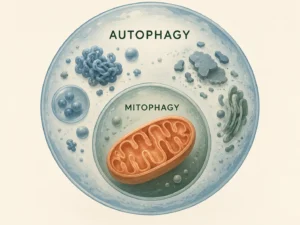
Most people who know anything about mitochondria know them as the parts of our cells that help produce energy.
That makes it easy to assume that when muscle function declines with age, mitochondria must simply be making less energy.
But research suggests the story is more complicated.
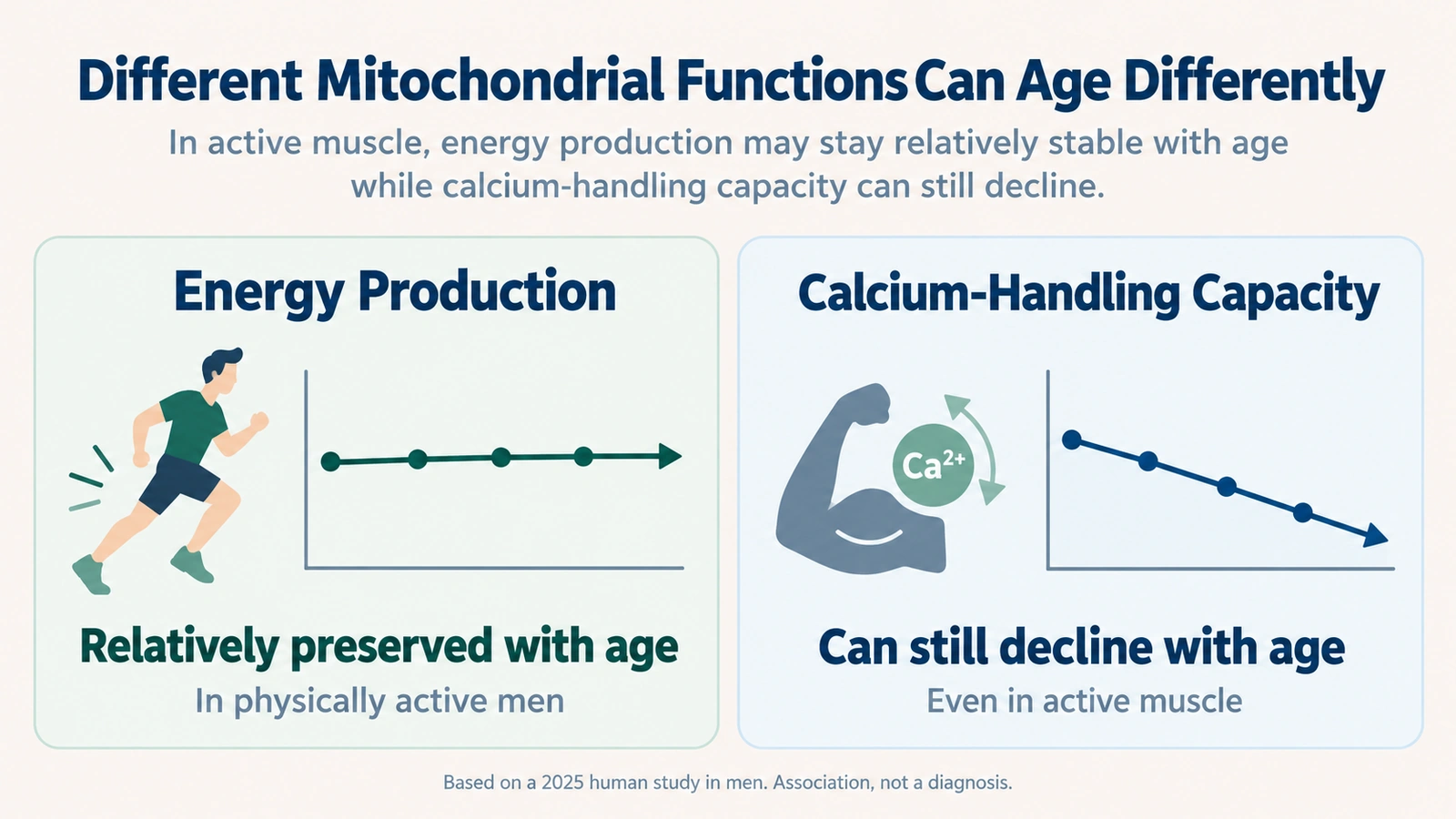
In people who remain physically active, mitochondrial energy production can stay relatively well preserved with age. At the same time, other parts of mitochondrial function may become less resilient.
So aging muscle is not only an energy problem.
It can also be a maintenance problem.
Energy Production Can Hold Up Surprisingly Well
A 2025 study examined skeletal muscle in 139 men between the ages of 20 and 93, 51 were classified as inactive and 88 as physically active..
Researchers measured physical performance along with several aspects of mitochondrial function. Among the active men, mitochondrial energy production remained relatively stable across age, even though strength, power, muscle mass, and other aspects of physical performance still changed.
That finding suggests that muscle aging cannot be explained simply as a loss of mitochondrial energy production.
The more interesting result was that another mitochondrial function did decline with age.
Muscle Depends on More Than Energy
Every muscle contraction depends on calcium.
When a muscle receives a signal to contract, calcium is released inside the muscle cell. Once the contraction ends, that calcium has to be brought back under control so the muscle can relax and prepare for the next contraction.
Most of this work is handled by a specialized calcium-storage system inside muscle cells, but mitochondria are involved too.
They respond to calcium and can temporarily take some of it up. This helps connect muscle activity with energy production and other cellular signals.
Because of this, researchers can test how well mitochondria cope with increasing calcium stress.
In the 2025 study, they measured how much calcium the mitochondria could handle before they lost control of their internal environment.
This is called mitochondrial calcium retention capacity.
The term sounds technical, but the basic question is simple: How much calcium stress can the mitochondria tolerate before the system begins to fail?
That capacity declined with age in both active AND inactive men.
The researchers also found that lower calcium retention capacity was associated with lower thigh muscle mass, weaker leg strength, and poorer performance on walking and step tests.
That does not prove that declining calcium handling causes age-related muscle loss, however. Muscle aging involves many processes, including changes in muscle fibers, nerve function, protein turnover, nutrition, physical activity, and recovery.
But the finding does show that one part of mitochondrial function can remain relatively strong while another becomes less resilient.
Output Is Not the Same as Capacity
This is where the distinction becomes useful.
A system can continue producing what is needed under normal conditions while gradually losing some of its reserve. Think of a machine that still performs its usual job but becomes less tolerant of heat, heavy loads, or repeated stress.
If you measured only its output, you might conclude that nothing had changed. But its operating margin would be smaller.
Muscle may age in a similar way.
A person may still walk, train, climb stairs, or perform demanding work effectively. Yet some of the cellular systems that help muscle cope with repeated demand may be becoming less robust.
That is why mitochondrial health cannot be judged only by how much energy mitochondria produce.
It also depends on how well the system maintains itself.

Mitochondria Need Ongoing Maintenance
Mitochondria are not permanent structures that simply sit inside cells and make energy.
They are continually being maintained.
Cells monitor them for damage and stress. Worn components can be removed. New mitochondrial material can be produced. Proteins and membranes have to remain functional.
Together, these processes form part of what is called mitochondrial quality control.
The basic idea is straightforward: The cell must keep the mitochondrial network useful, not merely keep mitochondria present.
This is important because a cell can contain plenty of mitochondria and still have a poorly maintained network.
More mitochondria do not automatically mean better-functioning mitochondria.
Quantity and quality are different things.
What Exercise Protects, and What It May Not
Physical activity remains one of the strongest tools we have for preserving muscle function with age. In the 2025 study, the active participants generally performed better and showed stronger mitochondrial energy-producing capacity than the inactive participants.
Regular movement gives muscle a reason to maintain the machinery needed to meet demand. We look more closely at the relationship between Mitozz, muscle recovery, and strength in Mitozz, Muscle Recovery & Strength.
Even among the active men, mitochondrial calcium retention capacity declined with age.
That does not mean exercise failed. It means that different parts of the system may respond differently to aging.
Some functions can remain remarkably resilient. Others may become more vulnerable.
There is also an important limitation to the study: it included men only. We should not assume that every pattern will be identical in women until comparable research is available.
Maintenance Matters Even When Muscle Mass Looks Good
A 2026 mouse study adds another piece to this picture. Researchers studied a protein called ATF5, which helps cells respond when mitochondria are under stress.
Older mice without ATF5 retained more muscle mass than older normal mice.
At first glance, that sounds positive but when their muscles were repeatedly stimulated to contract, those mice fatigued more quickly.
The researchers also found changes in mitochondrial stress responses and protein maintenance. So preserving more muscle mass did not necessarily mean preserving better muscle performance.
This was a mouse study using a genetic model, so it does not tell us how changing ATF5 would affect people.
But it supports a broader idea:
Muscle quantity and muscle capacity are not always the same thing.
How well the underlying machinery is maintained matters too.
What This Means in Everyday Life
For most people, the practical message remains simple.
Movement comes first.
Regular physical activity helps preserve strength, physical performance, and mitochondrial energy capacity.
But training is only one part of the cycle.
The body also needs enough recovery to respond to that training.
Sleep matters.
Nutrition matters.
Periods of recovery matter.
The goal is not simply to create more demand. It is to maintain the ability to respond, recover, and perform again.
That is why it is useful to think about mitochondrial health as a cycle of use and maintenance rather than as a single number to maximize.
For more on this relationship between demand and recovery, see How Your Body Recovers After Physical and Mental Stress.
Where Mitozz Fits
This broader view of mitochondrial health is where Mitozz fits.
Mitozz contains high-purity (−)-epicatechin, a compound studied for its effects on mitochondrial signaling, structure, and pathways involved in maintaining mitochondrial function.
That makes it relevant to a bigger goal than simply producing more energy: supporting the systems that help mitochondria stay functional under repeated demand.
Movement, sleep, nutrition, and recovery remain the foundation. Mitozz is designed to complement that foundation as part of a broader strategy for maintaining mitochondrial and physical capacity over time.
A Better Way to Think About Aging Muscle
The simplest view of muscle aging says that mitochondria get older, make less energy, and muscles become weaker.
The biology appears to be more complicated.
In physically active people, mitochondrial energy production can remain relatively well preserved across adulthood.
At the same time, other functions can become less resilient.
Calcium handling can change.
Stress responses can change.
The systems that maintain mitochondrial proteins and membranes can change.
So the better question is not only:
How much energy can mitochondria make?
It is also:
How well can the mitochondrial network keep working under repeated demand?
Energy production matters.
Maintenance matters too.
To learn more about how cells identify mitochondrial stress, remove damaged components, rebuild capacity, and maintain the network over time, download Mitochondrial Quality Control from the Mitozz Download Center.
Share this blog article
References
Cefis M, Marcangeli V, Hammad R, et al. Impact of physical activity on physical function, mitochondrial energetics, ROS production, and Ca²⁺ handling across the adult lifespan in men. Cell Reports Medicine. 2025;6(2):101968.
Sanfrancesco VC, Hood DA. ATF5 is required for the maintenance of mitochondrial homeostasis and skeletal muscle health during aging. Aging. 2026;18:213–233.
Understanding mitochondrial health is a long-term process. That’s why we created the Mitozz Newsletter: a free way to keep learning about cellular energy, mitochondrial health, and the lifestyle signals that support your body over time. You’ll receive science-based educational content, practical guidance, and updates from Mitozz, all at your own pace.
Sign up for the Mitozz Newsletter
Get science-based education on mitochondrial health, cellular energy, and lifestyle signals that support your body over time.
Medical Disclaimer: The information provided in this article is for educational and informational purposes only and is not intended as medical advice. It is not a substitute for professional medical diagnosis, treatment, or guidance. Always consult with a qualified healthcare professional before making changes to your diet, exercise routine, fasting practices, or supplement use, especially if you have a medical condition, are pregnant or nursing, or are taking medications.
FDA Disclaimer: These statements have not been evaluated by the Food and Drug Administration. They are not not intended to diagnose, treat, cure, or prevent any disease.