Points clés à retenir
- NAD+ is essential for energy metabolism, but having more NAD+ does not automatically mean mitochondria can produce more energy.
- Mitochondrial capacity also depends on biogenesis, quality control, membrane structure, and coordinated redox signaling.
- Age-related changes in NAD+ appear to differ by tissue, so a blood NAD+ measurement should not be treated as a direct measure of mitochondrial health.
- Human studies show that NAD precursors can raise NAD-related metabolites, but changes in mitochondrial function do not necessarily follow.
- A better approach to mitochondrial health is to support the whole adaptive system rather than focusing on a single molecule.
NAD+ has become one of the most discussed molecules in longevity and biohacking. Supplements containing precursors such as nicotinamide mononucleotide (NMN) and nicotinamide riboside (NR) are often discussed with the idea that if you raise NAD+, you can improve cellular energy, and therefore improve mitochondrial function.
There is real biology behind the interest in NAD+. It is essential to cellular metabolism and closely connected with mitochondrial function.
The part that deserves more attention is what comes after that.
NAD and mitochondrial capacity are closely related, but they are not the same thing. A cell can have the molecular resources needed for energy metabolism without necessarily having a larger, healthier, or more adaptable mitochondrial network.
Understanding that distinction gives us a more useful way to think about mitochondrial health.
What NAD+ actually does in cellular energy metabolism
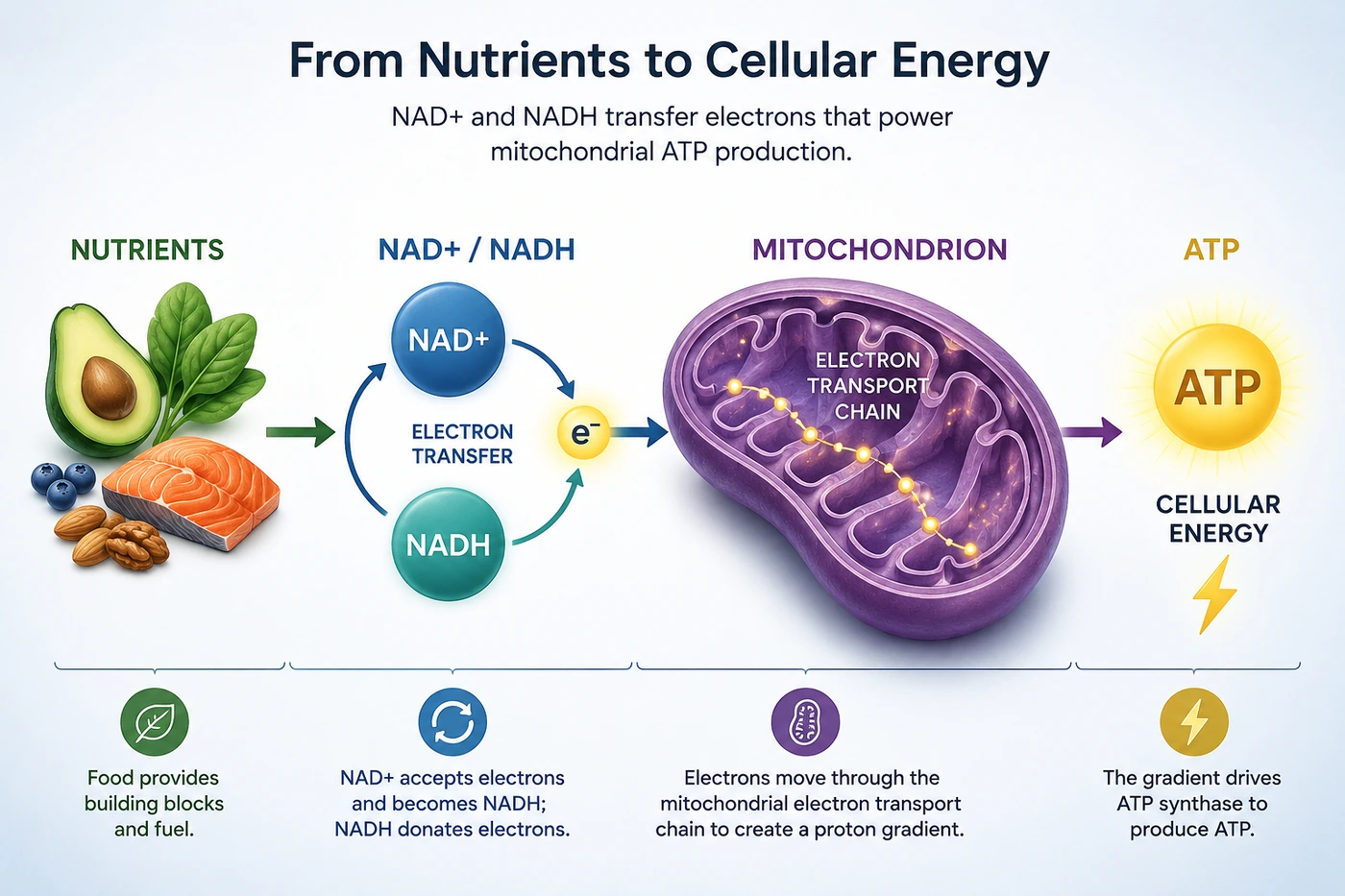
NAD stands for nicotinamide adenine dinucleotide. It exists in different forms, including oxidized NAD+ and reduced NADH, and continually moves between them as cells process nutrients.
One of its main jobs is carrying electrons.
As carbohydrates, fats, and other fuels are broken down, NAD+ accepts electrons and becomes NADH. NADH can then deliver those electrons to the mitochondrial respiratory system, where their energy contributes to the process that ultimately produces ATP, the usable energy currency of the cell.
NAD+ also acts as a substrate for enzymes involved in cellular regulation, including sirtuins and PARPs. These enzymes connect NAD availability with processes such as metabolic regulation, DNA repair, stress responses, and mitochondrial signaling.
So NAD+ is not a minor player. If NAD availability becomes limiting, important metabolic and signaling reactions can be affected.
But that still does not make NAD+ a measure of mitochondrial capacity.
A useful analogy is to think of NAD+ as part of the electrical and logistical system of a factory. The factory cannot operate properly without it. But supplying more wiring or transport capacity does not automatically build more machinery, replace damaged equipment, reorganize the production floor, or increase the factory’s maximum output.
Those require other processes.
Does NAD+ really decline as we age?
The common statement that “NAD declines with age” needs some qualification.
There is evidence for lower NAD+ abundance in some human tissues. A 2022 study of human skeletal muscle found lower NAD+ in older adults, with the lowest levels in physically impaired older participants. Exercise-trained older adults had muscle NAD+ abundance closer to that found in younger adults. NAD+ abundance was also associated with physical activity, mitochondrial function, and muscle function in that study.
However, that does not mean NAD+ declines uniformly throughout the body.
In May 2026, researchers reporting in Nature Metabolism measured whole-blood NAD+ across seven independent human cohorts. They found that whole-blood NAD+ remained remarkably stable across age and lifestyle interventions, while responding to NR supplementation. The authors concluded that whole-blood NAD+ may not be a useful biomarker of aging.
This distinction matters because NAD metabolism is compartmentalized.
NAD+ in blood is not necessarily telling us what is happening inside skeletal muscle mitochondria, brain cells, or another tissue. Likewise, raising a circulating NAD marker does not by itself tell us whether a tissue has increased its ability to generate ATP under demand.
Cellular stress adds another layer.
NAD+ is consumed by enzymes involved in processes such as DNA repair and cellular signaling. When those pathways are highly active, NAD demand can change. NAD status therefore reflects a balance between synthesis, recycling, compartmentalization, and consumption rather than a single universal “NAD level.”
Mitochondrial capacity requires more than NAD+
If NAD+ is one necessary component, what actually determines mitochondrial capacity?
At a practical level, mitochondrial capacity describes how well a tissue’s mitochondrial network can meet energy demand and adapt when that demand changes.
Several systems have to work together.
1. Biogenesis builds additional capacity
Mitochondrial biogenesis is the coordinated process through which cells expand their mitochondrial machinery.
This is not simply making more copies of mitochondria. Cells have to coordinate nuclear and mitochondrial genes, produce respiratory proteins, build membranes, assemble enzyme systems, and integrate the new components into an existing mitochondrial network.
Exercise provides one of the clearest examples. Human skeletal muscle responds to repeated training with changes in proteins and signaling pathways associated with mitochondrial biogenesis, along with changes in mitochondrial content and respiratory function. Different types and intensities of exercise can produce different adaptations.
NAD-dependent signaling can participate in this process, but having more NAD+ does not itself prove that biogenesis has occurred.
2. Mitophagy helps remove what is no longer working well
Building new mitochondrial components is only half of maintenance.
Cells also need ways to identify and remove mitochondria, or portions of the mitochondrial network, that have become damaged or dysfunctional.
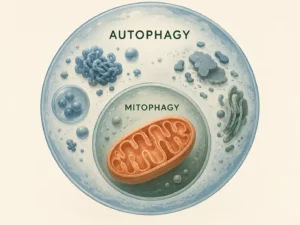
Selective mitochondrial recycling is known as mitophagy.
Human exercise research shows that physical activity can influence mitochondrial quality-control pathways, including signaling associated with autophagy, fission, and mitophagy. Recent work using human muscle biopsies has also provided direct evidence that resistance exercise can initiate mitophagy-related remodeling.
This creates an important balance:
Biogenesis adds capacity. Mitophagy helps preserve its quality.
Increasing one metabolic molecule does not automatically coordinate both sides of that equation.
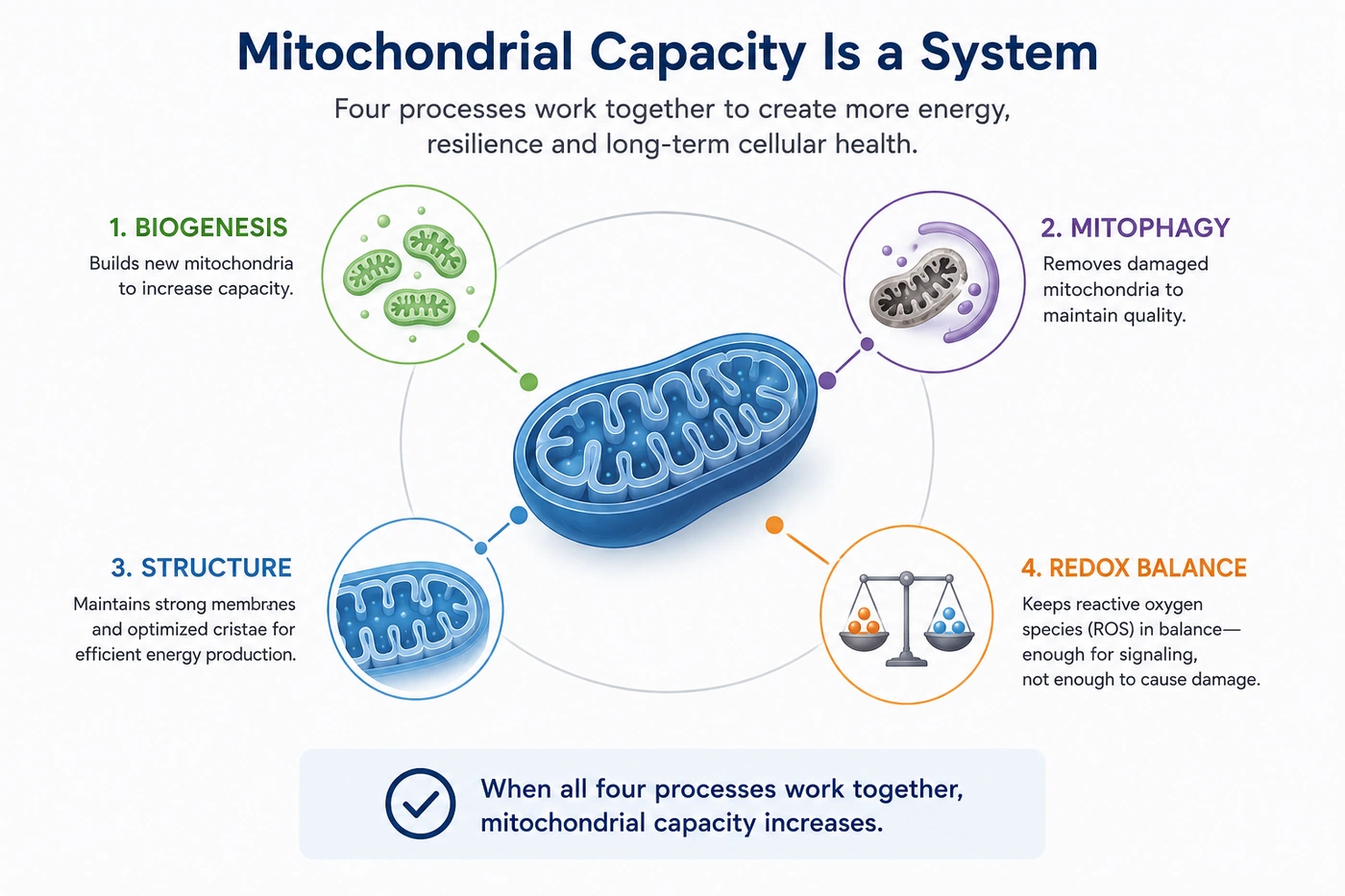
3. Mitochondrial structure matters
Mitochondria are highly organized structures, not bags filled with energy-producing chemicals.
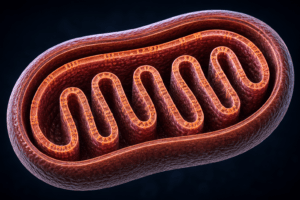
Their inner membrane forms folds called cristae. The respiratory complexes that transfer electrons and help generate the proton gradient needed for ATP synthesis are organized within this membrane system.
Experimental research has shown that cristae architecture can influence respiratory-chain organization and mitochondrial respiratory efficiency. In other words, the physical organization of a mitochondrion is closely tied to how it functions.
A higher NAD+ concentration cannot substitute for damaged membranes, poorly organized respiratory machinery, or an impaired mitochondrial network.
4. Redox signaling has to stay balanced
NAD+ and NADH are themselves part of the cell’s redox system, but healthy redox biology is much broader than simply maximizing the amount of oxidized NAD+.
Redox balance is the cell’s ability to produce energy and use oxidative signals without letting them build up to damaging levels.
Mitochondria continually respond to fuel availability, oxygen demand, reactive oxygen species, calcium signals, exercise, nutrient status, and cellular stress.
Some oxidative signaling is useful. It helps tell cells that conditions have changed and that adaptation is needed. Too much persistent oxidative stress, on the other hand, can damage proteins, lipids, DNA, and mitochondrial structures.
The goal is therefore not to eliminate oxidation or maximize one side of the system. It is to keep these signals controlled so cells can sense demand, respond appropriately, recover, and adapt.
Human NAD studies illustrate the distinction
This difference between raising a molecule and improving an entire physiological system is not merely theoretical.
Human studies show that NAD precursors can alter NAD metabolism. For example, NR supplementation has been shown to increase NAD-related metabolites in humans, and the 2026 whole-blood study found that NR changed blood NAD+ even though age and lifestyle interventions did not.
But mitochondrial outcomes can tell a different story.
In a randomized trial involving 40 middle-aged men with obesity and insulin resistance, participants received a high dose of NR or placebo for 12 weeks. Researchers directly examined skeletal muscle biopsies. NR did not change muscle mitochondrial respiratory capacity, mitochondrial quantity, or mitochondrial morphology. Muscle NAD+ concentrations also remained unchanged in that particular study.
That study does not mean NR or NAD support is useless. It makes a narrower and more important point:
A change in NAD-related biology should not automatically be interpreted as an increase in mitochondrial capacity.
Those are different endpoints, and both need to be measured if we want to know what actually changed.
A better way to think about mitochondrial support
Instead of asking only, “How do I raise NAD?” a more useful question is:
What helps the mitochondrial system remain capable, adaptable, and well maintained?
That shifts attention from a single molecule toward several coordinated processes:
- adequate NAD+ availability for normal metabolism and signaling
- repeated signals for mitochondrial adaptation and biogenesis
- quality-control processes that remove damaged components
- healthy mitochondrial membranes and structural organization
- balanced redox signaling
- adequate fuel, oxygen delivery, sleep, and recovery
Regular physical activity remains especially important because it engages several of these systems at once. Human muscle adapts to repeated energy demand by remodeling mitochondrial content, function, structure, and quality-control pathways.
Sleep, nutrition, and recovery help create the biological conditions in which those adaptations can occur.
NAD support can fit within that larger picture but it should not be mistaken to account for the whole picture.
Mitozz dans ce contexte
Mitozz is formulated with 98% pure (−)-epicatechin, a plant-derived flavanol studied across several areas of mitochondrial biology, including energy sensing, biogenesis-related signaling, mitochondrial structure, mitophagy, vascular function, and redox regulation.
Human research has reported increases in markers such as PGC-1α and mitochondrial cristae abundance after purified (−)-epicatechin. Laboratory research has also shown that (−)-epicatechin can stimulate mitophagy, the quality-control process cells use to remove damaged mitochondria.
That broader biological profile is what makes (−)-epicatechin particularly relevant here. Rather than focusing on a single part of cellular energy metabolism, it has been studied across several systems involved in building, maintaining, and regulating mitochondrial capacity.
That is where Mitozz differs from a single-lever approach like NAD supplementation. Its 98% pure (−)-epicatechin is relevant across multiple systems involved in mitochondrial function and capacity, not just one part of cellular energy metabolism.
Conclusion
NAD+ deserves the attention it receives. Cells need it for energy metabolism, redox reactions, DNA repair, and important regulatory pathways.
But more NAD+ and more mitochondrial capacity are not synonymous.
Capacity emerges from a coordinated system that has to produce energy, build new machinery, remove damaged components, preserve membrane architecture, manage redox signals, and adapt repeatedly to changing demand.
That distinction changes the goal.
Rather than searching for the one molecule that controls mitochondrial health, it makes more sense to support the network of processes that allows mitochondria to remain functional and adaptable over time.
NAD+ is an important part of that network.
It is not the entire network.
Partager cet article de blog
Références
- Trętowicz, M. M., et al. (2026). Human whole-blood NAD+ levels do not vary with age or lifestyle interventions. Nature Metabolism.
- Janssens, G. E., et al. (2022). Healthy aging and muscle function are positively associated with NAD+ abundance in humans. Nature Aging.
- Ryu, K. W., et al. (2018). Metabolic regulation of transcription through compartmentalized NAD+ biosynthesis. Science.
- Dollerup, O. L., et al. (2020). Nicotinamide riboside does not alter mitochondrial respiration, content or morphology in skeletal muscle from obese and insulin-resistant men. The Journal of Physiology.
- Cogliati, S., et al. (2013). Mitochondrial cristae shape determines respiratory chain supercomplexes assembly and respiratory efficiency. Cell.
- Díaz-Castro, F., et al. (2024). A single bout of resistance exercise triggers mitophagy, potentially involving the ejection of mitochondria in human skeletal muscle. Acta Physiologica.
- McDonald, C. M., et al. (2021). (−)-Epicatechin induces mitochondrial biogenesis and markers of muscle regeneration in adults with Becker muscular dystrophy. Muscle & Nerve.
- Auguste, S., Yan, B., & Guo, M. (2023). Induction of mitophagy by green tea extracts and tea polyphenols: A potential anti-aging mechanism of tea. Food Bioscience
- Schwarz, N. A., et al. (2018). (−)-Epicatechin supplementation inhibits aerobic adaptations to cycling exercise in humans. Frontiers in Nutrition.
Comprendre la santé mitochondriale est un processus de longue haleine. C’est pourquoi nous avons créé la Mitozz : un moyen gratuit de continuer à vous informer sur l’énergie cellulaire, la santé mitochondriale et les choix de mode de vie qui favorisent le bien-être de votre corps au fil du temps. Vous recevrez du contenu éducatif fondé sur des données scientifiques, des conseils pratiques et les dernières actualités de Mitozz, le tout à votre rythme.
Inscrivez-vous à la Mitozz
Bénéficiez d'une formation fondée sur des données scientifiques concernant la santé mitochondriale, l'énergie cellulaire et les choix de mode de vie qui favorisent le bien-être de votre corps à long terme.
Avertissement médical : Les informations fournies dans cet article sont uniquement à titre éducatif et informatif et ne constituent en aucun cas un avis médical. Elles ne sauraient se substituer à un diagnostic, un traitement ou des conseils médicaux professionnels. Consultez toujours un professionnel de santé qualifié avant de modifier votre régime alimentaire, votre programme d'activité physique, vos pratiques de jeûne ou votre consommation de compléments alimentaires, en particulier si vous souffrez d'une affection médicale, si vous êtes enceinte ou si vous allaitez, ou si vous prenez des médicaments.
Avertissement de la FDA : Ces allégations n'ont pas été évaluées par la Food and Drug Administration. Elles ne visent pas à diagnostiquer, traiter, guérir ou prévenir une quelconque maladie.