Mitozz


Découvrez les principes scientifiques qui sous-tendent l'énergie cellulaire, la santé mitochondriale, la récupération et la longévité.

Older woman walking outdoors in a sunlit park, illustrating physical activity and healthy aging.

Oxygen and Aging: Why Getting Enough May Not Be Enough

Getting enough oxygen is only part of healthy aging. Discover why mitochondrial function, oxygen utilization, and the body's ability to adapt may matter just as much.
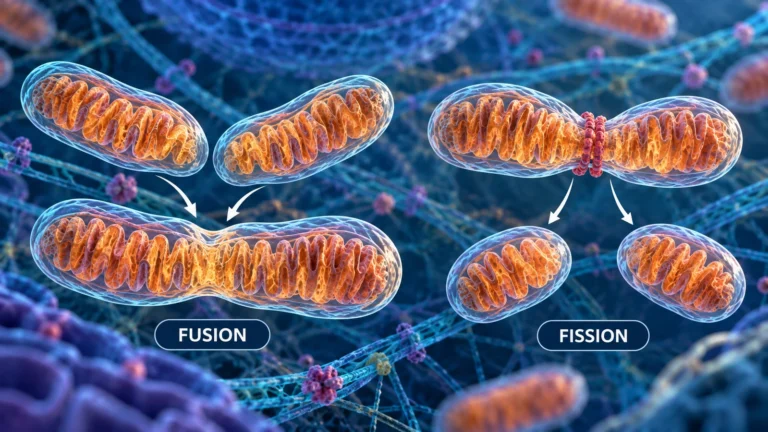
Illustration of mitochondrial fusion and fission, showing two mitochondria merging into one and a single mitochondrion dividing into two, supporting cellular quality control.

Fusion and Fission: Why Mitochondria Have to Change Shape

Mitochondria don't just produce energy. They constantly merge, divide, and reorganize. Discover why this process matters for mitochondrial function, quality control, and healthy aging.
Illustration of a senescent cell releasing inflammatory signaling molecules that influence surrounding immune cells.

When Worn Mitochondria Keep the Immune System on Alert

Damaged mitochondria can trigger immune alarms even without an infection. Why do some aging cells keep those signals active, and what does mitochondrial maintenance have to do with it?
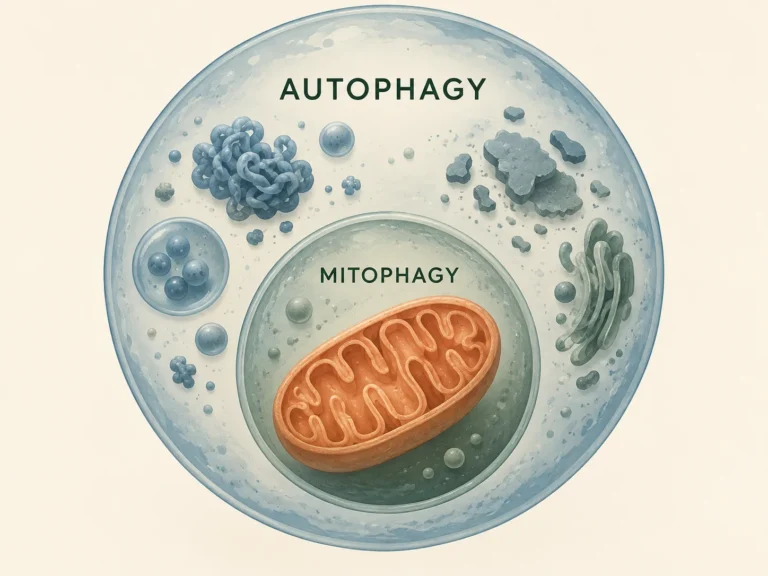
Scientific illustration of cellular recycling with mitochondria and other cell components.

Autophagy Is Not the Same as Mitophagy

Autophagy helps cells recycle unwanted material, while mitophagy specifically targets damaged or worn mitochondria. But removing what no longer works is only half the story: how do cells repair, rebuild, and maintain the mitochondria they need to stay healthy?
Active older man exercising outdoors, representing muscle aging and mitochondrial capacity

Why Aging Muscle Can Still Make Energy but Lose Capacity

Aging muscle does not simply lose its ability to make energy. Research suggests mitochondrial energy production can remain surprisingly resilient while other functions, including calcium handling and cellular maintenance, become less robust.
Healthy older woman hiking outdoors, representing mitochondrial quality control, cellular energy, and healthy aging.

Why Damaged Mitochondrial DNA Changes the Aging Conversation

As we age, we tend to lose mitochondrial capacity. But having fewer mitochondria does not tell the full story. The quality of the mitochondria that remain, including the condition of their DNA, also plays an important role in how well cells continue to produce and manage energy.
Generic NAD+ support supplement bottle representing NAD and mitochondrial energy metabolism

NAD and Mitochondrial Capacity: Why More NAD Is Not Enough

Raising NAD+ may support cellular energy metabolism, but does more NAD+ actually mean better mitochondria? The answer depends on what happens beyond NAD+.
Large ROS text above the word ENEMY crossed out in red, illustrating that reactive oxygen species are not always harmful.

ROS Are Not the Enemy: How Cells Turn Stress Into Adaptation

Reactive oxygen species are usually portrayed as cellular enemies. In controlled amounts, however, they help cells respond to exercise, tissue injury, and mitochondrial stress. The real issue is when a useful signal becomes chronic noise.

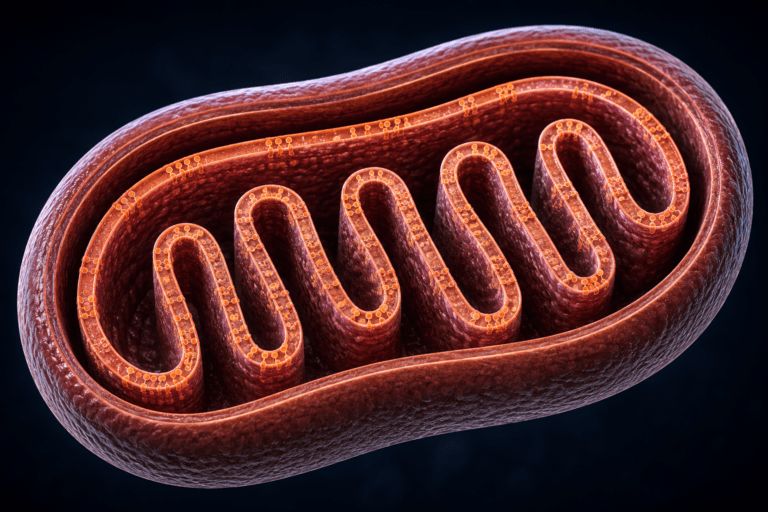
Mitochondrion with cardiolipin highlighted along the curved inner membrane and cristae.

Cardiolipin: The Mitochondrial Fat Almost Nobody Talks About

Cardiolipin is a specialized phospholipid found mainly in the inner mitochondrial membrane. Its unusual four-tailed structure helps support mitochondrial cristae and the proteins involved in ATP production. Here is why this little-known membrane lipid matters for mitochondrial organization, energy production, and renewal.
Une femme se tient debout dans une douce lumière tamisée, un rayon de lumière mettant en valeur sa région abdominale pour symboliser le lien entre le microbiote intestinal et l'énergie mitochondriale.

Comment le microbiome et les mitochondries s'influencent mutuellement

Le microbiome intestinal ne se contente pas de faciliter la digestion. Les métabolites microbiens peuvent influencer l'utilisation des sources d'énergie par les mitochondries, la signalisation et le contrôle qualité, tandis que les mitochondries contribuent elles aussi à façonner l'environnement intestinal.
Portrait photoréaliste en gros plan montrant un teint irrégulier, une légère rougeur et une texture visible sur la joue d'une jeune femme.

Les mitochondries, le stress oxydatif et le teint irrégulier

Le teint irrégulier n'est pas seulement un problème superficiel. Cet article explique les liens entre le stress oxydatif, les mitochondries, l'exposition aux UV et les soins quotidiens de la peau.
Femme âgée en bonne santé, aux cheveux gris, regardant l'objectif sous une lumière douce et naturelle, Mitozz .

Mitochondries, collagène et structure cutanée : les fondements biologiques de la fermeté et de l'élasticité

La fermeté de la peau ne dépend pas uniquement du collagène. Cet article explique comment les mitochondries, les fibroblastes, le stress oxydatif et l'hydratation influencent les mécanismes biologiques qui sous-tendent l'élasticité de la peau.