
Healthy mitochondria do more than produce energy. They constantly merge, divide, and reorganize to meet the changing needs of the cell. This ability to adapt is an important part of mitochondrial health, reminding us that how mitochondria function matters just as much as how many we have.
Imagine watching a mitochondrion under a microscope. It stretches into an elongated tube, narrows at one point, and eventually separates into two smaller structures.
A moment earlier, there was one. Now there are two.
Has the cell increased its mitochondrial capacity?
Not necessarily.
The division has produced two separate mitochondria, but it has not automatically created additional energy-producing machinery. The amount of mitochondrial material may be essentially unchanged.
This illustrates an important limitation in how mitochondrial health is often discussed.
We frequently hear about increasing mitochondrial numbers, stimulating mitochondrial biogenesis, or preventing the mitochondrial decline associated with aging. Those are legitimate areas of scientific interest, but they leave out another important consideration: how mitochondria are organized and maintained.
Mitochondria are commonly illustrated as isolated, bean-shaped structures floating inside cells. That image is useful for teaching basic anatomy, but it does not capture their dynamic behavior.
In living cells, mitochondria may appear as elongated tubes, connected networks, or smaller individual structures. Their organization can change as cells grow, work, respond to stress, and recover.
Researchers call this continuous remodeling mitochondrial dynamics. Two processes are particularly important: fusion and fission. [1]
Understanding them reveals why mitochondrial health cannot be reduced to a simple count.
Mitochondrial fusion occurs when two mitochondria join together, combining their outer and inner membranes and allowing contents within their internal compartments to mix.
Why would a cell benefit from joining mitochondria?
One reason is that individual mitochondria do not always contain exactly the same resources or have identical functional capabilities.
Some may temporarily have less of a particular protein or other component needed for normal activity. By exchanging contents through fusion, mitochondria can help maintain function across the mitochondrial population.
Think of two workshops that share equipment and supplies. One workshop may lack a necessary tool while the other has an extra. Connecting their resources can help both remain productive.
Mitochondrial fusion provides a biological version of this cooperation.
It can allow the redistribution of proteins, metabolites, and components associated with mitochondrial DNA, helping mitochondria compensate for certain functional limitations. [1,2]
But fusion is not a universal repair mechanism. Combining two mitochondria cannot necessarily correct severe damage or replace every missing component.
The importance of fusion became particularly clear in research examining what happens when the process is disrupted.
In a 2010 study published in Cell, researchers genetically disrupted proteins required for mitochondrial fusion in the skeletal muscle of mice.
The result was not simply a change in mitochondrial appearance. The mice developed abnormalities in mitochondrial DNA maintenance, mitochondrial dysfunction, and muscle atrophy. [3]
The findings demonstrated that fusion has an important role in maintaining mitochondrial integrity, extending beyond the visible arrangement of the organelles.
In other words, mitochondrial shape is connected to mitochondrial function.
If fusion allows mitochondria to cooperate, why would a cell ever separate them?
Because remaining connected is not always the best solution.
Mitochondrial fission is the process by which one mitochondrion divides into two smaller structures.
This division serves several purposes.
As cells grow and produce additional mitochondrial components, fission helps distribute that material into separate mitochondria. It also contributes to the organization and positioning of mitochondria within cells.
This matters because energy demand is not necessarily uniform throughout a cell.
Some regions may require more energy or have different metabolic responsibilities. Mitochondria must be organized in ways that support those local requirements.
Fission also plays an important role when mitochondrial damage occurs.
Imagine a long mitochondrion in which one region has become dysfunctional. Keeping that region connected to the rest of the structure may not always be beneficial.
Under certain circumstances, fission helps separate the affected portion, allowing the cell to handle it independently.
This is one way mitochondrial remodeling contributes to quality control. [1,5]
However, there is an important distinction here.
Fission itself is not evidence of mitochondrial damage.
It is a normal biological process. Its consequences depend on why division occurs, how it is regulated, and what happens to the resulting mitochondria.
A cell with fragmented mitochondria is not automatically unhealthy, just as a cell with long, connected mitochondria is not automatically healthy.
The context matters.
A study published in Nature in 2021 provided a particularly interesting example of how mitochondrial division can serve different purposes.
Researchers used advanced live-cell microscopy to observe mitochondrial fission in cultured monkey cells and mouse heart muscle cells.
They identified two patterns of division associated with different outcomes. [4]

In one pattern, division occurred near the middle of a mitochondrion. This midzone fission was associated with mitochondrial growth and proliferation.
In another pattern, division occurred closer to one end. This peripheral fission was frequently associated with a smaller mitochondrial fragment showing signs of dysfunction.
That smaller fragment could subsequently be targeted for removal.
The distinction is important because the same general process, mitochondrial division, was associated with two very different activities.
One supported expansion of the mitochondrial population.
The other helped separate material that the cell might need to eliminate.
The researchers also found differences in the molecular machinery associated with these division patterns, suggesting that cells can regulate them through partially distinct mechanisms.
These observations came from experimental cell systems, not a clinical study of mitochondrial health in humans. They do not mean that every mitochondrial division can be classified neatly into one of two categories.
Nevertheless, the findings illustrate an important principle.
The value of mitochondrial division depends on what the cell accomplishes through it.
Simply increasing or decreasing fission is not necessarily desirable. What matters is whether the process is appropriately regulated for the cell’s needs.
Mitochondrial organization is not fixed because the conditions inside a cell are not fixed.
Energy requirements change. Nutrient availability changes. Cells encounter mechanical demands, metabolic challenges, and environmental stress.
Mitochondria participate in the response to these changes. Under some conditions, mitochondria become more interconnected. Under others, they become shorter or more fragmented.
These changes can influence mitochondrial metabolism, communication between organelles, and the cell’s ability to adapt to stress. [2]
For example, mitochondrial elongation can be part of an adaptive response to certain forms of nutrient stress. Fragmentation, meanwhile, may participate in normal mitochondrial distribution or in responses to damage.
Neither arrangement is universally superior.
Cell type also matters.
Mitochondria in skeletal muscle operate within a highly organized structure built for repeated contraction. Neurons face different challenges because they must supply energy and other mitochondrial functions across long cellular extensions.
The arrangement most useful in one environment may not be the arrangement required in another.
This creates an important difficulty when researchers try to evaluate mitochondrial health using appearance alone. An image may reveal whether mitochondria are elongated, connected, or fragmented. But that image does not necessarily explain why they have adopted that configuration or whether the configuration is helping the cell.
A more complete assessment requires understanding mitochondrial function alongside mitochondrial structure.
Mitochondrial health, therefore, is not about maintaining one ideal shape.
It is about retaining the capacity to reorganize when circumstances require it.
Fusion and fission are closely connected to the broader maintenance of the mitochondrial population.
Through fusion, mitochondria can exchange contents and compensate for some functional weaknesses.
Through fission, cells can redistribute mitochondrial material and separate regions that may require additional attention.
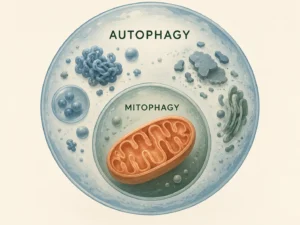
When a mitochondrial fragment is sufficiently dysfunctional, it may be removed through mitophagy, the selective recycling of mitochondria.
Research has shown that fission and selective fusion can help separate mitochondria that are less likely to rejoin the functional population, making them available for elimination. [5]
But mitochondrial quality control does not stop at removal.
Cells must also maintain and produce the proteins, membranes, and other components required for continued mitochondrial function.
This is why fusion, fission, mitochondrial biogenesis, and mitophagy are best understood as related activities rather than isolated solutions.
A cell that removes dysfunctional mitochondria but cannot adequately renew its mitochondrial population may eventually lose capacity.
A cell that produces more mitochondrial material but cannot maintain its organization may also encounter problems.
And a cell in which fusion or fission is severely disrupted may struggle to preserve mitochondrial function even when mitochondrial material remains abundant.
The objective is not simply to recycle more, build more, fuse more, or divide more.
It is to maintain a functional mitochondrial population capable of responding to changing demands.
Mitochondrial health is often presented as a problem of quantity.
As we age, mitochondria may become reduced in quantity and/or less effective, so the apparent solution is to make more of them. But mitochondrial research points to a more complicated picture.
The condition of mitochondrial membranes, the maintenance of mitochondrial DNA, the ability to respond to stress, and the organization of the mitochondrial population all influence how effectively cells use their mitochondria.
Fusion and fission are part of that larger picture.
This does not mean that people should attempt to maximize either process.
Although researchers can experimentally alter mitochondrial fusion and fission, we do not yet have a simple, clinically validated way to determine an individual’s ideal balance or to deliberately optimize it through a specific supplement.
The practical foundations of mitochondrial health remain familiar: regular physical activity, adequate sleep, appropriate nutrition, and sufficient recovery.
These habits support the broader physiological conditions in which mitochondria function. They should not be interpreted as guarantees of a particular mitochondrial shape.
Scientists are also investigating compounds that interact with mitochondrial signaling and related aspects of cellular function.
Mitozz, formulated with high-purity (−)-epicatechin, is designed as part of a broader approach to mitochondrial support. However, the research discussed here does not establish that Mitozz changes fusion or fission in humans.
The distinction is worth maintaining because the science of mitochondrial dynamics is important even without turning every discovery into a product claim.
A useful mitochondrial population is not necessarily the largest one. It’s a population that can maintain its components, respond to changing demands, reorganize when needed, and participate in the cell’s ongoing maintenance processes.
Fusion helps mitochondria cooperate.
Fission helps them divide, distribute, and sometimes separate material that needs to be removed.
Together, they contribute to the changing organization of the mitochondrial population.
This is why mitochondrial health involves more than producing ATP or increasing mitochondrial numbers.
It also involves maintaining the flexibility and organization needed to keep that machinery useful over time.
For a broader look at the processes that preserve mitochondrial function, download our free guide, Mitochondrial Quality Control, available in the Mitozz Download Center.
Share this blog article
Kamerkar, S. C., Liu, A., & Higgs, H. N. (2025). Mitochondrial fission: changing perspectives for future progress. Journal of Cell Science, 138, jcs263640.
Youle, R. J., & van der Bliek, A. M. (2012). Mitochondrial fission, fusion, and stress. Science, 337, 1062–1065.
Eisner, V., Picard, M., & Hajnóczky, G. (2018). Mitochondrial dynamics in adaptive and maladaptive cellular stress responses. Nature Cell Biology, 20, 755–765.
Chen, H., et al. (2010). Mitochondrial fusion is required for mtDNA stability in skeletal muscle and tolerance of mtDNA mutations. Cell, 141, 280–289.
Kleele, T., et al. (2021). Distinct fission signatures predict mitochondrial degradation or biogenesis. Nature, 593, 435–439.
Twig, G., et al. (2008). Fission and selective fusion govern mitochondrial segregation and elimination by autophagy. The EMBO Journal, 27, 433–446.
Understanding mitochondrial health is a long-term process. That’s why we created the Mitozz Newsletter: a free way to keep learning about cellular energy, mitochondrial health, and the lifestyle signals that support your body over time. You’ll receive science-based educational content, practical guidance, and updates from Mitozz, all at your own pace.
Get science-based education on mitochondrial health, cellular energy, and lifestyle signals that support your body over time.
Medical Disclaimer: The information provided in this article is for educational and informational purposes only and is not intended as medical advice. It is not a substitute for professional medical diagnosis, treatment, or guidance. Always consult with a qualified healthcare professional before making changes to your diet, exercise routine, fasting practices, or supplement use, especially if you have a medical condition, are pregnant or nursing, or are taking medications.
FDA Disclaimer: These statements have not been evaluated by the Food and Drug Administration. They are not not intended to diagnose, treat, cure, or prevent any disease.