Virtually every cell in your body keeps time at the molecular level. Using an internal feedback loop of clock genes, your body anticipates the demands of the day before they arrive by timing:
- Hormone secretion (cortisol, melatonin, insulin, growth hormone)
- Immune activity and inflammatory response timing
- Cell division and DNA repair
- Body temperature regulation
- Gut motility and digestive enzyme secretion
- Cardiovascular function (blood pressure, heart rate, vascular tone)
- Cognitive function, attention, and reaction time
One of the most important things this clock governs is energy production, specifically when and how efficiently your mitochondria generate it.
Jet lag, at its core, is what happens when that timing system falls out of sync with the world around you. The fatigue you feel is a direct reflection of what being out of sync has done to your body at the cellular level.
Your Body Runs on Two Clocks
There’s a central clock in your brain, housed in a structure called the suprachiasmatic nucleus, that receives light signals from your eyes and uses them to synchronize the body’s biological timing with the external day and night cycle. It’s your body’s master pacemaker.
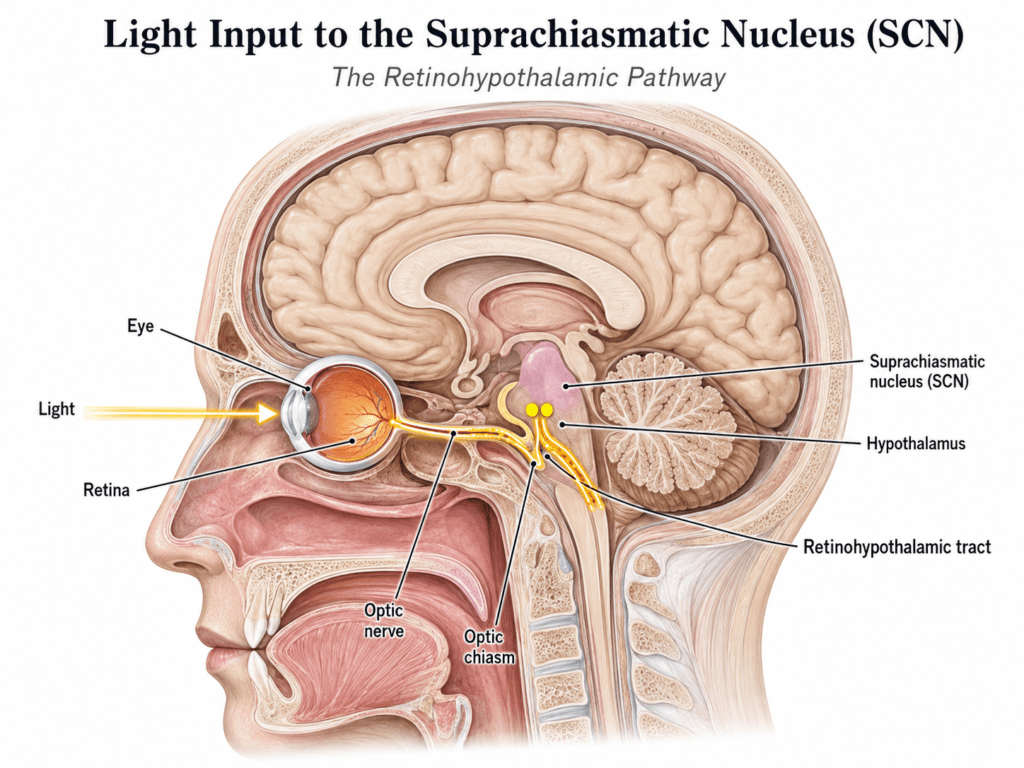
But every tissue in your body, your muscles, your liver, your heart, your fat cells, also have their own local clock. These peripheral clocks sync to the central clock and together they coordinate the timing of metabolism, cellular repair, and energy output.
When you land in Tokyo after a flight from New York City, your master clock starts responding to the visual signals from Tokyo within a day or two. The peripheral clocks take longer. They don’t receive light directly. Instead, they rely on other cues like meal timing, physical activity, and hormonal signals to recalibrate. The result is a period of internal desynchrony where your brain clock is beginning to adjust, but your cells are still operating on New York time. That mismatch is why jet lag can linger for several days even after you feel mentally adjusted.
The Molecular Clock Inside Your Cells
At the cellular level, the circadian rhythm is maintained by a feedback loop of clock genes. Two of the most important are CLOCK and BMAL1. They form a protein complex that acts as the engine of the cellular clock, turning on genes in waves across the day and night cycle.
CLOCK and BMAL1 help regulate NAD+, a molecule your cells need for normal energy metabolism. NAD+ also supports enzymes such as SIRT1, which are involved in mitochondrial maintenance and the creation of new mitochondria. In other words, the circadian clock does more than track time, it helps coordinate the daily rhythm of cellular energy production.
When clock gene expression is disrupted, this entire chain is affected.
NAD+ and the Energy-Clock Connection
Research published in the journal Frontiers in Cell and Developmental Biology describes the relationship between the circadian clock and mitochondrial function as bidirectional. The clock regulates mitochondrial energy output, and signals from the mitochondria can feed back to influence clock timing (Aon et al., 2020). This bidirectionality matters because it means that when one system is disrupted, both are affected.
When BMAL1 activity is impaired, through the kind of clock desynchrony that jet lag creates, NAD+ levels decline, SIRT1 activity drops, and PGC-1α is less able to drive the expression of genes related to mitochondrial maintenance and energy production. Research in mice deficient in BMAL1 has observed significant reductions in NAD+ levels in liver tissue, illustrating how tightly the clock and the metabolic machinery are coupled (Peek et al., 2013, Science).
This is not just a theoretical concern. Studies on shift workers and people with chronic social jet lag, who consistently create mismatch between their biological clock and their daily schedule, have found associations with impaired metabolic health and increased risk of conditions linked to mitochondrial dysfunction (Roenneberg et al., 2012).
The acute version of this, flying across eight time zones, creates a compressed version of the same disruption.
How Jet Lag Disrupts Mitochondrial Energy Production
The practical consequence is that your mitochondrial respiration, the process by which mitochondria convert oxygen and fuel substrates into ATP, becomes less coordinated during the days following long-haul travel. Mitochondria are normally tuned to produce more energy during active periods and to slow production during rest. That timing is driven partly by the circadian clock through the NAD+/SIRT1/PGC-1α axis described above.
When the clock is misaligned, the timing of mitochondrial energy output no longer matches the body’s actual demand. You’re awake and asking your cells to perform but they’re operating on a rhythm that says it should be 3 in the morning.
The mismatch shows up as that particular kind of fatigue that isn’t just sleepiness. It’s a heaviness, a slowness in thought and reflexes, a body that feels like it’s running on partial power. Because it is!
Mitochondrial Dynamics Follow the Rhythm of Day and Night
There’s another layer to the story that’s worth understanding. Mitochondria are not static organelles. They constantly change shape, fusing together to form elongated networks, or dividing into smaller, more isolated units, in a process called mitochondrial fission and fusion. These dynamics influence how efficiently mitochondria can produce energy and respond to cellular stress.
Research from the University of Basel, published in Cell Metabolism, found that the structure of the mitochondrial network shifts over the course of the day in a rhythm that is tied to the circadian clock. The design of the network at any given time determines the cell’s energy capacity. When the clock is disrupted, that structural rhythm breaks down, and energy production loses its characteristic daily pattern (Schmitt et al., 2018).
A separate line of research has shown that disrupting the Drp1 protein, which governs mitochondrial fission, not only alters energy production but also interferes with circadian clock function itself, illustrating again the feedback relationship between these two systems.
Why this matters: Jet lag doesn’t just make you tired because you’re sleeping at the wrong time. It temporarily undermines the cellular machinery that determines how much energy your mitochondria can produce, and when.
O que isso significa na prática
Most people recover from a single episode of jet lag without any lasting effects. The body is resilient. The clock systems and the mitochondria re-synchronize over several days as external cues accumulate. But the experience points to something worth taking seriously – mitochondrial energy output is not fixed. It’s rhythmic, and it’s sensitive to the same conditions that disrupt sleep and circadian timing.
This matters beyond travel. Social jet lag, the weekly cycle of staying up late on weekends and rising early for work on Monday, creates a low-grade, chronic version of the same desynchrony.
Research has associated persistent social jet lag with metabolic dysregulation, elevated inflammation markers, and impaired glucose metabolism (Roenneberg et al., 2019). None of these are travel-specific. It highlights how the body responds to any sustained misalignment between the biological clock and the external schedule.
Practical Ways to Support Recovery
Recovery from jet lag is primarily a matter of resetting the clock, which means working with the key external inputs that influence it.
Light is the most powerful “time giver,” for the central circadian clock. After eastward travel, morning light exposure helps resynchronize the clock. After westward travel, dark exposure helps resynchronize the clock.
Getting outdoors during the appropriate window, even for 20–30 minutes, gives the suprachiasmatic nucleus the signal it needs to start calibrating. Conversely, avoiding bright light at the wrong phase can accelerate misalignment rather than correct it.
Meal timing also matters for peripheral clocks. The liver, muscle tissue, and digestive system all use feeding cues to calibrate their local rhythms. Eating on the destination schedule from arrival, rather than following hunger cues driven by the home clock, can help accelerate the synchronization of peripheral tissues.
Sleep timing, hydration, and moderate physical activity are part of the picture as well. The CDC’s guidance on jet lag management recommends adjusting sleep schedule toward destination time in the days before a flight where possible, avoiding alcohol and excess caffeine in transit, and keeping daytime naps brief to protect nighttime sleep consolidation at the destination (CDC Yellow Book, 2025).
Foundational Recovery Strategies
- Get outdoor light at the right local time
- Avoid bright light at the wrong time (including phone and computer screens)
- Eat meals on the destination schedule
- Keep daytime naps short
- Stay hydrated
- Avoid alcohol during travel and use caffeine carefully
- Walk or move lightly during the day
None of these strategies is a shortcut to recovery. They’re meaningful tools that honor your body’s natural ability to recalibrate and strengthen from within..
O Mitozz
Mitozz is a nutraceutical developed by FMG Health Sciences, formulated around 98% pure (-)-epicatechin, a flavanol found in cacao and green tea that has been studied in relation to mitochondrial function and cellular energy. Research in this area, including human clinical work led by investigators at UC San Diego and UCSD School of Medicine, has investigated (-)-epicatechin’s effects on markers of mitochondrial biogenesis, including PGC-1α expression and mitochondrial density in muscle tissue.
Mitozz is not a jet lag remedy. It doesn’t reset the circadian clock and it isn’t a substitute for foundational strategies listed above. What it is designed to support is the mitochondrial health that underlies cellular energy capacity over time.
For frequent travelers, people managing irregular schedules, or anyone whose lifestyle creates ongoing demands on their cellular energy systems, supporting mitochondrial health with Mitozz as part of a consistent routine may be a reasonable complement to the fundamentals.
If you’re curious about the science behind mitochondrial energy and how it responds to the conditions of modern life, the article on what happens to your mitochondria when you don’t sleep enough covers the sleep side of this picture in detail. And if you want to understand what mitochondrial health actually means at a biological level, What Is Mitochondrial Function and Why Is It Key to Your Health? is a good place to start.
Conclusão
Jet lag is a vivid demonstration of something that’s easy to forget during normal life, your body’s energy systems are not on-demand. They’re orchestrated.
Your circadian clock coordinates when mitochondria produce energy, how much, and in what form, through molecular pathways involving NAD+, SIRT1, PGC-1α, and the structure of the mitochondrial network itself. When you cross time zones, that orchestration temporarily falls out of sync.
Recovery from jet lag isn’t just about sleeping at the right local time. It’s about resetting a system that reaches from the neurons of the suprachiasmatic nucleus all the way down to the fusion-fission mitochondrial dynamics inside individual cells.
Understanding that depth allows us to move beyond simply waiting out the fatigue, and instead prioritize the light, movement, and nutritional cues that invite our cellular engines back into a steady, resilient rhythm.
Compartilhe este artigo do blog
Referências
- Aon, Et al (2020). Mitochondria: An integrative hub coordinating circadian rhythms, metabolism, the microbiome, and immunity. Frontiers in Cell and Developmental Biology, 8, 51.
- Centers for Disease Control and Prevention. (2025). Jet lag disorder. CDC Yellow Book: Health Information for International Travel.
- Peek, C. B., Et al (2013). Circadian clock NAD+ cycle drives mitochondrial oxidative metabolism in mice. Science, 342(6158), 1243417.
- Roenneberg, Et al (2012). Social jetlag and obesity. Current Biology, 22(10), 939–943.
- Roenneberg, Et al (2019). Chronotype and social jetlag: A (self-) critical review. Biology, 8(3), 54.
- Schmitt, Et al (2018). Circadian control of DRP1 activity regulates mitochondrial dynamics and bioenergetics. Cell Metabolism, 27(3), 657–666.
- Stenvers, D. J., Scheer, F. A. J. L., Schrauwen, P., la Fleur, S. E., & Kalsbeek, A. (2019). Circadian clocks and insulin resistance. Nature Reviews Endocrinology, 15(2), 75–89.
Compreender a saúde mitocondrial é um processo de longo prazo. É por isso que criamos o Mitozz : uma forma gratuita de continuar aprendendo sobre energia celular, saúde mitocondrial e os hábitos de vida que apoiam seu corpo ao longo do tempo. Você receberá conteúdo educativo com base científica, orientações práticas e novidades da Mitozz, tudo no seu próprio ritmo.
Inscreva-se no Mitozz da Mitozz
Obtenha informações com base científica sobre saúde mitocondrial, energia celular e hábitos de vida que contribuem para a saúde do seu corpo a longo prazo.
Aviso médico: As informações fornecidas neste artigo têm caráter exclusivamente educativo e informativo, não constituindo orientação médica. Não substituem o diagnóstico, o tratamento ou a orientação de um profissional de saúde. Consulte sempre um profissional de saúde qualificado antes de fazer alterações em sua dieta, rotina de exercícios, práticas de jejum ou uso de suplementos, especialmente se você tiver alguma condição médica, estiver grávida ou amamentando, ou estiver tomando medicamentos.
Isenção de responsabilidade da FDA: Estas declarações não foram avaliadas pela Food and Drug Administration. Elas não se destinam a diagnosticar, tratar, curar ou prevenir qualquer doença.