Key Takeaways
- Mitochondria respond to both feeding and fasting signals.
- Fasting can shift the body toward greater fat and ketone use.
- Metabolic flexibility matters more than extreme restriction.
- Food quality still shapes the mitochondrial environment.
- Mitozz may fit as one support tool within a broader lifestyle strategy.
Food is more than fuel. Every meal sends information to your cells about energy availability, nutrient status, and what kind of work your body may need to do next.
Fasting sends a different signal. When food is not coming in, the body begins shifting from recently absorbed glucose toward stored fuels, including fatty acids and, after longer fasting periods, ketone bodies. This shift is part of metabolic flexibility, the ability to move between fuel sources depending on availability and demand.
Mitochondria sit near the center of this conversation because they help convert fuel and oxygen into ATP, the cell’s usable energy currency. They also participate in signaling, stress responses, redox balance, and quality control.
That means the relationship between food, fasting, and mitochondria is not just about calories. It is about how your cells interpret abundance, scarcity, stress, and recovery.
Food and fasting are two important mitochondrial signals, but they work best inside a larger system. To see how nutrition fits alongside exercise, sleep, recovery, hormesis, mitophagy, and targeted nutrient support, read our full guide to bio-hacking mitochondria.
The Fed State and the Fasting State
After a meal, your body is in a fed state. Glucose, amino acids, and fats enter the bloodstream, insulin rises, and tissues begin storing or using the incoming nutrients. This process is closely related to glucose metabolism, the way the body handles and uses glucose for energy.
This is not a “bad” state. It is how the body rebuilds, replenishes glycogen, supports protein synthesis, and meets immediate energy needs. Eating gives the body materials it cannot create from fasting alone.
During fasting, the pattern changes. As hours pass without food, insulin tends to fall, glycogen stores become more relevant, and the body gradually increases the use of fatty acids. This includes greater reliance on fatty acid oxidation, the process of breaking down fatty acids to help produce usable cellular energy.
With longer fasting windows, the liver can produce ketone bodies, which some tissues can use as an alternative fuel. Reviews on intermittent fasting often describe this as a metabolic switch from glucose-centered metabolism toward fatty acid and ketone metabolism.
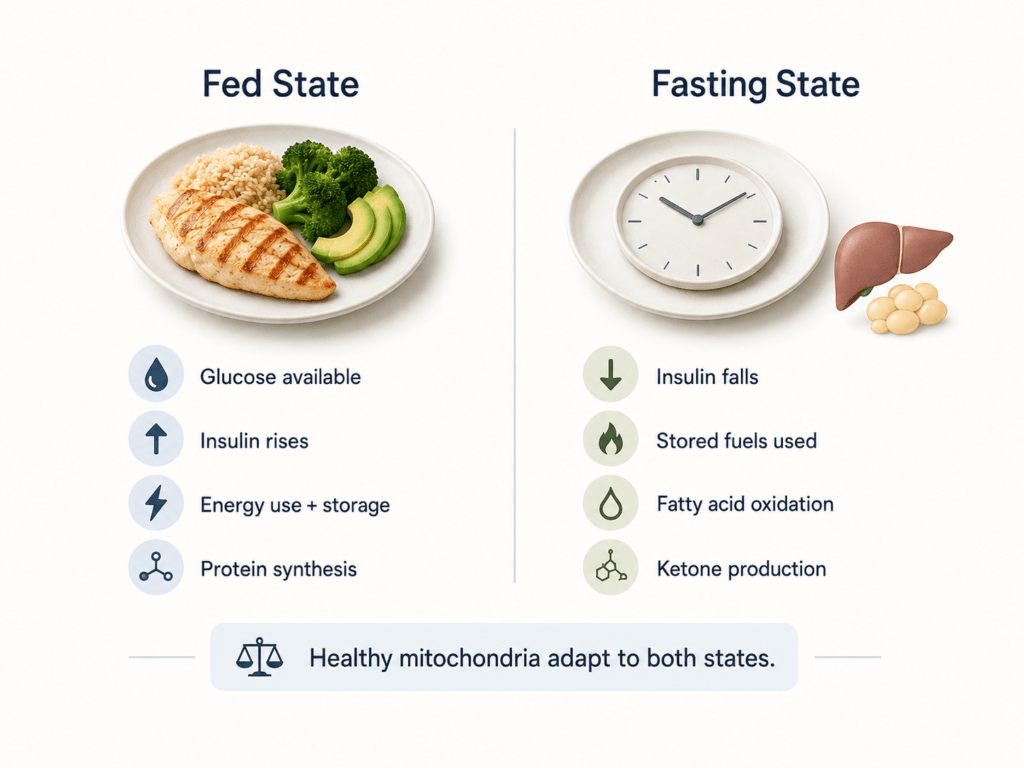
The important point is balance. Your mitochondria are not healthiest only when you are fed, and they are not healthiest only when you are fasting. They are designed to respond to changing conditions.
A healthy system can use nutrients when they arrive, store some energy for later, and shift toward stored fuels when needed.
Why Mitochondria Care About Nutrient Timing
Mitochondria do not make energy in isolation. They operate inside a larger metabolic network shaped by hormones, meal timing, sleep, movement, stress, and inflammation.
Food provides energy substrates, including fats, carbohydrates, and amino acids, that mitochondria can use depending on availability and demand. But the body also interprets food as information.
When nutrients are abundant, cells receive signals that support growth, storage, and rebuilding. When nutrients are scarce, cells receive signals related to energy conservation, fuel mobilization, and internal recycling.
These shifts involve nutrient-sensing pathways such as AMPK and mTOR. AMPK is often discussed as an energy-sensing pathway. When cellular energy availability is lower, AMPK can help shift metabolism toward pathways that generate ATP.
mTOR tends to be more active when nutrients, especially amino acids, are available and growth conditions are favorable. This is useful for repair and rebuilding, especially when paired with adequate protein and resistance exercise.
This is why fasting is often described as a signaling event, not just a calorie gap. It changes the cellular context in which mitochondria operate.
What Fasting May Signal to Mitochondria
Fasting can influence mitochondrial biology through several related mechanisms. The evidence is strongest for broad metabolic switching and nutrient-sensing pathways, while some details around mitochondrial quality control remain more mechanistic or preclinical.
Fuel switching
A fasted state encourages the body to rely less on incoming glucose and more on stored fuels. This can include increased fatty acid oxidation and, when fasting is long enough, increased ketone production.
The timing of this shift varies based on glycogen stores, activity, meal composition, sleep, training status, and individual physiology. The phrase “metabolic switch” is useful, but it should not be treated as an on-off button. For many people, fuel use changes gradually across the day.
AMPK and energy sensing
When cells detect lower energy availability, AMPK can help coordinate a response. This includes pathways involved in glucose uptake, fatty acid oxidation, and mitochondrial adaptation.
This does not mean that more fasting is always better. AMPK is part of a larger network. The body also needs fed-state signals to support recovery, muscle protein synthesis, hormone balance, and tissue repair.
Autophagy and mitophagy
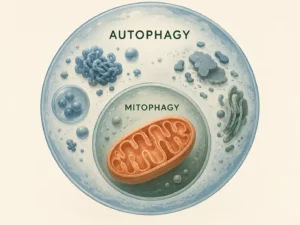
Autophagy is a cellular recycling process. Mitophagy is a more specific form of mitochondrial quality control that helps remove damaged or inefficient mitochondria.
Fasting and calorie restriction have been studied in relation to these pathways, but much of the detailed evidence comes from animal, cell, and mechanistic research. It would be too strong to say that every skipped meal “cleans your mitochondria.”
A more careful interpretation is that nutrient availability is one of several signals that can influence cellular maintenance pathways.
Mitochondrial biogenesis
Fasting and exercise are also studied in relation to mitochondrial biogenesis, the process through which cells increase mitochondrial content or related machinery in response to demand.
Exercise remains one of the most reliable lifestyle signals for mitochondrial adaptation. Fasting may interact with this system, but it should not be viewed as a substitute for movement, strength training, and cardiorespiratory fitness.
Redox balance and oxidative stress
Mitochondria naturally produce reactive oxygen species as part of energy metabolism. In appropriate amounts, these molecules participate in signaling. In excess, they can contribute to oxidative stress.
Human time-restricted eating studies have reported changes in oxidative stress markers in some contexts, but the results depend on the population, eating window, weight change, and study design.
A careful interpretation is that fasting may influence redox-related signaling, but it should not be framed as a guaranteed antioxidant strategy.
What Human Studies Suggest About Fasting and Metabolism
Human fasting research is promising, but it is not simple. Many studies are short, involve specific populations, or combine meal timing with unintentional calorie reduction. That makes it hard to separate the effects of fasting timing from weight loss, food quality, and adherence.
One well-known early time-restricted feeding trial in men with prediabetes found improvements in insulin sensitivity, beta-cell function, blood pressure, appetite, and oxidative stress markers even without weight loss. This suggests that meal timing itself may influence metabolic physiology in some contexts.
Another randomized trial comparing 4-hour and 6-hour time-restricted feeding windows in adults with obesity found modest weight loss and improvements in some cardiometabolic markers over eight weeks. The researchers reported that both fasting regimens produced similar reductions in body weight and may improve some aspects of cardiometabolic health.
Reviews of intermittent fasting emphasize a consistent theme: animal studies are often more dramatic than human studies, while human trials are generally shorter and more variable.
The strongest real-world takeaway is not that everyone needs extreme fasting. It is that meal timing, fasting duration, calorie intake, food quality, sleep, and circadian rhythm all interact with metabolic health.
Food Quality Still Matters
Fasting cannot make a poor diet biologically neutral. Mitochondria still operate in the environment created by your overall food pattern.
A diet rich in protein, fiber, minimally processed carbohydrates, healthy fats, and micronutrient-dense foods gives the body the raw materials it needs for repair, enzyme function, redox balance, and steady energy. Highly refined, low-fiber, ultra-processed meals can create larger swings in glucose and triglycerides for many people, especially when paired with low activity, poor sleep, and chronic stress.
Mitochondria use fuel, but they also need context. Magnesium, B vitamins, iron, copper, zinc, polyphenols, omega-3 fats, amino acids, and other nutrients all play roles in energy metabolism or the systems around it.
The goal is not to eat for mitochondria in a narrow way. The goal is to create a stable metabolic environment.
That means food and fasting should not be treated as opposites. Food provides substrate and building blocks. Fasting provides intervals where the body shifts fuel use and cellular signals. Both can be useful when matched to the person, the goal, and the life they actually live.
The Circadian Layer: When You Eat Also Matters
Your metabolism follows a daily rhythm. Insulin sensitivity, glucose handling, digestive function, body temperature, and hormone patterns change across the day.
Feeding and fasting help set these rhythms, which is one reason late-night eating and irregular meal timing can feel different from eating earlier in the day.
Reviews of time-restricted eating note that feeding-fasting cycles interact with circadian clocks and metabolic regulation. The evidence is still developing, but the basic idea is practical: your body may handle the same meal differently depending on timing, sleep, and light exposure.
For many people, a gentle overnight fast is a reasonable place to start. This might mean finishing dinner earlier, avoiding constant late-night snacking, and eating breakfast at a consistent time if that supports energy and appetite.
It does not require pushing into aggressive fasting windows.
What This Means in Real Life
A mitochondrial-friendly approach to food and fasting is usually less extreme than the internet makes it sound.
Start with rhythm. Try to eat at consistent times most days. Give your body a clear daily pattern of feeding and fasting rather than grazing from early morning until late night.
Prioritize food quality before fasting intensity. A 12-hour overnight fast with balanced meals may be more useful than a long fasting window followed by under-fueling, overeating, poor sleep, or high stress.
Use movement as a partner. A walk after meals can support glucose handling and helps reinforce the connection between fuel intake and energy demand. Exercise is also one of the strongest known lifestyle signals for mitochondrial adaptation.
Watch your recovery. Fasting is still a stressor. It may feel supportive for one person and draining for another, especially during heavy training, poor sleep, illness recovery, pregnancy, a history of disordered eating, or medically complex situations.
In those cases, personalized guidance matters.
The goal is not to prove discipline. The goal is to build a system that can make energy, switch fuels, recover, and adapt.
Where Mitozz Fits In
Lifestyle foundations come first. Food quality, meal rhythm, movement, sleep, and recovery create the environment in which mitochondria function. No supplement replaces those signals.
That said, researchers are also interested in specific food-derived compounds that may influence metabolic and mitochondrial-related signaling. Flavanols, a family of plant compounds found in foods such as cacao, have been studied in relation to vascular, metabolic, and cellular signaling pathways.
(−)-Epicatechin, a plant-derived flavanol, has been studied in relation to postprandial metabolism, skeletal muscle biology, vascular signaling, and mitochondrial-related markers. One human study reported that acute (−)-epicatechin intake influenced postprandial fat and carbohydrate metabolism, with effects associated with lower post-meal glucose and triglyceride responses.
Research involving epicatechin-rich cocoa in a small group of patients with type 2 diabetes and heart failure reported changes in skeletal muscle mitochondrial structure and markers of mitochondrial biogenesis. This was a small, specific clinical context, and the authors noted that future controlled studies were warranted. It should not be generalized into a broad disease or performance claim.
Mitozz is formulated around 98% pure (−)-epicatechin, a cacao-derived flavanol studied for its relationship with cellular signaling pathways involved in mitochondrial biology. In the context of this article, it fits best as one possible support tool within a broader cellular energy strategy that also includes food timing, nutrient quality, movement, sleep, and recovery.
If you are building a practical mitochondrial health routine, think of Mitozz as part of the support layer, not the foundation. The foundation is still how you feed, move, rest, and recover.
FAQ
Does fasting improve mitochondria?
Fasting can influence nutrient-sensing pathways, fuel switching, autophagy, and mitochondrial-related signaling. However, the effect depends on fasting duration, food quality, sleep, activity, and individual health context. Human evidence is promising but more limited than animal research.
How long do you need to fast for mitochondrial benefits?
There is no single fasting duration that guarantees mitochondrial benefits. Some metabolic shifts begin after glycogen use increases and insulin declines, while deeper ketone production often requires longer fasting. For everyday health, a consistent overnight fasting rhythm may be more sustainable than extreme fasting.
Is intermittent fasting better than eating smaller meals?
Not always. Some people do well with time-restricted eating, while others feel better with regular meals. The best pattern is one that supports stable energy, adequate protein, nutrient intake, training recovery, sleep, and long-term consistency.
Can food support mitochondrial health without fasting?
Yes. Food quality, protein adequacy, micronutrients, fiber, healthy fats, and polyphenol-rich plant foods all help shape the metabolic environment. Movement and sleep also strongly influence mitochondrial function.
Should everyone fast?
No. Fasting is not appropriate for everyone. People who are pregnant, underweight, recovering from disordered eating, managing complex medical conditions, taking glucose-lowering medication, or experiencing persistent fatigue should seek qualified guidance before changing meal timing.
Conclusion
Food and fasting both speak to your mitochondria.
Food provides the raw materials for energy production, repair, and adaptation. Fasting changes the signal, nudging the body toward stored fuel use, metabolic switching, and cellular maintenance pathways. Neither is magic by itself.
The most useful strategy is not extreme restriction. It is a repeatable rhythm: nourishing meals, periods without constant snacking, regular movement, adequate sleep, and recovery that gives your body a reason to adapt.
Mitochondrial health is built through signals repeated over time. Food and fasting are two of those signals. Used wisely, they can help support the cellular energy system you rely on every day.
For related reading, explore How to Repair and Maintain Mitochondrial Health Naturally, Why Am I Always Tired?, and What Happens to Your Mitochondria When You Don’t Sleep Enough?.
Share this blog article
References
- De Cabo, R., & Mattson, M. P. (2019). Effects of intermittent fasting on health, aging, and disease. New England Journal of Medicine.
- Anton, S. D., et al. (2018). Flipping the metabolic switch: Understanding and applying the health benefits of fasting. Obesity.
- Goodpaster, B. H., & Sparks, L. M. (2017). Metabolic flexibility in health and disease. Cell Metabolism.
- Sutton, E. F., et al. (2018). Early time-restricted feeding improves insulin sensitivity, blood pressure, and oxidative stress even without weight loss in men with prediabetes. Cell Metabolism.
- Cienfuegos, S., et al. (2020). Effects of 4- and 6-h time-restricted feeding on weight and cardiometabolic health: A randomized controlled trial in adults with obesity. Cell Metabolism.
- Webster, B. R., et al. (2014). Regulation of autophagy and mitophagy by nutrient availability and acetylation. Biochimica et Biophysica Acta.
- Mehrabani, S., et al. (2020). The effect of fasting or calorie restriction on mitophagy induction. BioMed Research International.
- Gutiérrez-Salmeán, G., et al. (2014). Acute effects of an oral supplement of (−)-epicatechin on postprandial fat and carbohydrate metabolism in normal and overweight subjects. Food & Function.
- Taub, P. R., et al. (2012). Alterations in skeletal muscle indicators of mitochondrial structure and biogenesis in patients with type 2 diabetes and heart failure: effects of epicatechin-rich cocoa. Clinical and Translational Science.
Understanding mitochondrial health is a long-term process. That’s why we created the Mitozz Newsletter: a free way to keep learning about cellular energy, mitochondrial health, and the lifestyle signals that support your body over time. You’ll receive science-based educational content, practical guidance, and updates from Mitozz, all at your own pace.
Sign up for the Mitozz Newsletter
Get science-based education on mitochondrial health, cellular energy, and lifestyle signals that support your body over time.
Medical Disclaimer: The information provided in this article is for educational and informational purposes only and is not intended as medical advice. It is not a substitute for professional medical diagnosis, treatment, or guidance. Always consult with a qualified healthcare professional before making changes to your diet, exercise routine, fasting practices, or supplement use, especially if you have a medical condition, are pregnant or nursing, or are taking medications.
FDA Disclaimer: These statements have not been evaluated by the Food and Drug Administration. They are not not intended to diagnose, treat, cure, or prevent any disease.