Key Takeaways
- Uneven skin tone involves many pathways, including UV exposure, inflammation, oxidative stress, and melanocyte biology.
- Mitochondria help skin cells manage energy and stress, but they do not control skin tone by themselves.
- Melanin is protective biology, not a problem to eliminate.
- Repeated or intense UV exposure can increase oxidative stress and contribute to visible skin aging.
- Mitozz and Mitozz RS fit only as supportive products, not pigmentation treatments.
Uneven skin tone can be frustrating because it rarely has one simple cause. It may show up as dullness, blotchiness, lingering marks, redness, sun-related discoloration, or skin that looks less smooth and uniform.
The natural question is: what can you do about it?
The answer starts with the biology. More even-looking skin depends on protecting skin from unnecessary UV stress, keeping the barrier hydrated and calm, avoiding repeated irritation, and supporting the cellular environment beneath the surface.
One important part of that environment is oxidative stress. When skin cells face more reactive stress than they can comfortably manage, the skin may look dull, uneven, or less calm. Mitochondria are part of that story because they help skin cells manage energy and stress signals.
Uneven tone is about more than pigment
Skin tone is influenced by melanin, the pigment made by melanocytes. Melanin helps protect skin from UV exposure, so the goal is not to fight melanin. The goal is to support skin that looks more even, calm, and healthy.
Uneven tone can come from several overlapping factors like sun exposure, dryness, redness, irritation, lingering post-blemish marks, changes in texture, or uneven pigment distribution. That is why the best approach is usually not one aggressive “brightening” step, but a steady routine that protects, hydrates, and reduces unnecessary stress on the skin.
This article focuses on everyday skin appearance and skin biology. It is not about treating melasma, vitiligo, hyperpigmentation disorders, or any medical condition. New, sudden, spreading, painful, or concerning pigmentation changes should be evaluated by a dermatologist.
Where mitochondria enter the skin-tone conversation
Mitochondria are best known for helping cells produce ATP, but they also participate in stress signaling, reactive oxygen species biology, programmed cell death, and cellular adaptation. Skin is a high-turnover tissue, so these processes matter in keratinocytes, fibroblasts, melanocytes, immune cells, and the broader tissue environment.
That does not mean mitochondria determine whether skin looks even or uneven. Skin tone is too complex for that. A better understanding is that mitochondrial function belongs in the larger biology of how skin cells respond to stress, especially stress from UV exposure, pollution, inflammation, and aging-related changes.
When mitochondria are under stress, they can become part of a feedback loop involving reactive oxygen species, inflammatory signaling, DNA stress, and altered cellular behavior. In skin biology, this can affect the environment in which pigment-producing cells and supporting skin cells operate.
Oxidative stress is one reason skin can look uneven
Oxidative stress happens when skin cells face more reactive stress than they can comfortably manage. This can come from UV exposure, pollution, inflammation, poor recovery, or repeated irritation.
That does not mean reactive oxygen species are always harmful. In normal amounts, they help cells communicate and adapt. The problem is too much stress, too often, without enough recovery.
UV exposure is one of the clearest examples. Sunlight has benefits, including vitamin D biology and circadian rhythm support. But repeated or intense UV exposure can increase oxidative stress in skin and contribute to visible aging, dullness, uneven tone, and texture changes.
This is why the basics matter: sunscreen when needed, shade, protective clothing, smart timing, hydration, and a routine that does not constantly irritate the skin.
More even-looking skin starts with reducing avoidable stress.
Melanocytes respond to the skin environment
Melanocytes are the specialized cells that produce melanin. They do not, however, work in isolation. They respond to signals from surrounding keratinocytes, UV exposure, inflammation, hormones, and oxidative stress.
Uneven tone can emerge when the local skin environment becomes uneven. Some areas may experience more UV stress, more irritation, more inflammation after blemishes, or more barrier disruption. Those differences can influence how the skin looks, even when the whole face is exposed to the same routine.
This is where mitochondria and oxidative stress are relevant. They are part of the stress-response network around melanocytes and surrounding skin cells.
The dermis also affects how even skin appears
Uneven tone is not only about pigment. The dermis, the deeper skin layer rich in fibroblasts and extracellular matrix, affects how light reflects from the skin. Hydration, collagen organization, fine lines, texture, and inflammation can all influence whether skin looks smooth and uniform.
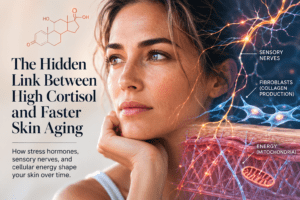
Research in aged human skin has linked collagen fragmentation with oxidative stress and increased matrix metalloproteinase-1 activity in dermal fibroblasts. This matters because the visible appearance of skin depends partly on the condition of the matrix beneath the surface.
Again, the point is not that oxidative stress “causes” uneven tone by itself but that it is one part of a larger tissue environment that affects how skin looks over time.
What daily skin support looks like in real life
A practical tone-support routine should focus on lowering avoidable stress and supporting the skin barrier. That usually means consistent habits rather than aggressive treatments.
Good foundations include:
- using sunscreen when UV exposure is prolonged or intense
- using shade, hats, and protective clothing when appropriate
- avoiding over-exfoliating or repeatedly irritating the skin
- keeping the skin hydrated with humectants and barrier-supportive care
- prioritizing sleep, protein, micronutrient adequacy, and recovery
- being patient, because visible skin appearance changes slowly
Hydration is important because dry, irritated, or rough skin can scatter light unevenly. Barrier stress can also make skin look redder, duller, or less calm. Supporting hydration does not correct pigmentation but it can help the skin look more even and comfortable.
What research on flavanols can and cannot tell us
Plant flavanols have been studied in skin and mitochondrial biology, but the details matter. A human randomized controlled trial using cocoa flavanols in photo-aged women reported changes in wrinkle roughness and elasticity over 24 weeks, while hydration and barrier measures were not significantly different.
(−)-Epicatechin has also been reviewed in relation to mitochondrial function and mitochondrial biogenesis pathways. Most of that evidence is not direct skin-outcome evidence but it remains useful in a biological context.
Catechins are also discussed in cosmetic science because of antioxidant mechanisms and possible topical applications.
Where Mitozz and Mitozz RS fit in
Mitozz belongs to the broader internal mitochondrial health conversation because it is built around 98% pure (−)-epicatechin and designed to support normal mitochondrial function and cellular energy. The skin science discussed here helps explain why mitochondrial biology matters throughout the body, including in skin cells.
Mitozz RS is the more directly skin-facing product. It is a topical cosmetic serum formulated for daily skin care with 98% pure (−)-epicatechin, hyaluronic acid, glycerin, vitamin C, vitamin E, and supporting gel ingredients. It is designed to support the appearance, hydration, and conditioning of skin.
Conclusion
Uneven skin tone is rarely the result of one cause, so it usually does not improve through one isolated step. It reflects the way skin responds over time to sun exposure, dryness, irritation, inflammation, hormones, genetics, pigment biology, barrier health, and the cellular stress environment beneath the surface.
That is why the most reliable approach is steady and layered. Protect the skin from unnecessary UV stress. Keep it hydrated. Avoid repeated irritation. Support the body with sleep, nutrition, and recovery. Use cosmetic skin care consistently enough to give the skin time to look calmer and more balanced.
Mitochondria and oxidative stress help explain why this steady approach matters. Skin is living tissue, and living tissue responds to the conditions around it. When those conditions are more balanced, the skin has a better environment to look healthy, calm, and more even over time.
Share this blog article
References
- Natarelli, N., Gahoonia, N., Aflatooni, S., Bhatia, S., & Sivamani, R. K. (2024). Dermatologic manifestations of mitochondrial dysfunction: A review of the literature. International Journal of Molecular Sciences.
- Quan, T., Qin, Z., Xia, W., Shao, Y., Voorhees, J. J., & Fisher, G. J. (2009). Collagen fragmentation promotes oxidative stress and elevates matrix metalloproteinase-1 in fibroblasts in aged human skin. American Journal of Pathology.
- Yoon, H. S., et al. (2016). Cocoa flavanol supplementation influences skin conditions of photo-aged women: A 24-week double-blind, randomized, controlled trial. Journal of Nutrition.
- Daussin, F. N., Heyman, E., & Burelle, Y. (2021). Effects of (−)-epicatechin on mitochondria. Nutrition Reviews.
- Mita, S. R., Husni, P., Putriana, N. A., Maharani, R., Hendrawan, R. P., & Dewi, D. A. (2024). A recent update on the potential use of catechins in cosmeceuticals. Cosmetics.
Understanding mitochondrial health is a long-term process. That’s why we created the Mitozz Newsletter: a free way to keep learning about cellular energy, mitochondrial health, and the lifestyle signals that support your body over time. You’ll receive science-based educational content, practical guidance, and updates from Mitozz, all at your own pace.
Sign up for the Mitozz Newsletter
Get science-based education on mitochondrial health, cellular energy, and lifestyle signals that support your body over time.
Medical Disclaimer: The information provided in this article is for educational and informational purposes only and is not intended as medical advice. It is not a substitute for professional medical diagnosis, treatment, or guidance. Always consult with a qualified healthcare professional before making changes to your diet, exercise routine, fasting practices, or supplement use, especially if you have a medical condition, are pregnant or nursing, or are taking medications.
FDA Disclaimer: These statements have not been evaluated by the Food and Drug Administration. They are not not intended to diagnose, treat, cure, or prevent any disease.