
主なポイント
- Exercise is a direct signal for mitochondrial adaptation.
- Aerobic training strongly supports mitochondrial remodeling.
- Strength training also contributes to muscle energy capacity.
- Recovery is where the adaptation becomes real.
- Mitozz may fit as one support tool, but not a replacement for movement.
Exercise may not sound like a hack but in the truest biological sense, it is! It’s something we can do that can create a repeatable input that changes how your cells respond to energy demand.
Every walk, lift, sprint, climb, or ride sends a signal. Your muscles need more ATP. Oxygen use rises. Fuel metabolism shifts. Cellular sensors turn on. Over time, with enough repetition and recovery, the body adapts by improving the systems that help produce and manage energy.
That message is heard especially loudly in skeletal muscle, where mitochondria help convert nutrients and oxygen into usable cellular energy. Exercise does not bypass biology. It uses biology.
The most proven “bio-hack,” then, is not a shortcut. It is consistent movement that your cells can recover from and adapt to.
Exercise is one of the strongest signals in a broader mitochondrial strategy. To see how movement fits alongside nutrition, fasting, sleep, recovery, hormesis, and targeted nutrient support, read our full guide to bio-hacking mitochondria.
Exercise Speaks the Language of Mitochondria
Mitochondria are often called the powerhouses of the cell, but they are more than energy generators. They are responsive organelles that adjust to the demands placed on the body.
When you walk briskly, climb stairs, lift weights, cycle, swim, or run, your muscles need more ATP, the cell’s usable energy currency. To meet that demand, muscle cells increase fuel use, oxygen consumption, calcium signaling, and energy-sensing activity.
One important energy sensor is AMPK, short for AMP-activated protein kinase. AMPK helps cells recognize that energy demand has increased. Another major regulator is PGC-1α, a signaling coordinator often discussed in relation to mitochondrial biogenesis, oxidative metabolism, and endurance adaptation.
Workouts don’t instantly build mitochondria. A single workout starts a conversation. Repeated workouts, with sufficient recovery in between, help the body turn that signal into adaptation.
Mitochondrial Biogenesis: Building More Energy Capacity
One of the most discussed exercise adaptations is mitochondrial biogenesis, the process by which cells increase mitochondrial components and energy-producing capacity.

In practical terms, this is one reason endurance training can make the same pace feel easier over time. Your muscles become better prepared to use oxygen, process fuel, and sustain work.
A 2025 systematic review and meta-regression on human skeletal muscle found that exercise training can increase mitochondrial content and capillarization. The response was influenced by factors such as training type, training frequency, starting fitness level, and total training exposure. (PubMed)
This matters because mitochondrial capacity is not just about athletic performance. It is part of the body’s ability to meet demand and recover from it.
Mitophagy: Cleaning Up the Energy System
Healthy mitochondrial adaptation is not only about building more machinery. It is also about maintaining quality.
That is where mitophagy comes in. Mitophagy is a selective recycling process that helps remove damaged or less functional mitochondria. This supports a healthier mitochondrial network over time.
Exercise has been studied as a regulator of mitochondrial quality control, including biogenesis, maintenance, and clearance. Reviews describe these systems as part of the mitochondrial life cycle that helps muscle adapt to repeated energy demand. (PMC)
This is one reason consistency matters more than intensity alone. The goal is not to crush the body into adaptation. The goal is to give it a clear signal, then enough recovery to remodel.
Aerobic Exercise: The Classic Mitochondrial Stimulus
Aerobic exercise is the most familiar mitochondrial training signal because it repeatedly asks muscles to use oxygen to produce ATP.
This includes brisk walking, cycling, swimming, hiking, rowing, jogging, and steady zone 2-style training. These activities rely heavily on oxidative phosphorylation, the mitochondrial process that uses oxygen to help generate ATP.
Over weeks and months, aerobic training can support improvements in mitochondrial respiration, mitochondrial proteins, capillary density, and substrate utilization. In plain language, your muscles may become better at using oxygen and fuel during sustained effort.
For beginners, this does not require extreme training. A repeatable walking routine can be a meaningful start. The key is progression that your body can tolerate.
What About High-Intensity Exercise?
High-intensity interval training, often called HIIT, can also produce strong mitochondrial signals. Short bursts of intense effort create a large energy challenge in a short period of time, which can stimulate mitochondrial and cardiovascular adaptation.
The important caveat is recoverability. High-intensity work is powerful, but it is not automatically better for every person. If intense workouts disrupt sleep, increase soreness for days, or make consistency harder, the dose may be too high for the current training base.
A practical approach is to build a foundation first. Once easy and moderate movement feel sustainable, one or two brief intensity sessions per week may be useful for some people.
Strength Training and Mitochondria
Strength training is often discussed for muscle mass, bone strength, and healthy aging, but it also intersects with mitochondrial biology.
Resistance exercise challenges muscle fibers in a different way than endurance training. It creates mechanical tension, recruits high-threshold muscle fibers, and stimulates repair and remodeling. Human research has found that resistance training can alter mitochondrial function in skeletal muscle, even though its mitochondrial effects may differ from aerobic training. (PubMed)
Strength training is especially useful because muscle is a major metabolic tissue. Preserving and building muscle supports physical function, glucose handling, and long-term resilience.
For mitochondrial health, the best strategy is often not aerobic versus strength training. It is aerobic plus strength training, adjusted to the person’s capacity and recovery.
Biogenesis and Mitophagy Work Together
Mitochondrial health is not only about having more mitochondria. It is about having a dynamic, responsive network that can produce energy efficiently and maintain quality over time.
Biogenesis helps build capacity. Mitophagy helps recycle what is no longer working well. Mitochondrial fusion and fission also help the network reshape itself as energy demand changes.
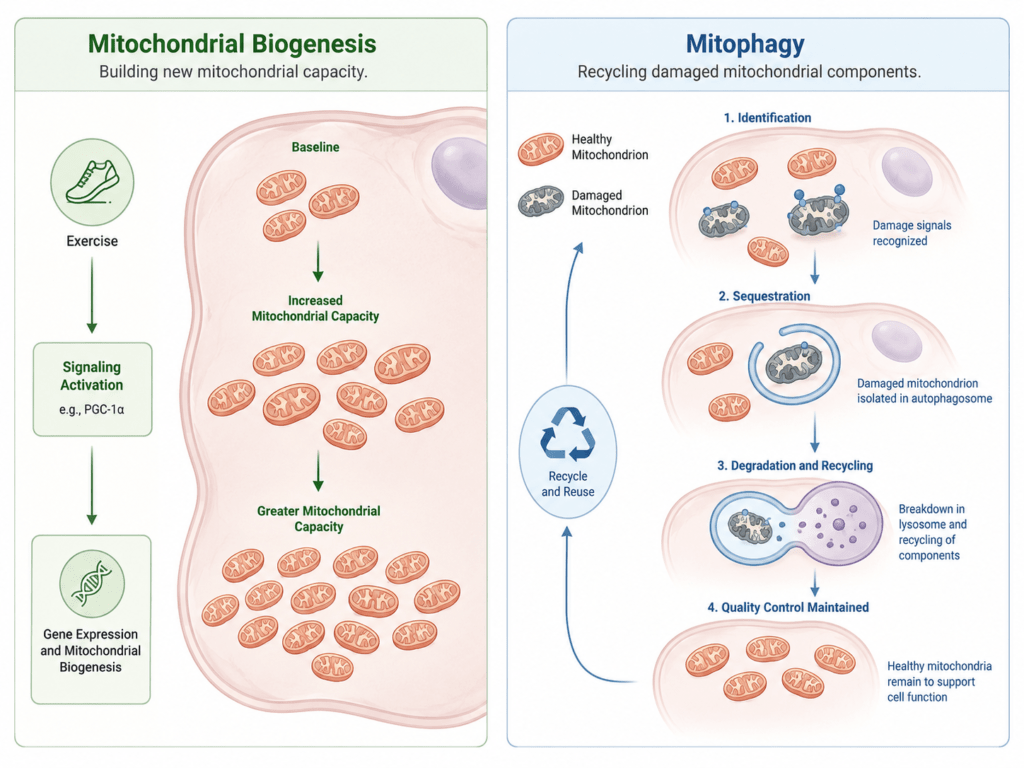
Exercise touches all of these systems. That is why movement is such a complete signal. It does not send only one message to the cell. It creates a coordinated challenge involving energy demand, oxygen use, circulation, nutrient handling, contraction, and recovery.
What This Means in Real Life
If exercise improves mitochondrial health, what should a regular person actually do?
Start with the minimum effective dose. For many people, that might mean walking most days, adding two strength sessions per week, and gradually increasing the amount of time spent moving.
The body adapts to what it can repeat. A 20-minute walk done consistently is more powerful than a perfect plan that collapses after one week.
Pay attention to recovery signals. If your resting heart rate is elevated, sleep is worse, motivation is unusually low, or soreness lingers for days, your training may be exceeding your current recovery capacity.
Mitochondria respond to training, but they do not adapt in isolation. Sleep, protein intake, energy availability, stress load, and recovery days shape whether the signal becomes progress.
A Simple Mitochondria-Supportive Exercise Framework
A practical routine does not need to be complicated.
Start with frequent low-intensity movement. Walking, cycling, easy swimming, or relaxed hiking can build aerobic consistency without overwhelming recovery.
Add strength training two or three times per week. Focus on large movement patterns such as squats, hinges, rows, presses, carries, and step-ups. The goal is not exhaustion. The goal is progressive, repeatable tension that helps muscle stay capable.
Use intensity sparingly. Short intervals or hill efforts can be useful, but they should support the routine rather than disrupt it.
Protect recovery. Sleep, hydration, protein, minerals, and rest days are part of the training signal. Adaptation happens after the workout, not only during it.
The Most Proven Bio-Hack Is Boring in the Best Way
Exercise is not glamorous because it is familiar. But biologically, it is profound.
It tells muscle cells that energy demand is rising. It encourages metabolic flexibility, which is the ability to shift between fuels. It supports circulation and oxygen delivery. It influences mitochondrial remodeling and quality control.
This is why exercise remains the foundation of any serious mitochondrial health strategy. Supplements, nutrition strategies, recovery tools, and tracking devices may have a place, but they work best around the signal that movement provides.
The goal is not to train like an athlete. The goal is to become a person whose body regularly receives the message: we need capacity, we need resilience, and we need to recover well enough to do this again.
Where Mitozz Fits In
Mitozz is not a substitute for exercise. It should not be framed as a shortcut around movement, sleep, nutrition, or recovery.
Mitozz is formulated around 98% pure (−)-epicatechin, a cacao-derived flavanol studied for its relationship with cellular signaling pathways involved in mitochondrial biology.
That distinction matters. Exercise is the most evidence-supported lifestyle stimulus for mitochondrial adaptation. Mitozz may fit as one targeted support tool within a broader strategy that includes movement, adequate fueling, sleep, recovery, and stress management.
For people already building a mitochondrial health routine, Mitozz can be positioned as part of the larger conversation around cellular energy support and healthy aging. The foundation remains consistent movement that the body can adapt to.
FAQ
Does exercise increase mitochondria?
Exercise can increase mitochondrial content and improve mitochondrial-related function in skeletal muscle, especially with consistent aerobic training. The exact response depends on training type, intensity, volume, baseline fitness, age, nutrition, and recovery.
Is cardio or strength training better for mitochondria?
Aerobic exercise is the classic mitochondrial stimulus because it directly trains oxygen-based energy production. Strength training also supports muscle health and can influence mitochondrial function. For most people, a combination is better than choosing only one.
How long does it take to improve mitochondrial health with exercise?
Some signaling changes can occur after a single workout, but meaningful adaptations usually require repeated training over weeks to months. Many people notice practical changes first, such as easier breathing, better stamina, or faster recovery.
Is HIIT good for mitochondria?
HIIT can be a strong mitochondrial and cardiovascular stimulus, but it should be matched to recovery capacity. Too much intensity can backfire if it reduces consistency or disrupts sleep and recovery.
結論
Exercise and mitochondria are deeply connected because movement creates the demand that mitochondrial systems adapt to meet.
Aerobic training builds sustained energy capacity. Strength training supports muscle resilience. Intensity can sharpen the signal when used wisely. Recovery turns effort into adaptation.
The most proven bio-hack is not a secret protocol. It is a repeatable rhythm of movement and recovery that tells your cells to build capacity over time.
Mitozz may fit into that broader routine as a targeted support tool formulated around 98% pure (−)-epicatechin. But the foundation remains the same: move consistently, recover intelligently, and give your mitochondria a reason to adapt.
このブログ記事をシェアする
参考文献
- Memme, J. M., et al. (2021). Exercise and mitochondrial health. The Journal of Physiology.
- Mølmen, K. S., et al. (2025). Effects of Exercise Training on Mitochondrial and Capillary Growth in Human Skeletal Muscle: A Systematic Review and Meta-Regression. Sports Medicine.
- Axelrod, C. L., et al. (2019). Exercise Training Remodels Human Skeletal Muscle Mitochondrial Fission and Fusion Machinery Towards a Pro-Elongation Phenotype. Acta Physiologica.
- Porter, C., et al. (2015). Resistance Exercise Training Alters Mitochondrial Function in Human Skeletal Muscle. Medicine & Science in Sports & Exercise.
- Yan, Z., et al. (2012). Exercise training-induced regulation of mitochondrial quality. Exercise and Sport Sciences Reviews.
- Drake, J. C., et al. (2019). How exercise improves mitochondrial quality in myofibers. Journal of Applied Physiology.
ミトコンドリアの健康を理解するには長い時間がかかります。だからこそ、私たちは「Mitozz を立ち上げました。ここは、細胞エネルギーの科学を探求し、生活習慣がミトコンドリアにどのような影響を与えるかを学び、専門家によるディスカッションや教育コンテンツ、ライブQ&Aを通じて最新情報を入手できる、自由な場です。ご自身のペースでご利用いただけます。
Mitozz に参加しましょう
細胞エネルギーとミトコンドリアの健康に焦点を当てた、会員や専門家によるディスカッション、教育コンテンツ、ライブQ&Aセッションをご利用いただけます。
医療に関する免責事項:本記事で提供される情報は、教育および情報提供のみを目的としており、医学的アドバイスを意図したものではありません。専門的な医学的診断、治療、または指導に代わるものではありません。 食事、運動習慣、断食、またはサプリメントの使用を変更する前には、必ず資格を持つ医療専門家に相談してください。特に、持病がある方、妊娠中または授乳中の方、あるいは薬を服用中の方は注意が必要です。
FDA免責事項:これらの記述は、米国食品医薬品局(FDA)による評価を受けたものではありません。これらは、いかなる疾患の診断、治療、治癒、または予防を目的としたものではありません。