
The Human Energy Crisis

Longer lives
are not enough.

An ongoing framework by Mani Agrawal

We have learned how to extend life and treat disease. We have not yet built equivalent systems to preserve the energy, function, and resilience that allow people to live those longer lives well.

Cellular Capacity Daily Life Human Environments Societal Systems
Begin with the gap

The Core Problem

We are adding years to life.
But not life to those years.

People are living longer than previous generations. But added years do not automatically mean added years of strength, mobility, cognitive capacity, independence, or resilience.

The result is a widening gap between lifespan and healthspan: more time alive, but not always more quality time to participate fully in work, family, community, and daily life.
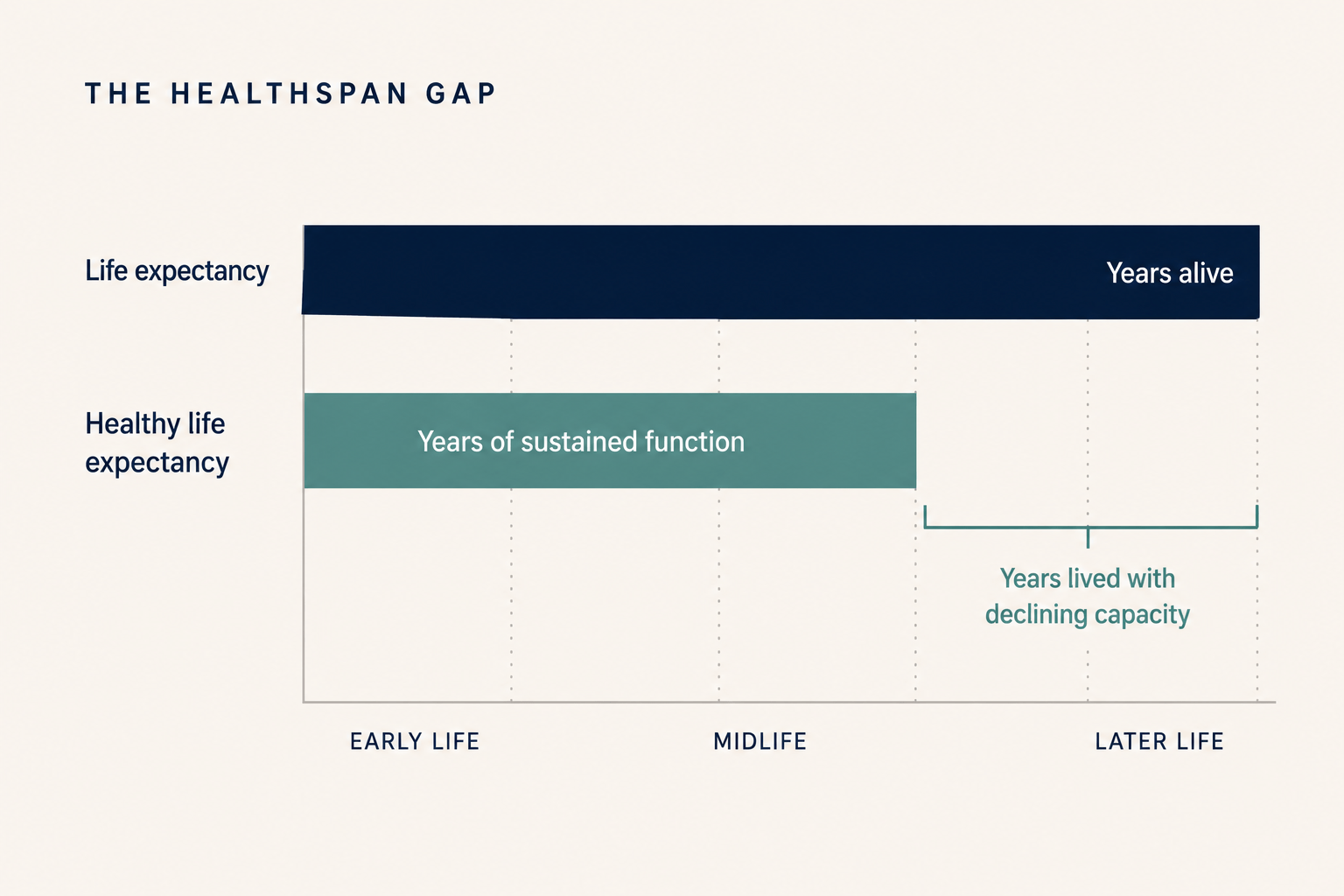
Chart comparing life expectancy with healthy life expectancy, highlighting the years lived with declining capacity between sustained function and total lifespan.

This is the Human Energy Crisis.

The Missing Layer

The capacity beneath a healthy life.

Living longer does not automatically preserve the ability to move, think, recover, adapt, and remain independent. Those abilities depend on the body’s capacity to produce and use energy over time.

The usual advice still matters: eat well, move, sleep, manage stress, and seek care when needed. But those inputs can only do so much if the biological systems that turn them into function lose capacity.
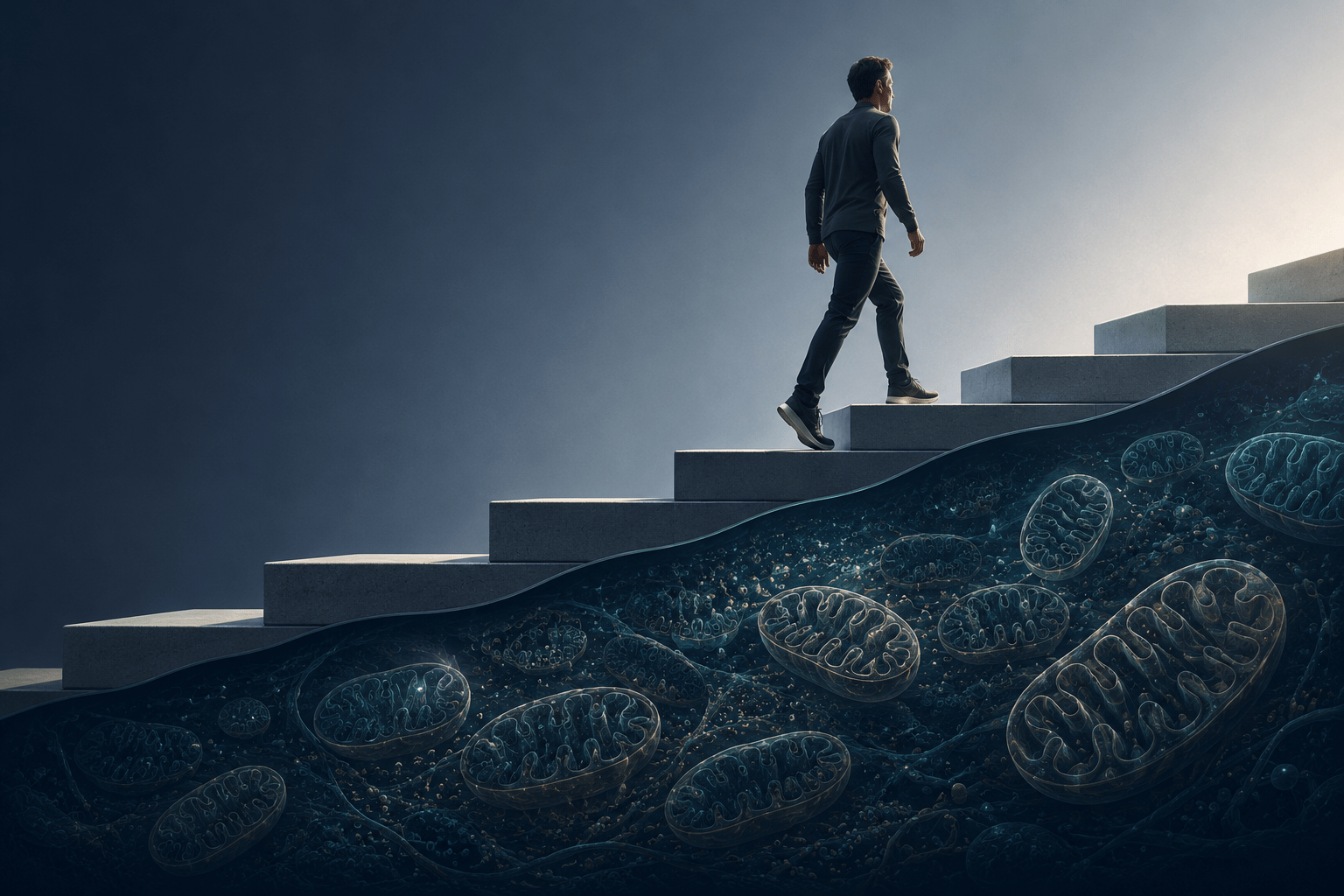
Conceptual illustration of a person climbing stairs above a hidden layer of mitochondria, representing biological capacity as the foundation of visible human movement and function.

What we see is movement. What makes movement possible is biological capacity.

Cellular energy is part of that foundation. Mitochondria help generate the energy cells use for daily function, recovery, and resilience.

Why It Matters

Human capacity is not only a personal asset. It is shared infrastructure.

A loss of energy, function, or resilience is rarely carried by one person alone. It can change how someone works, cares for family, participates in community, and remains independent over time.

At scale, those individual changes affect employers, insurers, health systems, and governments. They influence caregiving demand, workforce participation, healthcare spending, and the broader capacity of societies to adapt and grow.

Families & caregivers

Independence, time, care needs, and the ability to remain engaged in everyday life.

Workplaces & employers

Workforce participation, absence, retention, and the capacity to contribute over time.

Insurers & health systems

Prevention, claims, long-term care needs, and demand for increasingly complex support.

Governments & communities

Public spending, labor participation, social resilience, and long-term economic capacity.

The Opportunity

A future built for more than longevity.

Imagine longer lives matched by sustained energy, function, and resilience. That is the opportunity: more years in which people can move, learn, work, care for others, and participate in the life around them.

When capacity is preserved, the benefits can extend beyond the individual. Families carry less avoidable care burden. Workplaces retain experience. Communities benefit from more people able to contribute.

Today

More years of function.

Greater ability to move, think, recover, remain independent, and engage in daily life.

Over time

More capacity to contribute.

More opportunity to work, care, learn, create, participate, and share experience with others.

Across generations

Stronger conditions for those who follow.

Less avoidable burden and more resilient families, communities, and institutions over time.

Multi-generational vitality means helping people remain capable today while building stronger conditions for those who come next.

The Framework

Human capacity is built by systems,
not single interventions.

Cellular capacity is foundational, but it does not operate in isolation. The ability to remain energetic, functional, and resilient over time is shaped by the interaction between biology, daily life, environments, care, and the incentives built into society.

Incentive systems

Employers, insurers, health systems, governments, education, and public policy determine whether societies invest upstream in human capacity.

Care & measurement

Prevention, functional assessment, diagnostics, clinical care, and long-term tracking help identify change before loss of function becomes harder to reverse.

Human environments

Homes, workplaces, architecture, transport, air quality, daylight, accessibility, and social connection shape the conditions in which people live.

Daily life

Movement, food, sleep, circadian rhythm, stress load, and recovery continually influence the body’s ability to sustain function.

Cellular capacity

Mitochondrial health, metabolism, circulation, recovery, and biological resilience provide a foundational layer for long-term human function.

Shared outcome Sustained human capacity

No layer works alone. The goal is to improve the conditions that help people remain capable across the life course.

Policy Implications

The question is not whether societies pay. It is when.

Declining capacity carries costs that are borne by individuals, families, employers, insurers, and public systems. The question is whether the rules and incentives allow people closest to the problem to recognize risk earlier, experiment with better solutions, and invest in preserving capacity before needs become more complex.

Reactive

Respond when capacity is lost.

Necessary care when illness, injury, or loss of independence requires support.

  • Treatment and recovery
  • Disability and caregiving support
  • Long-term care
  • Crisis response
Proactive

Make capacity easier to preserve.

Earlier action that helps people and institutions sustain function over time.

  • Earlier measurement
  • Health-supportive environments
  • Prevention and adaptation
  • Research and experimentation

A healthier future depends not only on how much society spends, but on whether its incentives reward earlier investment, experimentation, and sustained human capacity.

The Path Forward

Human capacity deserves to become a shared priority.

Preserving human capacity will not come from one policy, technology, or institution. It will depend on people and organizations recognizing change early, testing what works, and investing before decline becomes harder to reverse.

The Human Energy Crisis is an ongoing framework connecting biology, daily life, human environments, and incentives around one goal: more years of capability, independence, and contribution.

Led by Mani Agrawal — Co-founder & CEO
Disciplined Global Strategist with decades
of experience in global systems optimization and turnarounds

Follow Mani on LinkedIn

Continue the Work

Stay part of the conversation.

Follow the evolving ideas, connect with others exploring human capacity, and stay informed as new thinking is published.

Join Mito-Hackers

This page is updated regularly with the latest thinking on the Human Energy Crisis platform. Follow for new insights, data, and practical guidance as the framework evolves.