Key Takeaways
- A new Nature study suggests that support cells around sensory nerves may transfer healthy mitochondria directly into neurons.
- This mitochondrial transfer appears to happen through tiny cell-to-cell bridges called tunnelling nanotubes.
- The process may help sensory neurons maintain energy, repair capacity, and resilience under stress.
- Researchers identified MYO10 as an important protein involved in this mitochondrial sharing mechanism.
- The findings are still early, but they point to a bigger idea: nerve health may depend not only on blocking pain signals, but also on restoring cellular energy support.
When most people think about mitochondria, they think about energy. That’s true, mitochondria produce roughly 90% of all the energy our bodies need, but that’s only part of the story.
Mitochondria are not just small power producers inside cells. They are dynamic structures involved in stress response, repair, signaling, inflammation, and cellular resilience. In tissues with high energy demands, such as nerves, mitochondrial function can be especially important.
A recent study published in Nature adds an important new layer to this picture. Researchers found that certain support cells around sensory neurons may transfer healthy mitochondria directly into those neurons. In preclinical models, this mitochondrial transfer appeared to help protect against nerve damage and neuropathic pain.
The study does not mean that mitochondrial transfer is ready to become a clinical treatment. It does, however, point to a fascinating biological principle: sometimes cellular health depends not only on what happens inside one cell, but also on how neighboring cells support each other.
Why Sensory Nerves Need Mitochondria
Sensory neurons are the cells that help your body detect touch, temperature, pressure, position, and pain. Many of these neurons have long extensions that reach from the spinal region all the way to the skin, muscles, or internal tissues.
That length creates a biological challenge.
Long nerve cells need a steady supply of energy to maintain electrical signaling, repair local damage, transport materials, and preserve the health of their membranes. Mitochondria help provide that energy by producing adenosine triphosphate, or ATP, the main energy currency used by cells.
When mitochondrial function is impaired, nerve cells may become more vulnerable to stress. This is one reason mitochondrial dysfunction has been studied in conditions involving peripheral neuropathy, including diabetic neuropathy and chemotherapy-induced nerve injury.
Peripheral neuropathy can involve pain, numbness, tingling, burning sensations, weakness, or altered sensitivity, often in the hands and feet. It is a complex condition with many possible causes. The new study does not reduce neuropathy to a single mechanism, but it does suggest that mitochondrial support may be one important part of nerve resilience.
The Role of Satellite Glial Cells
The study focused on sensory neurons located in structures called dorsal root ganglia, often abbreviated as DRG. These are clusters of nerve cell bodies located near the spinal cord.
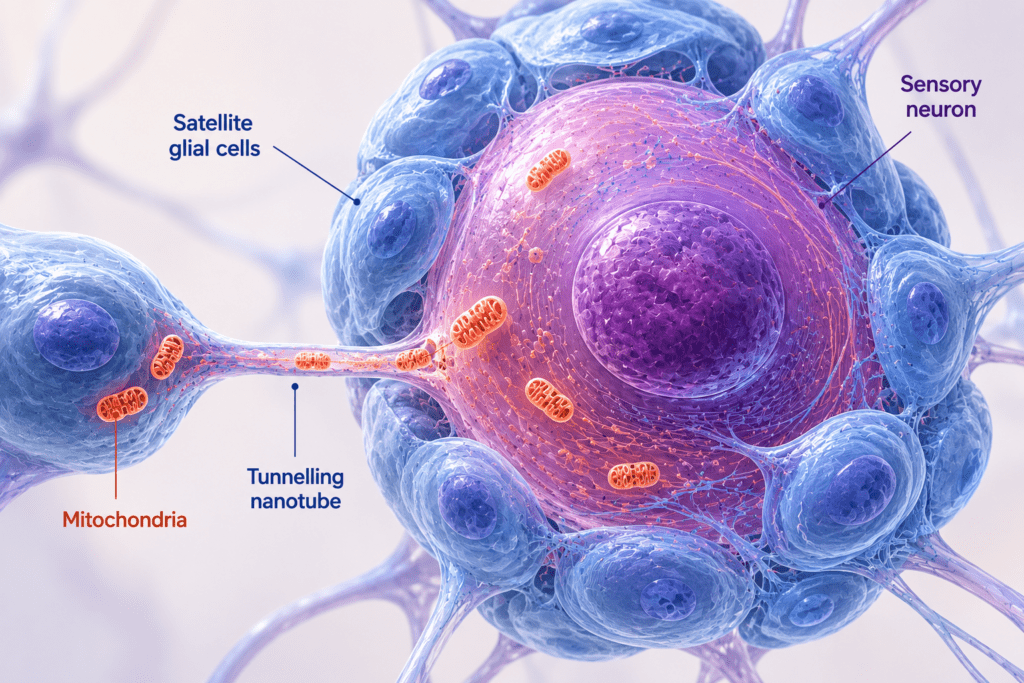
Inside the dorsal root ganglia, sensory neurons are surrounded by specialized support cells called satellite glial cells. For years, glial cells were often described mainly as supporting actors in the nervous system. That view has changed. Scientists now understand that glial cells can actively regulate inflammation, signaling, repair, and nerve activity.
This new research suggests that satellite glial cells may do something even more direct: they may donate mitochondria to nearby sensory neurons.
In other words, these support cells may help neurons maintain their mitochondrial supply.
That is a major idea. It suggests that nerve health may depend not only on the mitochondria a neuron already has, but also on whether neighboring cells can help replenish or stabilize that mitochondrial network.
What the Study Found
The researchers reported that satellite glial cells can transfer mitochondria to sensory neurons in several experimental settings, including cell-based systems, tissue models, animal models, and human tissue analysis.
This transfer appeared to occur through thin cellular bridges called tunnelling nanotubes. These microscopic structures can connect cells and allow biological material to move from one cell to another.
The study also identified a protein called MYO10, short for myosin 10, as an important part of the process. MYO10 appears to help form or maintain the structures needed for mitochondrial transfer.
When mitochondrial transfer was disrupted, nerve health worsened in the models studied. When healthy satellite glial cells or mitochondria were provided in experimental settings, neuropathic pain behaviors were reduced.
The researchers also found evidence that satellite glial cells from people with diabetes had reduced MYO10 expression and reduced mitochondrial transfer capacity. That finding is especially interesting because diabetic neuropathy is one of the most common forms of peripheral neuropathy.
Still, this should be interpreted carefully. The presence of a mechanism in human tissue analysis does not automatically mean that a treatment is ready for human use. It means researchers have identified a biologically relevant pathway that may deserve further study.
What Makes This Discovery Important
The most interesting part of the study is not simply that mitochondria matter. That part is already well supported.
The more interesting point is that mitochondria may be shared between cells as part of a protective response.
This shifts the way we think about mitochondrial health. Instead of imagining each cell as isolated, the study supports a more connected view of biology. Cells may cooperate to maintain energy balance, repair capacity, and resilience.
For nerve health, that could matter a great deal.
Sensory neurons have high energy demands. They also need to maintain long cellular projections across large distances. If their mitochondrial supply becomes damaged or insufficient, neighboring glial cells may help compensate by transferring healthier mitochondria.
This kind of cellular cooperation may be especially important under stress, such as diabetes, chemotherapy exposure, nerve injury, or chronic inflammation.
What This Does Not Mean Yet
It is important not to overstate the findings.
This study does not prove that mitochondrial transfer is a current treatment for neuropathy in humans. It does not show that any supplement, food, medication, or lifestyle intervention can reproduce this effect. It also does not mean that all neuropathic pain is caused by impaired mitochondrial transfer.
Neuropathic pain is complex. It can involve inflammation, immune signaling, nerve injury, altered ion channel activity, metabolic stress, vascular changes, and changes in how pain signals are processed by the nervous system.
What this study does show is that mitochondrial transfer may be one protective mechanism involved in maintaining sensory neuron health. It also suggests that impaired mitochondrial support from satellite glial cells could contribute to nerve vulnerability in some contexts.
That makes the research exciting, but still early.
Why This Matters for the Bigger Mitochondrial Health Conversation
At Mitozz, we follow mitochondrial science because it keeps showing the same larger pattern: mitochondria are not only about energy in the simple sense. They are deeply connected to how cells adapt, repair, communicate, and respond to stress.
This study fits that pattern.
It suggests that mitochondrial support may be part of how the nervous system protects itself. It also reinforces the idea that cellular energy is not just about feeling alert or avoiding fatigue. At a deeper biological level, energy availability can influence how tissues maintain structure, function, and resilience over time.
For people interested in mitochondrial health, the takeaway is not that one new study changes everything. The takeaway is that mitochondria continue to appear at the center of many biological systems that affect long-term function.
Nerve cells need energy. Support cells help regulate the nerve environment. Mitochondria may move between cells when support is needed. Together, these findings point to a more dynamic view of cellular health.
What This Means in Real Life
The idea that cells can share mitochondria may sound futuristic, but the basic concept is simple.
Your cells are not passive machines. They are constantly sensing stress, repairing damage, exchanging signals, and adapting to changing conditions. In the nervous system, that support network appears to include direct communication between neurons and glial cells.
When sensory neurons are under stress, their ability to maintain healthy mitochondria may affect how well they function. If nearby support cells can help restore mitochondrial supply, that may improve resilience. If that support system becomes impaired, the neuron may become more vulnerable.
This does not mean we can make direct medical claims from the study. But it does support a broader, science-based message: mitochondrial health is part of the foundation of cellular resilience.
The Future of Mitochondrial Research
The next major question is whether this discovery can eventually be translated into safe and effective therapies.
Future research will need to answer several questions:
- Can mitochondrial transfer be measured reliably in humans?
- Can the MYO10 pathway be safely targeted?
- Does impaired mitochondrial transfer contribute to neuropathy in specific patient groups?
- Could mitochondrial transfer mechanisms be supported without causing unwanted effects?
- Would this approach work for diabetic neuropathy, chemotherapy-induced neuropathy, or only certain subtypes of nerve injury?
These questions will take time to answer. But the study gives researchers a new direction: instead of only blocking pain signals after they appear, future therapies may aim to restore cellular support systems that help nerves stay healthy.
Conclusion
A new Nature study shows that satellite glial cells may help protect sensory neurons by transferring mitochondria through tunnelling nanotubes. The process appears to depend partly on MYO10 and may be impaired in diabetes-related nerve dysfunction.
The discovery is still early, but it is important. It shows that mitochondrial health is not just an internal feature of individual cells. It may also be part of a cooperative support network between neighboring cells.
For nerve health, pain research, and the broader science of cellular resilience, this is a powerful idea.
Sometimes the future of medicine may not be only about blocking signals. It may also be about restoring the cellular energy systems that help tissues protect and repair themselves.
References
Xu et al., (2026). Mitochondrial transfer from glia to neurons protects against peripheral neuropathy. Nature.
National Institutes of Health. (2026). Cellular mitochondria transfer prevents pain. NIH Research Matters.
Suggested Tags
mitochondria, mitochondrial health, nerve health, neuropathy, neuropathic pain, cellular energy, satellite glial cells, sensory neurons, dorsal root ganglia, tunnelling nanotubes, MYO10, cellular resilience, mitochondrial transfer, inflammation, Mitozz