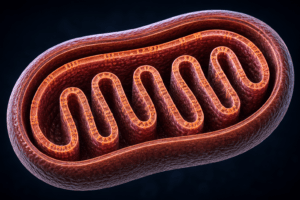
If you have ever felt that mid-afternoon slump where the coffee stops working and your focus begins to drift, you have felt a shift in your internal energy dynamics. We often think of energy as something we “get” from a meal or a nap, but at the most fundamental level, energy is something your body must actively produce. This production happens within the mitochondria, the specialized structures inside your cells that act as the primary engines of life.

Mitochondrial function is more than just a biological buzzword, as it represents your body’s total capacity to meet the demands of your day. When these engines are running efficiently, your cells can easily power everything from muscle contraction to deep cognitive work. However, when the demand for energy exceeds your current supply, you may notice a decline in recovery and overall resilience.
This article explores the mechanics of mitochondrial health and a vital process called mitochondrial biogenesis. Understanding how your body builds and maintains these energy factories is the first step toward supporting long-term physiological capacity.
The Biology of Cellular Energy
To understand mitochondrial function, we have to look at the relationship between cellular energy and the molecules that carry it. The primary currency of the cell is ATP, or adenosine triphosphate. Your mitochondria are responsible for taking the nutrients from your food and the oxygen you breathe and converting them into ATP through a complex series of steps.
This process is not just a simple one-to-one conversion. It requires a highly coordinated dance of proteins and membranes working in unison. When we talk about “healthy” mitochondrial function, we are describing a state where the mitochondria can produce high levels of ATP with minimal “exhaust” in the form of reactive oxygen species.
Why this matters: Efficient energy production ensures that your cells have the surplus resources needed to repair damage and adapt to stress, rather than just surviving the moment.
What Is Mitochondrial Biogenesis?
If mitochondria are the engines of the cell, then mitochondrial biogenesis is the manufacturing process that builds more of them. Your body does not have a fixed number of mitochondria for life. Instead, your cells can increase the density and volume of their mitochondrial network based on the signals they receive from your environment and behavior.
This process is primarily governed by a master signaling molecule known as PGC-1α. When this “master switch” is flipped, it triggers a cascade of genetic instructions that tell the cell to replicate mitochondrial DNA and assemble new structures. This is the body’s way of increasing its power grid to meet rising energy needs.
- Growth: New mitochondria are formed to increase total energy output.
- Repair: Biogenesis often works alongside mitophagy, the removal of old, damaged mitochondria.
- Network: Mitochondria often exist in a fluid, interconnected web rather than as isolated organelles.
Why this matters: Increasing your mitochondrial density through biogenesis is like adding more lanes to a highway, allowing for more “traffic” or energy to flow without causing a bottleneck.
The Impact of Cumulative Strain
Over time, our mitochondrial function tends to decline. This is rarely the result of a single event, but rather the cumulative effect of biological strain. Sedentary lifestyle, poor sleep, and the natural process of aging can lead to a state where mitochondria become less efficient and fewer in number.
When mitochondria struggle, the cell enters a state of energy deficit. You might experience this as a slower recovery after a workout or a feeling of being “run down” even when your schedule is light. Research indicates that as we age, the signaling pathways that trigger biogenesis, like PGC-1α, can become less responsive. This leads to a gradual shrinking of our energy capacity.
Why this matters: Maintaining the “machinery” of your cells is essential for resilience, as it allows you to bounce back from stress more effectively as the years pass.
Lifestyle Foundations for Mitochondrial Support
The good news is that mitochondria are highly adaptive. Because they evolved to respond to the needs of the body, we can influence their function through specific lifestyle “shocks” that signal a need for more energy.
Physical Activity and Metabolic Stress Exercise is perhaps the most well-documented trigger for biogenesis. When you challenge your muscles through endurance training or high-intensity intervals, you create an immediate demand for ATP. This stress signals to PGC-1α that the current mitochondrial supply is insufficient, prompting the cell to build more engines.
Nutrition and Recovery The raw materials for energy production come from our diet, but the “timing” of energy intake also matters. Strategies like intermittent fasting or caloric restriction have been studied for their ability to activate the AMPK pathway. This pathway acts as a fuel sensor, turning on energy-producing processes and encouraging the recycling of old cellular components.
Click this link for a more comprehensive list of things you can do to improve mitochondrial health.
Targeted Nutritional Support: Where Mitozz Fits In
While lifestyle remains the foundation, researchers are increasingly looking at specific compounds that may support the signaling pathways involved in mitochondrial function. One such compound is (-)-epicatechin, a unique flavanol found in cacao and green tea.
Evidence indicates that (-)-epicatechin may help support the activation of PGC-1α and improve the efficiency of the mitochondrial network.
Mitozz is a nutraceutical developed by FMG Health Sciences, designed to complement your lifestyle efforts. By providing a concentrated source of 98% pure (-)-epicatechin, it offers targeted support for the biological systems that govern cellular energy and adaptive capacity.
Conclusion: Building a Resilient Future
Mitochondrial function is the invisible engine behind your daily experience of energy and your long-term health span. By understanding that our cellular capacity is dynamic rather than fixed, we gain the agency to support our own resilience.
Focusing on movement, intentional recovery, and evidence-based nutritional support allows you to maintain a robust mitochondrial network. This systems-level approach ensures that your body has the energy it needs, not just for today, but for the years ahead.
Share this blog article
References
- Hood, D. A., et al. (2016). Mechanisms of exercise-induced mitochondrial biogenesis in skeletal muscle. Applied Physiology, Nutrition, and Metabolism.
- Nogueira, L., et al. (2011). (-)-Epicatechin enhances fatigue resistance and oxidative capacity in mouse muscle. Journal of Physiology.
- Lopez-Lluch, G., et al. (2008). Mitochondrial biogenesis and healthy aging. Experimental Gerontology.
- Gutierrez-Salmean, G., et al. (2014). Effects of (-)-epicatechin on molecular modulators of skeletal muscle growth and differentiation. Journal of Nutritional Biochemistry.
Understanding mitochondrial health is a long-term process. That’s why we created the Mitozz Newsletter: a free way to keep learning about cellular energy, mitochondrial health, and the lifestyle signals that support your body over time. You’ll receive science-based educational content, practical guidance, and updates from Mitozz, all at your own pace.
Sign up for the Mitozz Newsletter
Get science-based education on mitochondrial health, cellular energy, and lifestyle signals that support your body over time.
Medical Disclaimer: The information provided in this article is for educational and informational purposes only and is not intended as medical advice. It is not a substitute for professional medical diagnosis, treatment, or guidance. Always consult with a qualified healthcare professional before making changes to your diet, exercise routine, fasting practices, or supplement use, especially if you have a medical condition, are pregnant or nursing, or are taking medications.
FDA Disclaimer: These statements have not been evaluated by the Food and Drug Administration. They are not not intended to diagnose, treat, cure, or prevent any disease.