Puntos clave
- Heat and cold can act as hormetic stress signals.
- Mitochondria help coordinate energy, heat, and adaptation.
- Moderate stress may support resilience, while excess stress can overwhelm recovery.
- Cold exposure strongly involves thermogenesis and brown fat activity.
- Mitozz may fit as one support tool within a broader recovery-centered routine.
Heat and cold are more than sensations. At the right dose, they can be biological signals.
A hot sauna, a warm bath, a cold shower, or a brisk winter walk can all challenge the body’s temperature-control systems. That challenge changes circulation, breathing, metabolism, nervous-system activity, and cellular stress signaling. Mitochondria sit close to the center of this response because they help cells convert fuel and oxygen into ATP, the usable energy currency that supports work, repair, and adaptation.
This is where mitochondrial hormesis becomes useful. Hormesis describes a pattern where a small, manageable stress can trigger adaptive responses, while too much stress can become harmful. In mitochondrial biology, this idea is often called mitohormesis, especially when low-level mitochondrial stress signals help activate repair, antioxidant defense, and energy-adaptation pathways. Reviews describe mitohormesis as a process in which low levels of reactive oxygen species can help activate adaptive stress responses, while high levels can contribute to damage.
The key word is controlled. Heat and cold are not automatically beneficial. They become useful only when the stress is appropriate for the person, the dose, and the recovery that follows.
What Is Mitochondrial Hormesis?
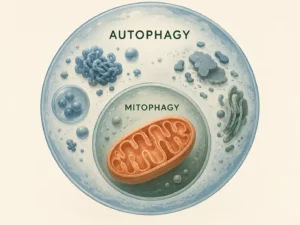
Mitochondrial hormesis refers to the idea that mild mitochondrial stress can stimulate positive adaptive responses in mitochondria. These responses may include antioxidant defense, protein repair, mitochondrial biogenesis, mitophagy, and improved stress tolerance.
To understand this, it’s important to understand that not all cellular stress is bad. Cells constantly receive signals from exercise, fasting, sleep loss, heat, cold, infection, emotional stress, and nutrient availability. Some of those signals are helpful in small amounts because they tell the body to build capacity. Others become harmful when they are too frequent, too intense, or if not followed by enough recovery.
Reactive oxygen species are a good example. ROS are often described as damaging byproducts of metabolism. That can be true when levels are excessive. But ROS also act as signaling molecules, helping cells detect energy demand and activate protective pathways.
This is why redox balance matters more than simply trying to suppress every reactive molecule. Cells need enough signaling to adapt, enough protection to prevent excess damage, and enough recovery to return to a stable baseline.
Hormesis is the biology of the middle zone. Too little stress may provide no signal to initiate adaptation. Too much stress may exceed the system’s ability to recover. The useful zone is that which challenges the system without overwhelming it.
Why Temperature Is a Powerful Signal
Temperature stress is biologically expensive. Your body works hard to keep internal temperature within a narrow range, usually around 36.1°C to 37.2°C, or about 97°F to 99°F.
Heat: When you are exposed to heat, the body increases skin blood flow and sweating to release heat. Heart rate often rises. Plasma volume and vascular responses can change with repeated exposure. Cells also activate heat-response pathways, including heat shock proteins, which help protect protein structure and support cellular maintenance.
Cold: When you are exposed to cold, the body reduces blood flow to the skin, may trigger shivering, and can activate nonshivering thermogenesis. Nonshivering thermogenesis is heat production without muscle shivering, largely involving brown adipose tissue. Brown fat is rich in mitochondria and uses energy to produce heat.
Both heat and cold increase biological demand. That demand can become a training signal when it is repeated carefully and paired with recovery.
How Heat Affects Mitochondria
Heat exposure appears to interact with mitochondria through several pathways.
First, heat can increase cellular stress-response proteins. Heat shock proteins help maintain protein folding and reduce the accumulation of damaged proteins. This matters because mitochondria rely on a large network of proteins to move electrons, maintain membrane potential, and produce ATP efficiently.
Second, heat increases circulation. More blood flow can change oxygen delivery, vascular shear stress, and nitric oxide signaling. A major review on heat therapy describes cardiovascular and vascular mechanisms as central to many observed heat-adaptation effects.
Third, repeated heat exposure may influence mitochondrial function in skeletal muscle. In a human study of localized heat therapy, six weeks of muscle-localized heat improved mitochondrial respiratory capacity, though it did not improve fatty acid oxidation capacity in the same way exercise did.
That distinction is important. Heat is not “exercise in a sauna.” Exercise creates mechanical tension, muscle contraction, calcium signaling, energy turnover, and many tissue-specific effects that passive heat does not fully reproduce. Heat may overlap with some adaptation pathways, but it is not a replacement for movement.
A practical way to think about heat is that it may be a supportive stress signal for circulation, cellular stress response, and mitochondrial adaptation, but only when the dose is safe and recovery is adequate.
How Cold Affects Mitochondria
Cold exposure communicates through a different biological language.
Our body’s immediate goal for cold exposure is temperature defense. The body tries to preserve core temperature by changing blood flow, increasing muscle activity if shivering occurs, and activating thermogenic tissues. Brown adipose tissue is especially relevant because it contains mitochondria that can generate heat through uncoupling mechanisms.
A systematic review and meta-analysis found that acute cold exposure can increase energy expenditure and brown adipose tissue activity in adults. Human cold-acclimation research has also shown that a 10-day cold-acclimation protocol increased brown adipose tissue activity in parallel with increased nonshivering thermogenesis.
Cold is not only about brown fat, though. It also affects the nervous system, blood vessels, glucose and lipid handling, breathing patterns, and perceived stress. The experience can feel energizing for some people and draining for others.
From a mitochondrial perspective, cold increases energy demand. The body has to decide how to allocate fuel toward heat production, movement, and basic maintenance. In the right context, this can become an adaptive signal. In the wrong context, especially with poor sleep, under-fueling, overtraining, or high stress, it can become another load on an already strained system.
The Hormesis Rule: Dose Makes the Signal
The most common mistake with heat and cold routines is assuming that more discomfort means more benefit.
That’s not how hormesis works. Hormesis depends on the relationship between stress and recovery. A small challenge can stimulate adaptation. A large or poorly timed challenge can become a stressor the body has to survive rather than adapt to.
The goal is not to “win” against temperature. The goal is to give the body a signal it can respond to.
Signs the dose may be too high include feeling wiped out after exposure, disrupted sleep, dizziness, headache, excessive fatigue, unusually high resting heart rate, or reduced training recovery. You shouldn’t confuse these as signs of “detox.” They are signals to reduce the dose or stop.
A better starting point is to use the minimum effective challenge. For heat, that may mean a shorter sauna or warm bath rather than an extreme session. For cold, that may mean cool water at the end of a shower rather than a long cold plunge.
Heat, Cold, and Recovery Work Together
Temperature exposure should not be separated from the rest of the day.
Heat after a hard workout may feel relaxing, but it still adds cardiovascular and thermal load. Cold after training may reduce soreness for some people, but intense cold exposure immediately after strength training may not always align with adaptation goals. The right timing depends on the person, the training phase, and the purpose.
Sleep is also central. Hormetic stressors work best when the body has enough recovery capacity. Poor sleep changes glucose regulation, stress hormones, appetite, inflammation, and perceived effort. A person who is sleeping poorly may not respond well to more stress. They may need less stress and more restoration.
Nutrition matters too. Heat and cold both interact with hydration, electrolytes, fuel availability, and metabolic flexibility. Cold exposure while under-fueled can feel very different from cold exposure after adequate nutrition. Heat exposure without enough fluid or electrolytes can become risky quickly.
Qué significa esto en la vida real
A practical temperature routine should feel like training, not punishment.
For heat, a beginner might start with comfortable warmth for a short session, then build gradually. The session should end with a sense of relaxation or mild challenge, not collapse.
For cold, a beginner might start with cool water for 15 to 30 seconds at the end of a shower. Over time, duration or intensity can be adjusted. The body should warm back up naturally afterward. If cold exposure creates prolonged shivering, anxiety, or exhaustion, the dose is obviously too high.
The best marker is next-day capacity. If your sleep, mood, energy, and training recovery stay steady or improve, the routine may be appropriate. If those markers decline, the stress dose is probably competing with recovery.
Hormesis is not about seeking stress for the sake of stress. It is about becoming more responsive to stress.
El lugar que Mitozz
Mitozz is formulated around 98% pure (−)-epicatechin, a plant-derived flavanol studied for its relationship with cellular signaling pathways involved in mitochondrial biology.
That matters because heat, cold, movement, and nutrition all communicate with mitochondria through mitochondrial signaling pathways. Some involve redox balance. Some involve nitric oxide. Some involve mitochondrial biogenesis, circulation, and stress-response systems.
For example, a cell study reported that (−)-epicatechin stimulated mitochondrial biogenesis and cell growth in C2C12 myotubes through a pathway involving the G-protein coupled estrogen receptor. A small human study using epicatechin-rich cocoa in people with type 2 diabetes and heart failure observed changes in skeletal muscle mitochondrial structure and biogenesis markers.
Mitozz is not designed to replace heat, cold, exercise, sleep, or nutrition. But Mitozz may fit as one targeted support tool within a broader cellular energy strategy. To see how temperature exposure fits into a broader routine, read our guide to bio-hacking mitochondria.
Preguntas frecuentes
Is mitochondrial hormesis good or bad?
It depends on the dose. Mild, recoverable stress may help activate adaptive pathways. Excessive or repeated stress without recovery can become harmful.
Are saunas good for mitochondria?
Heat exposure may influence mitochondrial-related pathways, circulation, heat shock proteins, and skeletal muscle respiratory capacity in some studies. But sauna use should be approached carefully and is not a substitute for exercise, sleep, or medical care.
Does cold exposure improve mitochondrial function?
Cold exposure can increase energy expenditure and brown fat activity in humans. Brown fat is rich in mitochondria and helps produce heat. However, the effect varies by person, cold dose, acclimation status, and recovery capacity.
Should I do heat and cold every day?
Not necessarily. Daily exposure may be too much for some people, especially if sleep, nutrition, stress, or training recovery are already strained. Start with a low dose and track how you feel the next day.
Conclusión
Heat and cold are not magic. They are signals.
Used carefully, temperature exposure may help the body practice adaptation.
The most important principle is recovery. Hormesis only works when the body can respond, repair, and adapt. Without recovery, heat and cold become just more stress your body has to deal with.
Comparte este artículo del blog
Referencias
- Ristow, M., & Schmeisser, S. (2014). Mitohormesis: Promoting health and lifespan by increased levels of reactive oxygen species. Dose-Response.
- Brunt, V. E., et al. (2021). Heat therapy: Mechanistic underpinnings and applications to cardiovascular health. Journal of Applied Physiology.
- Marchant, E. D., et al. (2022). Localized heat therapy improves mitochondrial respiratory capacity but not fat oxidation in human skeletal muscle. International Journal of Molecular Sciences.
- Huo, C., et al. (2022). Effect of acute cold exposure on energy metabolism and activity of brown adipose tissue in humans: A systematic review and meta-analysis. Frontiers in Physiology.
- van der Lans, A. A. J. J., et al. (2013). Cold acclimation recruits human brown fat and increases nonshivering thermogenesis. Journal of Clinical Investigation.
- Merry, T. L., & Ristow, M. (2016). Mitohormesis in exercise training. Free Radical Biology and Medicine.
- Moreno-Ulloa, A., et al. (2018). (−)-Epicatechin stimulates mitochondrial biogenesis and cell growth in C2C12 myotubes via the G-protein coupled estrogen receptor. European Journal of Pharmacology.
- Taub, P. R., et al. (2012). Alterations in skeletal muscle indicators of mitochondrial structure and biogenesis in patients with type 2 diabetes and heart failure: Effects of epicatechin rich cocoa. Clinical and Translational Science.
Comprender la salud mitocondrial es un proceso a largo plazo. Por eso hemos creado el Mitozz : una forma gratuita de seguir aprendiendo sobre la energía celular, la salud mitocondrial y los hábitos de vida que favorecen el bienestar de tu cuerpo a lo largo del tiempo. Recibirás contenido educativo con base científica, consejos prácticos y novedades de Mitozz, todo ello a tu propio ritmo.
Suscríbete al Mitozz de Mitozz
Obtén información con base científica sobre la salud mitocondrial, la energía celular y los hábitos de vida que favorecen el bienestar de tu cuerpo a largo plazo.
Aviso médico: La información proporcionada en este artículo tiene fines exclusivamente educativos e informativos y no pretende constituir un consejo médico. No sustituye el diagnóstico, el tratamiento ni la orientación médicos profesionales. Consulte siempre a un profesional sanitario cualificado antes de realizar cambios en su dieta, rutina de ejercicio, prácticas de ayuno o uso de suplementos, especialmente si padece alguna afección médica, está embarazada o en periodo de lactancia, o está tomando medicamentos.
Descargo de responsabilidad de la FDA: Estas declaraciones no han sido evaluadas por la Administración de Alimentos y Medicamentos (FDA). No están destinadas a diagnosticar, tratar, curar ni prevenir ninguna enfermedad.