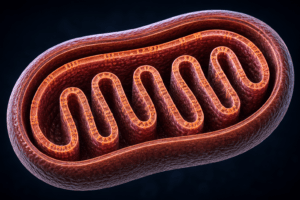
Pontos principais
- Aging is not only about having fewer mitochondria. The quality of the mitochondrial population matters too.
- Mitochondrial DNA, or mtDNA, provides a small but essential set of instructions used in cellular energy production.
- Cells can contain many mitochondria while still losing usable capacity if a growing share of mitochondrial genomes carries harmful mutations or deletions.
- Quality control depends on coordinated sensing, removal, and rebuilding. More mitochondrial turnover is not automatically better.
- Research on selectively reducing damaged mtDNA is scientifically interesting, but it remains largely preclinical and is not a consumer treatment strategy.
When people talk about mitochondria as it relates to aging, the conversation usually turns to question of quantity. Do we make fewer mitochondria as we get older? Can exercise help us build more?
Those are useful, important questions, but there is another part of the story we need to think about.
A cell can have a large mitochondrial population yet still have a weaker energy system if too much of that population carries damaged mitochondrial genetic instructions. In that sense, mitochondrial capacity is not only a question of how much machinery is present. It is also a question of how well that machinery is maintained.
That is why mitochondrial DNA deserves more attention in the aging conversation.
We have previously looked at the broader decline in mitochondrial capacity in Why Does Energy Drop as We Get Older?.
In todays article, the question is narrower: what happens when the mitochondria that remain are carrying increasingly uneven genetic instructions?
What mitochondrial DNA actually does
Mitochondria are unusual because they carry their own small genome, called mitochondrial DNA, or mtDNA. Human mtDNA contains 37 genes. Thirteen encode proteins that form essential parts of the oxidative phosphorylation system, while the rest encode RNAs needed to make those proteins. Most mitochondrial proteins, however, are encoded by genes in the cell nucleus and imported into the mitochondria.
This distinction matters because the mitochondrial genome helps provide instructions for some of the machinery involved in turning fuel and oxygen into ATP, the main form of usable cellular energy.
Cells also carry many copies of mtDNA rather than just one. A single cell can therefore contain a mixture of different mitochondrial genomes, including normal and mutated copies, a state known as heteroplasmy. The proportions of these variants can change over time and can differ between tissues.
The practical point is simple: mitochondrial genetics is not necessarily an all-or-nothing system. Quality can shift gradually within a mitochondrial population.
Why mtDNA can become a quality problem
Mitochondrial DNA sits inside mitochondria, close to the machinery that produces cellular energy. Unlike nuclear DNA, which is kept inside the nucleus of human cells, mitochondrial DNA is packaged and maintained differently, which affects how damage is handled over time.
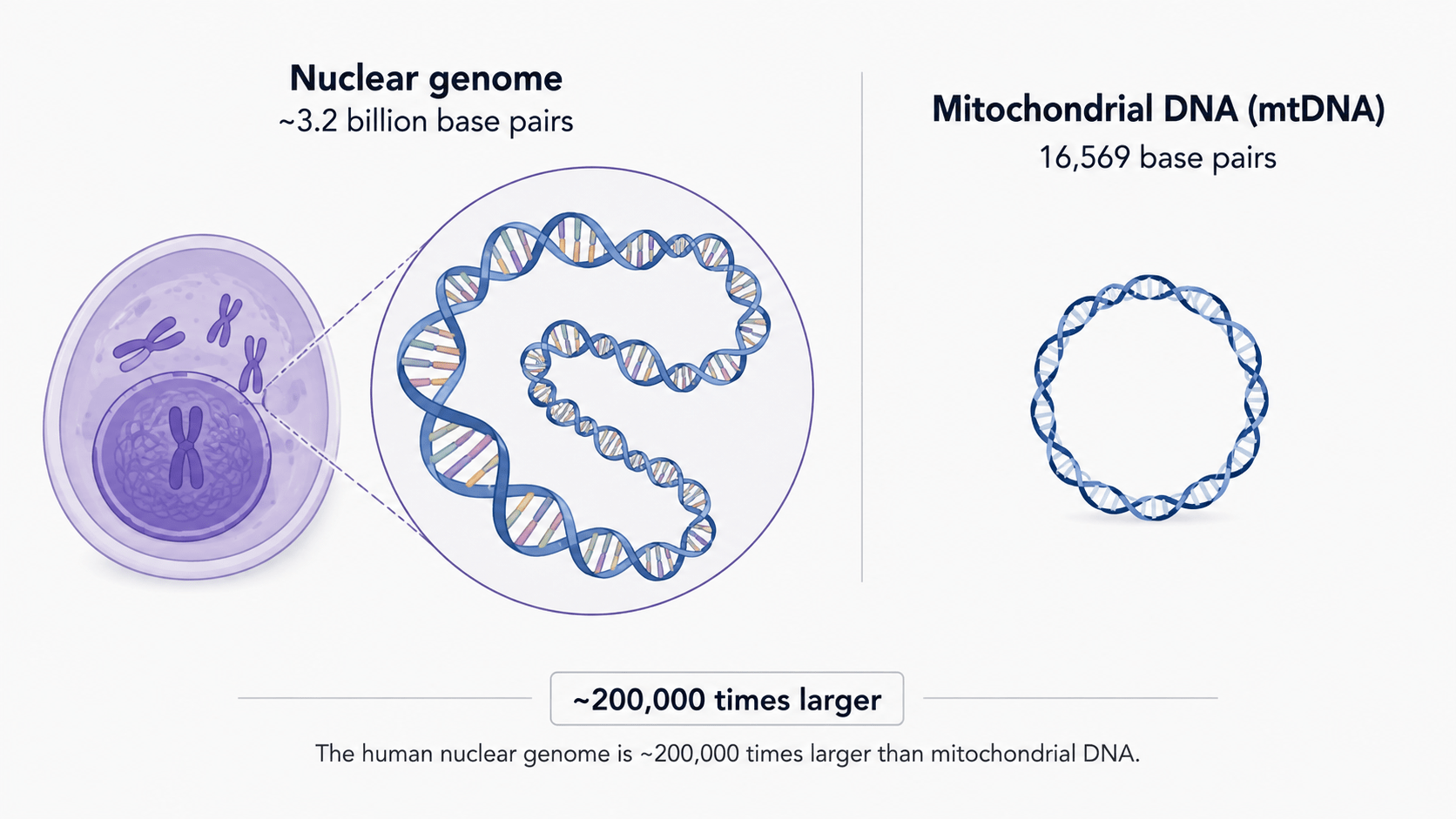
Mitochondrial DNA is protected, but not in the same way as nuclear DNA. Nuclear DNA is stored inside the cell nucleus, wrapped around histone proteins, and organized into chromosomes. Mitochondrial DNA sits inside mitochondria and is packaged with a different set of proteins. It also relies on different systems for copying, maintaining, and removing damaged DNA.
Over time, mutations and deletions can occur in mitochondrial DNA. In some cells, these damaged copies can become more common and make up a larger share of the mitochondrial DNA present. This is why researchers increasingly look at mitochondrial aging as a question of quality, not just quantity.
Why “more mitochondria” is not automatically better
Imagine two factories with the same number of machines.
In the first factory, most machines are maintained, defective components are removed, and replacements are installed as needed. In the second, the machine count looks similar, but a larger fraction is operating with faulty instructions or worn components.
Counting total number of machines alone would miss the difference.
Mitochondrial biology works in a similar way. Researchers describe mitochondrial quality control as an integrated system involving protein maintenance, mitochondrial fusion and fission, biogenesis, and mitophagy, the selective removal of mitochondria that are damaged or no longer useful.
A 2026 review in Nature Metabolism places this maintenance network at the center of mitochondrial function during human aging. The emphasis is important: maintaining capacity depends on both renewal and removal, not simply expansion.
That is the part of the aging conversation that gets lost if mitochondrial health is reduced to “make more mitochondria.”
Clearance is the other half of capacity
Cells continually inspect and remodel their mitochondrial network.
When a mitochondrion or part of the network becomes dysfunctional, cells have mechanisms that can isolate damaged material, reorganize the network, recycle components, and replenish capacity. Mitophagy is one part of that process, but it is not the whole system.
A useful way to think about mitochondrial maintenance is: sense, clear, rebuild.
This also explains why quality control cannot be reduced to a single pathway or molecule. Clearing damaged material without adequate replacement would be a poor maintenance strategy. Building new mitochondrial components without removing defective ones would leave another problem unresolved.
For the broader recycling mechanism, see Mitochondria and Mitophagy: The Science of Cellular Recycling.
What the damaged-mtDNA research actually showed
One experiment that continues to receive attention came from researchers at Caltech and UCLA and was published in Nature Communications in 2016.
The researchers created fruit flies whose flight-muscle cells contained a high proportion of mtDNA carrying a harmful deletion. By experimentally changing several quality-control pathways, including autophagy and the PINK1/Parkin pathway, they were able to sharply reduce the proportion of deletion-bearing mtDNA in that tissue.
The finding mattered because it showed, in a living model, that mutant mitochondrial genomes did not necessarily have to remain fixed at the same proportion. Under specific experimental conditions, the balance between damaged and normal mtDNA could be shifted.
But the boundaries of the finding matter just as much as the result.
This was an engineered Drosophila fruit fly model, not a human aging trial. The often-repeated claim that roughly 95% of damaged mtDNA was “cleared” refers to that laboratory system. It does not mean people can reproduce the effect through a supplement, diet, fasting routine, or other consumer protocol.
More recent research adds an important point that mitochondrial quality control works best as a balanced system, not as a process that should simply be pushed harder. In a 2024 Nature Communications study using a fruit-fly model with mtDNA mutations, researchers found that excessive autophagy could actually make the problem worse, while reducing parts of the process could be protective.
The takeaway is that mitochondrial maintenance is highly regulated. Cells need to identify damage, remove what is no longer working, and rebuild appropriately. More cleanup is not always better. What matters is coordinated quality control.
What this means in ordinary life
The practical message is that mitochondrial health depends on both quantity AND quality.
Having enough mitochondria matters because cells need sufficient energy-producing capacity to meet daily demand. But those mitochondria also need to remain functional, adaptable, and well maintained over time.
That is why the habits that support mitochondrial health work through more than one pathway.
Regular physical activity is one of the strongest signals for mitochondrial adaptation. Exercise can stimulate the building of new mitochondrial capacity while also influencing the quality-control systems involved in remodeling and turnover.
Recovery matters for the same reason. Sleep, adequate nutrition, and periods of lower demand give cells the resources and time needed to respond to stress, maintain mitochondrial function, and rebuild after activity.
The goal is not simply to accumulate more mitochondria but a mitochondrial network that is well maintained.
Support is a system, not a molecule
This is also why single-molecule explanations are usually incomplete.
Raising one cofactor, activating one signaling pathway, or taking one compound is not the same thing as restoring mitochondrial quality control. For a closer look at that distinction, see NAD and Mitochondrial Capacity.
Mitochondrial maintenance is distributed across many processes that have to remain coordinated. The foundation still looks familiar:
- regular movement, sufficient sleep,
- reasonable recovery windows,
- and nutrition that supports training and daily energy demand.
O Mitozz
Mitozz is formulated with 98% pure (−)-epicatechin, a plant-derived flavanol studied for its role in mitochondrial signaling, mitochondrial biogenesis, cellular energy pathways, and other processes involved in maintaining mitochondrial function.
That makes (−)-epicatechin especially relevant to the idea of building more quality mitochondria.
Rather than focusing on a single pathway, it fits into a broader strategy aimed at supporting mitochondrial function and cellular energy over the long term.
The Bottom Line
Healthy aging is not just about how many mitochondria we have. It is also about the quality of the mitochondrial population we maintain over time.
Mitochondrial DNA is part of that picture. As damaged mtDNA accumulates, the ability of cells to identify, clear, and replace poorly functioning mitochondrial components becomes increasingly important.
This gives us a more complete way to think about mitochondrial health: build enough capacity to meet demand, maintain the quality of that capacity, and support the systems that keep mitochondria functioning over time.
Go Deeper Into Mitochondrial Quality Control
Mitochondrial health depends on more than energy production. It also depends on how cells monitor, maintain, recycle, and renew the mitochondrial network over time.
Download Mitochondrial Quality Control Book
Compartilhe este artigo do blog
Referências
- Picca, A., & Ferrucci, L. (2026). Mitochondrial quality control in human ageing and longevity. Nature Metabolism.
- Ryall, C., Chinnery, P. F., & van den Ameele, J. (2026). Common principles underlie mitochondrial DNA heteroplasmy dynamics in the germline and soma. Annual Review of Genomics and Human Genetics.
- Kandul, N. P., Zhang, T., Hay, B. A., & Guo, M. (2016). Selective removal of deletion-bearing mitochondrial DNA in heteroplasmic Drosophila. Nature Communications.
- El Fissi, N., et al. (2024). Preventing excessive autophagy protects from the pathology of mtDNA mutations in Drosophila melanogaster. Nature Communications.
- Muñoz-Medina, C., Carriel-Nesvara, A., Botella, J., & Castro-Sepulveda, M. (2026). Impact of different exercise modalities on mitophagy in human skeletal muscle. International Review of Cell and Molecular Biology.
- Daussin, F. N., Heyman, E., & Burelle, Y. (2021). Effects of (−)-epicatechin on mitochondria. Nutrition Reviews.
- Melhuish Beaupre, L. M., Brown, G. M., Braganza, N. A., Kennedy, J. L., & Gonçalves, V. F. (2022). Mitochondria’s role in sleep: Novel insights from sleep deprivation and restriction studies. The World Journal of Biological Psychiatry.
Compreender a saúde mitocondrial é um processo de longo prazo. É por isso que criamos o Mitozz : uma forma gratuita de continuar aprendendo sobre energia celular, saúde mitocondrial e os hábitos de vida que apoiam seu corpo ao longo do tempo. Você receberá conteúdo educativo com base científica, orientações práticas e novidades da Mitozz, tudo no seu próprio ritmo.
Inscreva-se no Mitozz da Mitozz
Obtenha informações com base científica sobre saúde mitocondrial, energia celular e hábitos de vida que contribuem para a saúde do seu corpo a longo prazo.
Aviso médico: As informações fornecidas neste artigo têm caráter exclusivamente educativo e informativo, não constituindo orientação médica. Não substituem o diagnóstico, o tratamento ou a orientação de um profissional de saúde. Consulte sempre um profissional de saúde qualificado antes de fazer alterações em sua dieta, rotina de exercícios, práticas de jejum ou uso de suplementos, especialmente se você tiver alguma condição médica, estiver grávida ou amamentando, ou estiver tomando medicamentos.
Isenção de responsabilidade da FDA: Estas declarações não foram avaliadas pela Food and Drug Administration. Elas não se destinam a diagnosticar, tratar, curar ou prevenir qualquer doença.