Pontos principais
- The microbiome and mitochondria influence each other through metabolism and signaling.
- Gut microbes produce compounds, including butyrate, that can affect mitochondrial fuel use and activity.
- Experimental research suggests some microbial metabolites may influence mitochondrial biogenesis and mitophagy.
- Mitochondria in the gut lining help maintain the low-oxygen environment that shapes the microbial ecosystem.
- Research is still developing and the effects can differ from person to person.
The gut microbiome and mitochondria are typically discussed as separate topics: one belongs to digestion, the other to cellular energy. But in reality, they are part of the same metabolic conversation.
The microbiome is the community of bacteria, fungi, viruses, and other microorganisms that live in and on the human body. In the gut, these organisms help process components of food that human enzymes cannot fully break down. In doing so, they produce metabolites that can act as fuel, signaling molecules, or both.
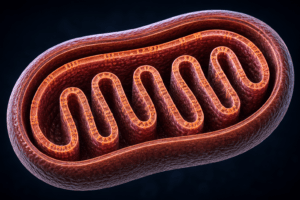
Mitochondria are the structures inside cells that help convert available fuel into usable energy, including ATP. They also participate in redox balance, immune signaling, calcium regulation, and cellular quality control.
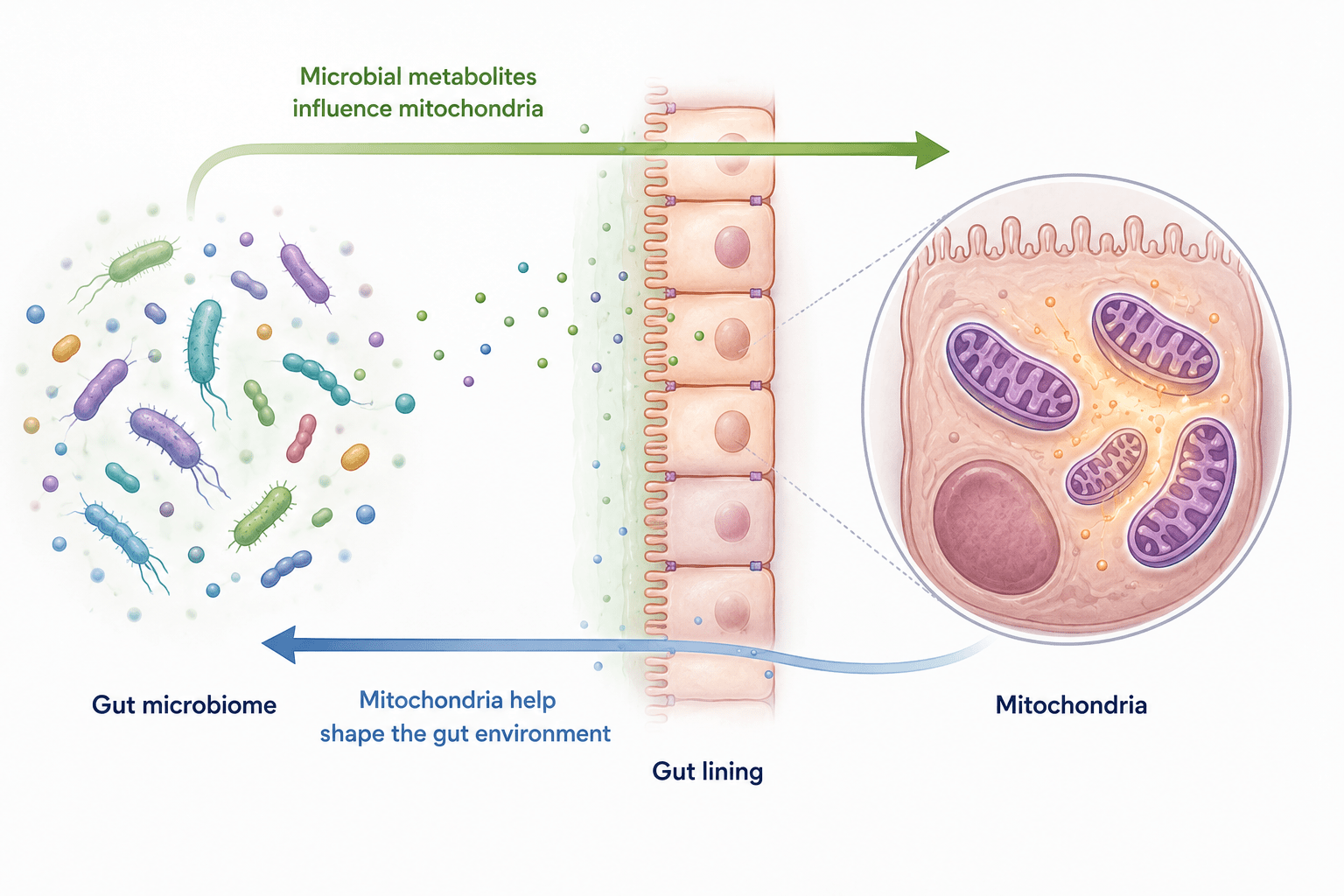
Microbial metabolites can influence mitochondrial fuel use, signaling, and quality control. In return, mitochondria in intestinal cells help maintain the low-oxygen environment and barrier function that influence which microbes can thrive.
That creates a two-way relationship.
Connected through metabolism
One of the clearest ways the microbiome affects mitochondria is through microbial metabolism.
When certain gut microbes ferment dietary fibers, they produce short-chain fatty acids, commonly called SCFAs. The best-known examples are acetate, propionate, and butyrate. These molecules are not simply waste products from microbial fermentation. They can enter host cells and influence how those cells use fuel and respond to their environment.
Butyrate is especially important in the large intestine. Colon cells, called colonocytes, can use butyrate as a major energy source. Once inside the cell, butyrate can be processed through mitochondrial pathways that help produce ATP.
This is a useful example of why gut health cannot be reduced to the presence or absence of one bacterial species. What matters is also what microbes are doing: which compounds they produce, in what amounts, and how those compounds interact with the tissues around them.
Research in germ-free mice has found that colon cells without normal microbial exposure can show lower mitochondrial respiration and altered cellular housekeeping. Introducing butyrate or butyrate-producing bacteria restored aspects of those responses in experimental settings.
That does not mean every microbiome change produces the same mitochondrial result in every person. It does show, however, that microbial metabolism can influence the way intestinal cells manage energy.
Butyrate may influence more than fuel use
Butyrate is often described only as food for colon cells. That is accurate, but incomplete.
Experimental studies suggest that butyrate and propionate can also influence signaling pathways involved in mitochondrial biogenesis. These pathways include PPARγ, AMPK, and PGC-1α, which are involved in coordinating fuel use, fatty-acid oxidation, and mitochondrial gene expression.
In some cell and animal models, SCFAs have been associated with increased mitochondrial mass, higher mitochondrial DNA copy number, and changes in proteins involved in mitochondrial function.
The important distinction is between a biological mechanism and a proven human outcome. These findings help explain how microbial metabolites may affect mitochondrial adaptation. They do not establish, however, that increasing fiber intake or taking a specific product will automatically create more mitochondria in every tissue of the body.
Still, the mechanism is meaningful. It shows that the relationship between diet, microbes, and cellular energy is not merely indirect. Microbial metabolites can interact with core pathways that cells use to sense and manage energy demand.
Urolithin A is another example of microbiome-dependent metabolism
Not every person processes food compounds in the same way.
Ellagitannins, found in foods such as pomegranates, walnuts, and some berries, can be transformed by certain gut microbes into compounds called urolithins. One of these, urolithin A, has drawn attention because experimental research has linked it to mitophagy.
This process matters because mitochondria are dynamic structures. Cells do not simply create them and keep them indefinitely. They continually adjust, repair, recycle, and replace them in response to changing conditions.
Studies in worms, rodents, and selected human research settings have examined urolithin A in relation to mitochondrial quality-control pathways. These findings are interesting, but they need careful interpretation.
First, the ability to produce urolithins varies between people because microbiomes vary individual to individual. Second, many of the strongest findings come from preclinical models or from direct administration of the metabolite rather than from ordinary dietary intake. Third, mitophagy is not a simple on-off switch that can be assumed to improve whenever a food or compound is added.
The important point of consideration is that the microbiome can influence which compounds become available to the body, and those compounds may affect mitochondrial quality-control pathways.
Mitochondria also shape the gut environment
The relationship isn’t a one way street.
Cells lining the intestine use mitochondria to consume oxygen. This matters because the inside of the large intestine is meant to remain relatively low in oxygen. Many fiber-fermenting gut microbes are adapted to those conditions.
When colonocytes use butyrate through mitochondrial oxidation, they consume oxygen near the gut lining. That helps maintain an oxygen gradient between the intestinal tissue and the lumen, the inner space of the gut where microbes live.
This local oxygen balance is one way host cells help shape microbial ecology.
Experimental work suggests that when epithelial mitochondrial activity is reduced, more oxygen and other respiratory electron acceptors can become available in the gut environment. In mouse models, that shift can favor the expansion of certain Enterobacteriaceae, a family that includes organisms such as Escherichia coli.
That does not mean these bacteria are inherently harmful or that a person’s microbiome can be judged by one group alone. It means the metabolic environment created by intestinal cells can influence which microbial strategies are favored.
In this sense, mitochondrial function in the gut lining helps set the conditions under which the microbiome operates.
Immune signaling, oxidative stress, and the gut barrier
The intestinal barrier is another part of the conversation.
The gut lining must allow nutrients and selected signals to pass while limiting unwanted movement of microbes and microbial components into underlying tissues. Mitochondria participate in the energy and signaling demands of this barrier, while microbial metabolites can influence immune activity around it.
This is where oxidative stress needs to be understood carefully.
Reactive oxygen species, or ROS, are not automatically harmful. At controlled levels, they can act as signaling molecules in immune cells and intestinal tissues. But excessive or poorly regulated ROS can contribute to cellular stress, inflammation, and impaired mitochondrial function.
The same principle applies to microbial molecules. Some bacterial components can activate immune pathways that affect mitochondrial respiration and ROS production. Under conditions of barrier disruption, those signals may become more relevant to inflammation and tissue stress.
ROS help cells communicate and respond to stress. In the gut, too much ROS can damage cells and contribute to inflammation, so balance matters.
Other microbial metabolites are also being studied
SCFAs and urolithins are not the only microbial products under investigation.
Secondary bile acids can influence signaling pathways related to lipid and carbohydrate metabolism. Certain microbial derivatives of tryptophan, vitamins, and nicotinamide-related compounds are also being studied for possible effects on mitochondrial respiration, redox balance, and quality-control pathways.
Hydrogen sulfide offers an especially useful reminder that dose and context matter. At lower levels, colonocyte mitochondria can metabolize hydrogen sulfide. At higher concentrations, it may interfere with mitochondrial respiration and ATP generation.
Microbial metabolites are not automatically good or bad. Their effects depend on how much is present and what is happening in the gut at that time.
O que isso significa na prática
The practical idea is not that people need to chase a single metabolite, test, probiotic, or supplement.
A diverse microbiome is often supported by simple habits: eating a varied diet with fiber-rich foods you can tolerate, staying active, sleeping well, and getting medical advice for ongoing digestive symptoms.
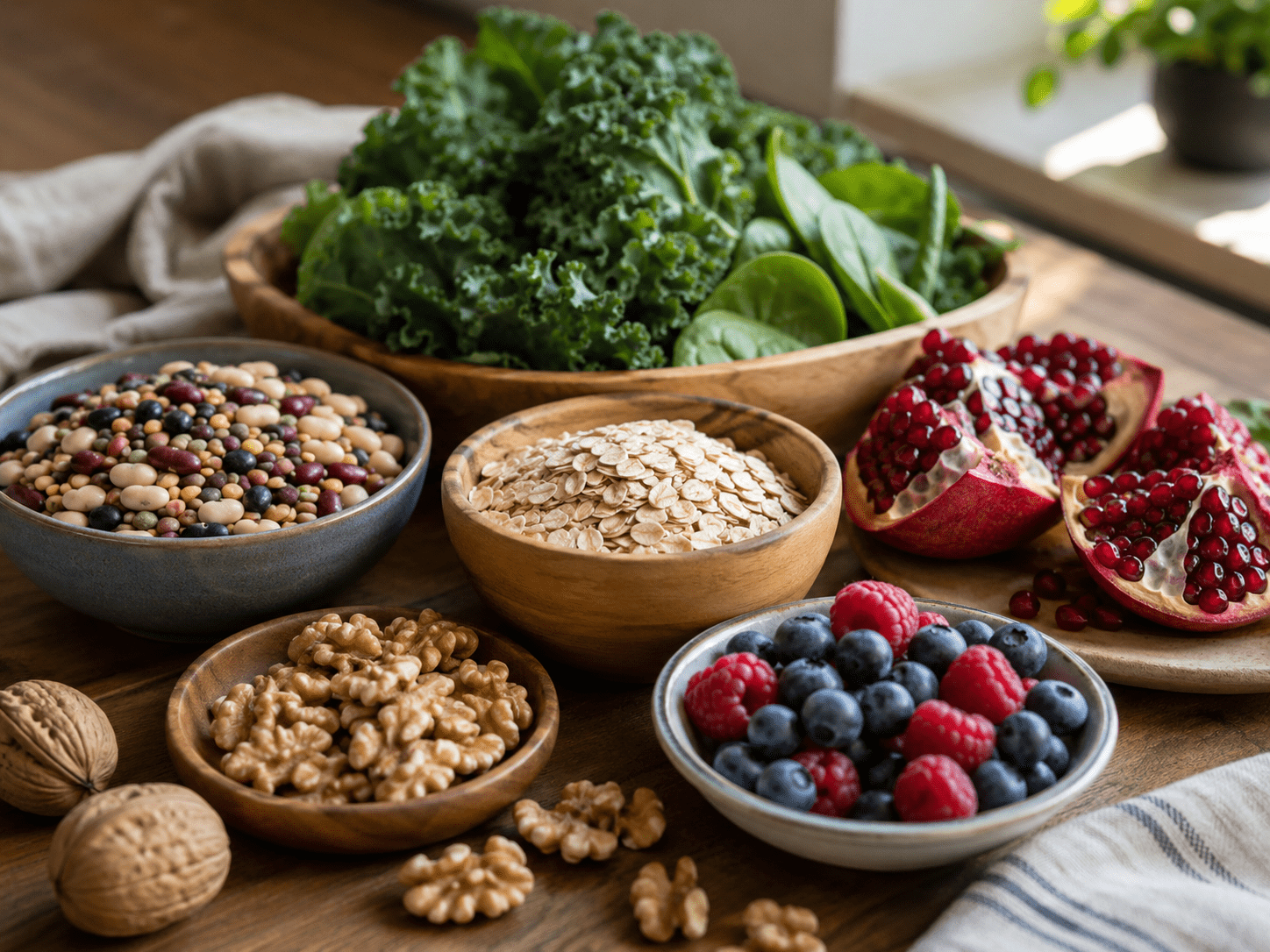
These habits do not guarantee a specific microbiome profile or mitochondrial outcome. They create conditions that support the broader systems involved in metabolic and cellular function.
For people with digestive disease, unexplained symptoms, restrictive diets, or major changes in bowel habits, individualized clinical guidance matters more than generalized microbiome advice.
What the current research can and cannot tell us
The microbiome-mitochondria connection is biologically plausible and increasingly well documented. But the evidence is not uniform.
Some mechanisms, such as butyrate use by colon cells and the role of epithelial oxygen consumption in the gut, are relatively well established. Other findings, including specific links between microbial metabolites and mitochondrial biogenesis or mitophagy, remain more dependent on cell studies, animal models, or early human research.
This research is still developing, but it shows that the microbiome can affect mitochondria in several ways. And it is always important that the impact may differ from person to person.
Conclusão
The microbiome and mitochondria are closely connected. Gut microbes produce compounds that can influence how cells use energy, manage stress, and maintain mitochondrial quality. Mitochondria in the gut lining in return help maintain the conditions that allow the gut to function normally.
Supporting gut health starts with the basics: a varied diet, fiber-rich foods you tolerate, regular movement, sleep, and attention to persistent symptoms. But cellular energy matters too.
Mitozz is made with 98% pure (−)-epicatechin for people who want to support healthy mitochondrial function and normal cellular energy. Mitochondria help cells meet daily energy demands throughout the body, including in the gut lining, making mitochondrial support a meaningful part of a broader health routine.
Keep Learning About Mitochondrial Health
For a broader understanding on cellular energy and mitochondrial function, explore Mitochondria 101.
Compartilhe este artigo do blog
Referências
- Koh et al., 2016 · From dietary fiber to host physiology: Short-chain fatty acids as key bacterial metabolites. Cell.
- Donohoe et al., 2011 · The microbiome and butyrate regulate energy metabolism and autophagy in the mammalian colon. Cell Metabolism.
- Gao et al., 2009 · Butyrate improves insulin sensitivity and increases energy expenditure in mice. Diabetes.
- Byndloss et al., 2017 · Microbiota-activated PPAR-γ signaling inhibits dysbiotic Enterobacteriaceae expansion. Science.
- Ryu et al., 2016 · Urolithin A induces mitophagy and prolongs lifespan in C. elegans and increases muscle function in rodents. Nature Medicine.
- Borbolis et al., 2023 · The crosstalk between microbiome and mitochondrial homeostasis in neurodegeneration. Cells.
Compreender a saúde mitocondrial é um processo de longo prazo. É por isso que criamos o Mitozz : uma forma gratuita de continuar aprendendo sobre energia celular, saúde mitocondrial e os hábitos de vida que apoiam seu corpo ao longo do tempo. Você receberá conteúdo educativo com base científica, orientações práticas e novidades da Mitozz, tudo no seu próprio ritmo.
Inscreva-se no Mitozz da Mitozz
Obtenha informações com base científica sobre saúde mitocondrial, energia celular e hábitos de vida que contribuem para a saúde do seu corpo a longo prazo.
Aviso médico: As informações fornecidas neste artigo têm caráter exclusivamente educativo e informativo, não constituindo orientação médica. Não substituem o diagnóstico, o tratamento ou a orientação de um profissional de saúde. Consulte sempre um profissional de saúde qualificado antes de fazer alterações em sua dieta, rotina de exercícios, práticas de jejum ou uso de suplementos, especialmente se você tiver alguma condição médica, estiver grávida ou amamentando, ou estiver tomando medicamentos.
Isenção de responsabilidade da FDA: Estas declarações não foram avaliadas pela Food and Drug Administration. Elas não se destinam a diagnosticar, tratar, curar ou prevenir qualquer doença.