Pontos principais
- Cognitive fatigue is a real performance state, not a lack of discipline or ambition.
- Sustained attention, complex decisions, and task switching place continuous energy demands on the brain.
- Mitochondria are relevant to brain energy, though there are other factors too.
- High performers can lose recovery margin when work, training, travel, and life stress accumulate.
- Sleep, movement, nutrition, workload design, recovery, and targeted mitochondrial support, such as with Mitozz, can all play a role in sustaining durable mental performance.
High performers are often good at pushing through daily challenges. They can work under pressure, make decisions with incomplete information, stay engaged through long meetings, and return to the task after everyone else has checked out.
That capacity can make an early warning sign easy to miss. The issue is not always a dramatic crash. Sometimes it is a shorter attention span in the afternoon, a growing reluctance to make difficult decisions, or the sense that work requiring deep thought now costs more than it used to.
This is where cognitive fatigue becomes useful as a concept. It is not a diagnosis, and it is not a verdict on your mindset. It is a state in which sustained mental effort begins to feel disproportionately difficult, even when motivation remains intact.
Cognitive fatigue is not the same as simply being tired
Ordinary tiredness can follow a short night of sleep, a hard workout, travel, illness, or an unusually busy day. Cognitive fatigue is more specific. It tends to show up after prolonged concentration, repeated decision-making, constant context switching, or demanding work that requires you to hold many variables in mind at once.
For an executive, that might mean several hours of negotiations, financial decisions, team problems, and back-to-back calls. For an entrepreneur, it may be the constant movement between strategy, operations, sales, and risk. For an athlete, it may appear when training, competition, travel, and life logistics leave little room to reset.
High performers are not necessarily biologically more vulnerable than everyone else. More often, they may be operating with a higher and more continuous cognitive workload, while also expecting themselves to recover quickly enough to do it again tomorrow.
Why demanding thinking has a biological cost
The brain is not a passive observer of work. It is a highly active organ that depends on a constant supply of energy to maintain attention, process information, regulate behavior, and coordinate communication between neurons.
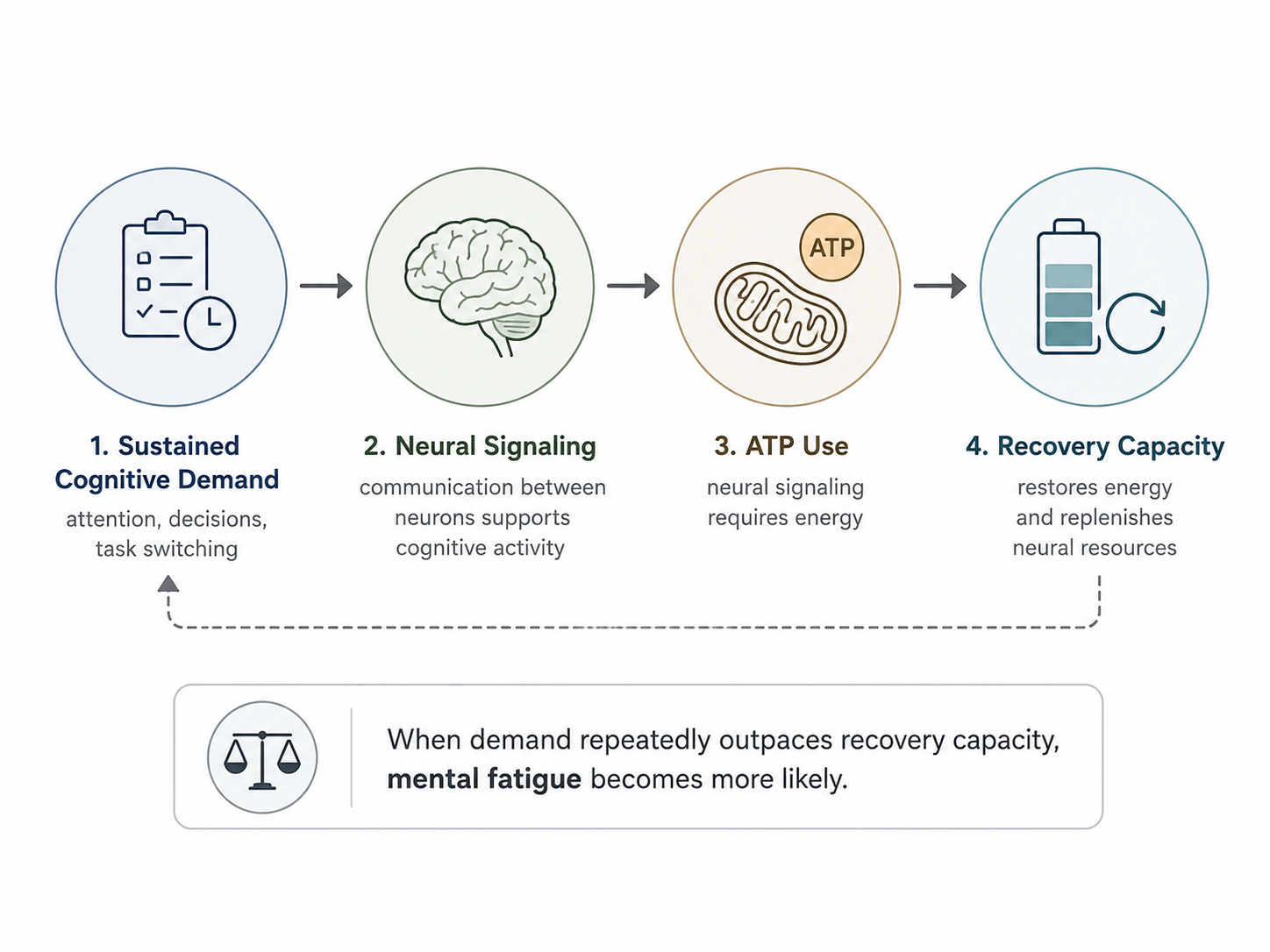
At the cellular level, mitochondria help convert available fuel and oxygen into ATP, the usable energy that supports neural signaling and many other cellular processes. Synaptic activity, ion balance, and communication across neural networks all require energy. ( Journal of Cerebral Blood Flow & Metabolism, Neuron.)
That does not mean a difficult meeting drains the brain like a phone battery. The brain does not suddenly run out of ATP because you spent an afternoon solving a complicated problem. But sustained mental work does place real metabolic demands on the systems that maintain attention, effort, and cognitive control.
Researchers are still working out exactly why mental effort eventually feels difficult. One controlled human study found that prolonged demanding cognitive work was associated with changes in the lateral prefrontal cortex and a greater tendency to favor lower-effort, more immediate choices afterward. (Current Biology)
This does not prove that high performers develop mitochondrial dysfunction from work. The more accurate takeaway is that cognitive fatigue has biology behind it. It is not simply an illusion, a personality flaw, or a sign that someone needs to want it more.
Where mitochondria fit in
Mitochondria matter in cognitive fatigue because the brain depends on continuous energy production and carefully regulated signaling. They are also involved in calcium handling, redox signaling, and mitochondrial quality control, all of which are relevant to healthy neural function.
It is reasonable to view mitochondrial health as part of the wider biology of mental capacity. A person carrying a high workload needs enough cellular energy capacity to meet demand, then enough recovery capacity to adapt before the next demanding period begins.
While energy availability is a foundational constraint, many common causes of mental fatigue operate through different primary mechanisms.
- Sleep deprivation, for example, disrupts neurotransmitter balance and synaptic homeostasis.
- Chronic stress alters cortisol signaling and attentional control.
- Circadian misalignment affects timing of alertness and hormone release.
- Under-fueling limits glucose availability.
- Work environments can overload attention regardless of cellular energy status.
Mitochondria are one part of this larger system.
Why cognitive fatigue can matter more in high-demand roles
In a demanding role, small declines in cognitive margin can have outsized consequences. The issue may not be whether you can finish the task. It may be whether you can still think clearly enough to notice a weak assumption, maintain patience in a difficult conversation, weigh tradeoffs, or distinguish an urgent issue from a merely loud one.
That is why cognitive fatigue can feel frustrating for people who are used to operating at a high level. They may still be productive, but the same work begins to require more effort, more caffeine, more time, or more recovery afterward.
Experimental studies have linked prolonged cognitive load with subjective fatigue and changes in autonomic balance. (Behavioral and Brain Functions) Other research has shown that mentally demanding work can reduce exercise tolerance by increasing perceived effort, even when motivation and basic physiological markers do not fully explain the difference. (Journal of Applied Physiology)
For people whose work and identity depend on sustained performance, this creates a practical problem. They may respond to declining mental margin by adding more stimulation, working later, or compressing recovery, which can make the cycle harder to interrupt.
Early patterns worth noticing
None of the following signs identifies a cause on its own. Still, patterns can be useful, especially when they become more frequent or begin to affect work, relationships, training, or daily life.
- Tasks requiring focus feel difficult earlier in the day.
- You rely on caffeine or stimulation just to reach your usual level of concentration.
- Decision-making feels more draining than it used to.
- You have less patience for complexity, ambiguity, or competing priorities.
- A demanding workday leaves less capacity for training, family, creativity, or recovery.
- You need longer than usual to feel mentally clear after intense work periods.
The idea is not to self-diagnose. It is to zoom out and look at the relationship between demand, recovery, and the systems that support both.
O que isso significa na prática
For high performers, better mental capacity rarely comes from one trick. It usually comes from reducing unnecessary cognitive friction while protecting the foundations that support recovery.
Protect uninterrupted focus
Constant switching between email, messages, meetings, notifications, and deep work can make a day feel longer than the number of hours suggests. Creating periods for focused work, with fewer competing inputs, may reduce avoidable cognitive load.
Treat recovery as part of performance
Sleep, regular movement, sufficient nutrition, time away from demanding tasks, and intentional support for mitochondrial health (including options like Mitozz supplementation) help maintain the biological environment in which attention, training adaptation, and day-to-day resilience can continue.
Match workload to available margin
Not every day needs to contain your hardest work, hardest training, and most demanding social obligations. When several high-demand inputs stack together, something usually gives. Planning around that reality is often more sustainable than trying to overpower it.
Small tools to help on cognitively demanding days
When mental effort is already running high, a few small changes can help reduce the load. A short, planned early-afternoon nap may help restore alertness after poor sleep, travel, or a demanding morning. Brief non-work breaks can also help, especially when they create real separation from messages, meetings, and screens.
It also helps to reduce the cognitive residue of unfinished work. Before switching tasks, write down where you stopped, the next action, and the question that still needs an answer. Set aside short, interruption-free blocks for important decisions, rather than making them between emails, messages, and meetings.
These are not replacements for sleep, recovery, or medical evaluation when fatigue is persistent. They are practical ways to make a demanding day less cognitively expensive.
O Mitozz
Mitozz is a nutraceutical developed by FMG Health Sciences and formulated with 98% pure (−)-epicatechin. Research has explored (−)-epicatechin in relation to cellular signaling, vascular function, metabolism, and mitochondrial-related pathways in specific study settings.
Its role is foundational. For individuals focused on supporting healthy mitochondrial function and normal cellular energy, Mitozz can be integrated into a broader performance strategy built on sleep, movement, nutrition, recovery, and a workload that allows for adaptation.
Take the Mitozz Vitality Self-Assessment for an educational look at daily energy, stamina, recovery, and performance patterns.
Learn about Mitozz and its approach to mitochondrial support.
Conclusão
At a high level, the cost of cognitive fatigue is not simply feeling tired. It is the gradual erosion of the qualities that make high performance possible: clear thinking, sound judgment, creativity, patience, and the ability to stay effective when the stakes are high.
Mitochondria are part of the biology behind that capacity. They help support the energy-intensive work of the brain.
The goal is to build durable capacity: the ability to focus when it matters, make sound decisions under pressure, recover when the work is done, and still have something left over for life beyond work.
Compartilhe este artigo do blog
Referências
- Attwell, D., & Laughlin, S. B. (2001). An energy budget for signaling in the grey matter of the brain. Journal of Cerebral Blood Flow & Metabolism.
- Harris, J. J., Jolivet, R., & Attwell, D. (2012). Synaptic energy use and supply. Neuron.
- Wiehler, A., Branzoli, F., Genon, S., et al. (2022). A neuro-metabolic account of why daylong cognitive work alters the control of economic decisions. Current Biology.
- Mizuno, K., Tanaka, M., Yamaguti, K., et al. (2011). Mental fatigue caused by prolonged cognitive load associated with sympathetic hyperactivity. Behavioral and Brain Functions.
- Marcora, S. M., Staiano, W., & Manning, V. (2009). Mental fatigue impairs physical performance in humans. Journal of Applied Physiology.
Compreender a saúde mitocondrial é um processo de longo prazo. É por isso que criamos o Mitozz : uma forma gratuita de continuar aprendendo sobre energia celular, saúde mitocondrial e os hábitos de vida que apoiam seu corpo ao longo do tempo. Você receberá conteúdo educativo com base científica, orientações práticas e novidades da Mitozz, tudo no seu próprio ritmo.
Inscreva-se no Mitozz da Mitozz
Obtenha informações com base científica sobre saúde mitocondrial, energia celular e hábitos de vida que contribuem para a saúde do seu corpo a longo prazo.
Aviso médico: As informações fornecidas neste artigo têm caráter exclusivamente educativo e informativo, não constituindo orientação médica. Não substituem o diagnóstico, o tratamento ou a orientação de um profissional de saúde. Consulte sempre um profissional de saúde qualificado antes de fazer alterações em sua dieta, rotina de exercícios, práticas de jejum ou uso de suplementos, especialmente se você tiver alguma condição médica, estiver grávida ou amamentando, ou estiver tomando medicamentos.
Isenção de responsabilidade da FDA: Estas declarações não foram avaliadas pela Food and Drug Administration. Elas não se destinam a diagnosticar, tratar, curar ou prevenir qualquer doença.