Pontos principais
- Autophagy is the cell’s broad recycling process, not a mitochondria-only pathway.
- Mitophagy is a selective form of autophagy that removes mitochondria chosen for recycling.
- Mitochondrial maintenance also depends on repair, network remodeling, and rebuilding.
- More autophagy is not automatically better, and laboratory markers do not prove a human benefit.
- The useful goal is balanced maintenance, not maximum cleanup.
Keeping cells healthy involves more than producing new components. Cells must also identify what can be repaired, what can be recycled, and what needs to be removed. This ongoing maintenance is especially important for mitochondria, which must remain functional as they respond to changing cellular demands.
Two processes involved in this maintenance are autophagy and mitophagy. Although closely related, they serve different purposes. Understanding the distinction reveals an important principle of mitochondrial health: removing damaged components is only one part of maintaining a healthy, functioning mitochondrial network.
Autophagy Is the Broader Recycling System
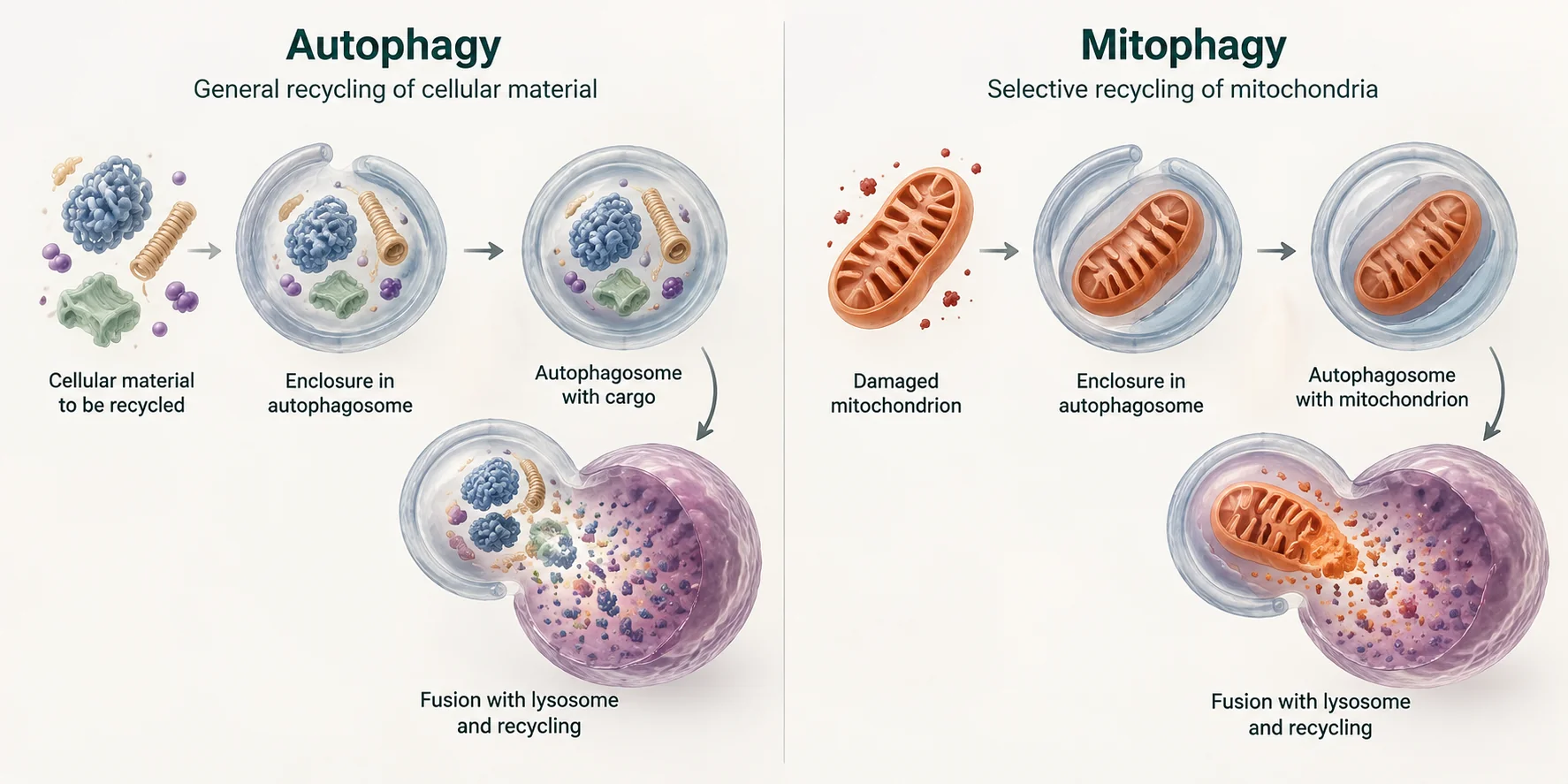
Cells continuously make, use, and break down proteins and other components. Some of that material can be repaired or reused; some needs to be dismantled. Autophagy is a set of cellular processes that delivers selected internal material to a breakdown system, often involving structures called lysosomes, where components can be recycled.
In the form most often discussed, cells enclose material within a membrane compartment and deliver it to a lysosome. The resulting building blocks can be reused in normal cell maintenance or when nutrient availability changes. Autophagy is active at a baseline level and is regulated according to the cell’s needs; it is not something that should be permanently switched on at full power. [1]
Think of autophagy as a broad recycling service. It handles different kinds of cellular material, but the word alone does not tell you which components are being removed, how effectively they are processed, or whether the cell benefits afterward.
Mitophagy Has a More Specific Assignment
Mitophagy is selective recycling directed at mitochondria. These structures help produce the usable energy that cells need, but they also participate in signaling and responses to stress. Mitochondria can become damaged or unnecessary as cellular conditions change.
Mitophagy helps identify and remove mitochondrial material that a cell has selected for disposal. It uses parts of the broader autophagy machinery, but adds the important step of selecting the mitochondrial target. That selection is why the two terms are related but not interchangeable. [2]
Autophagy describes the larger recycling system; mitophagy describes one specialized job within it. A change in general autophagy activity does not, by itself, demonstrate that damaged mitochondria were selectively cleared.
For a closer look at how mitochondria are selected for recycling, read our existing article, Mitochondria and Mitophagy: The Science of Cellular Recycling. The important point here is not the detailed pathway. It is what the distinction means when we evaluate claims about “cellular cleanup.”
Clearing Worn Mitochondria Is Only Part of Maintenance
Imagine a workshop that removes broken equipment but never services what remains or replaces what was removed. The workshop might look tidier while becoming less capable of doing the work required.
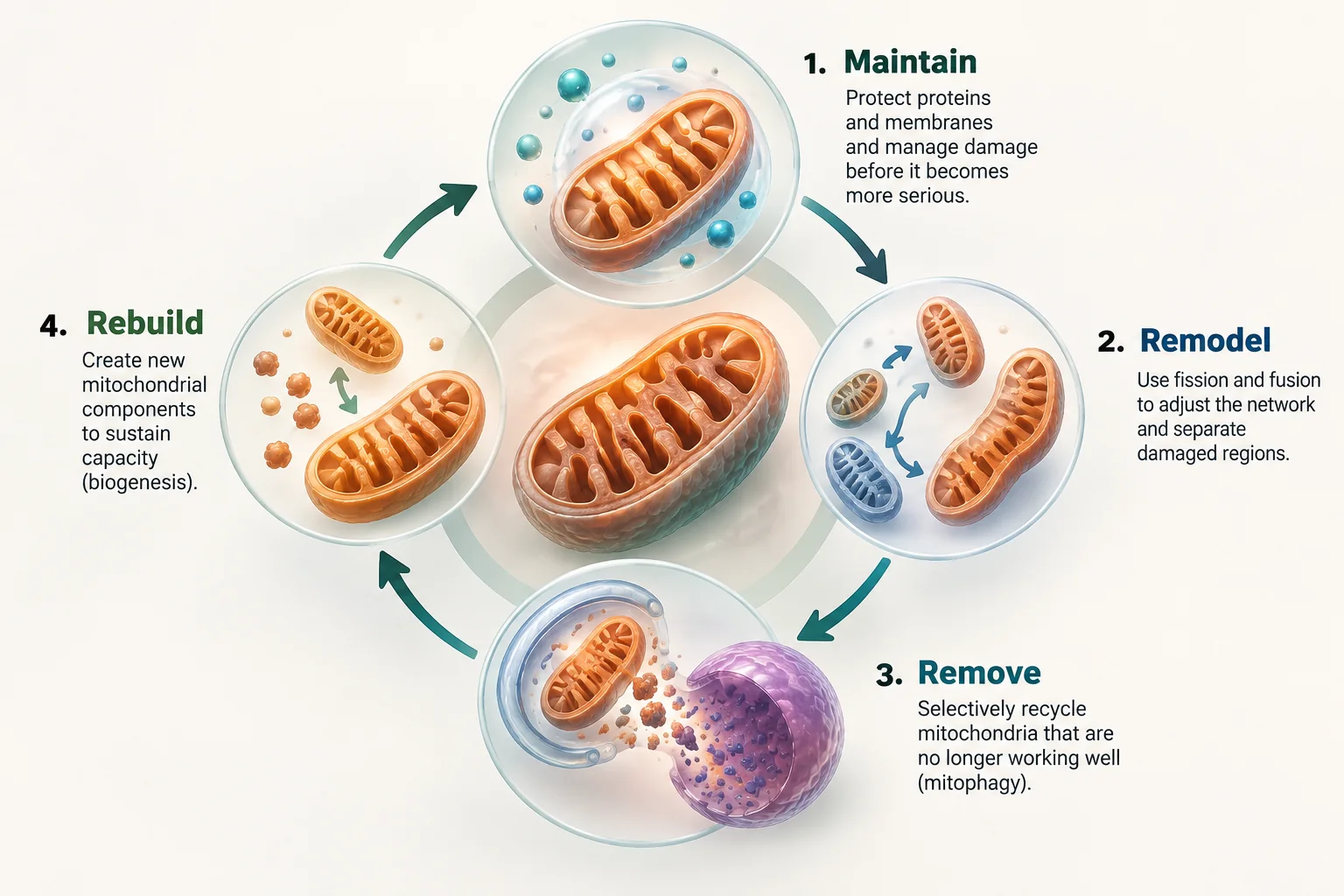
A cell faces a similar balancing problem. Mitophagy helps remove mitochondrial material, but the cell still needs enough functioning mitochondria to meet demand. Its wider mitochondrial quality-control system includes several connected tasks:
- Maintain: protect proteins and membranes and deal with damage that does not require removing an entire mitochondrion.
- Remodel: use fission and fusion, the splitting and joining of mitochondria, to adjust the network and separate some damaged regions.
- Remove: selectively recycle mitochondrial material that cannot usefully remain.
- Rebuild: use mitochondrial biogenesis to renew components and sustain capacity.
These jobs do not always happen in a neat four-step sequence. They overlap and respond to the needs of each tissue. The central idea is that removal, repair, remodeling, and renewal have to remain coordinated. [2]
That is also why “more cleanup” is an incomplete goal. In a 2024 study using fruit flies engineered to accumulate mitochondrial DNA mutations, researchers found that excessive autophagy contributed to harm in that particular model, while interventions that reduced the excessive response improved survival. This was not a human trial or evidence that people should suppress autophagy. It was a reminder that biological maintenance depends on context and balance. [3]
What This Means for Fasting, Supplements, and Daily Habits
A statement such as “this activates autophagy” can refer to a change in a signaling pathway or laboratory marker. It does not necessarily mean the entire recycling process ran to completion, that mitophagy increased, or that a person’s health improved.
Scientists distinguish between observing components of an autophagy pathway and measuring autophagic flux, the movement of material through the process to actual breakdown. Even in research settings, interpreting these measurements is difficult. Human studies face additional limits because researchers cannot easily monitor mitochondrial disposal across living tissues. [4]
Fasting, exercise, and nutritional compounds may affect cellular pathways linked to maintenance. But a pathway response in cells or animals is not the same as demonstrated selective mitochondrial clearance in people. It is reasonable to be interested in these approaches without treating every claim about “turning on autophagy” as an established outcome.
The practical foundation remains the same. Consistent movement, adequate nutrition, enough sleep, and recovery give the body a better setting for normal adaptation and maintenance. Exercise, in particular, has human evidence for influencing mitochondrial biogenesis-related responses in skeletal muscle, although that should not be mistaken for proof that every workout increases mitophagy. [5]
Mitozz fits into this broader approach to mitochondrial health. Its active ingredient, high-purity (−)-epicatechin, has been studied for its effects on cellular signaling and pathways involved in mitochondrial structure and quality control. Together with regular movement, adequate sleep, and recovery, it represents another area of interest in the science of maintaining healthy mitochondria.
Think Maintenance, Not Maximum Cleanup
Autophagy matters because cells must recycle material to keep functioning. Mitophagy matters because mitochondria sometimes need selective removal. Neither is a stand-alone measure of how healthy the mitochondrial network is.
The better question is not, “How do I activate cleanup as much as possible?” It is, “How does the cell maintain enough working capacity while repairing, removing, and renewing what it needs?”
That is the more useful way to understand mitochondrial quality control, not a single cleanup slogan, but an ongoing maintenance cycle.
To follow the full cycle from identifying mitochondrial stress to clearing and rebuilding, download the free Mitochondrial Quality Control guide from the Mitozz Download Center.
Compartilhe este artigo do blog
Referências
- Mizushima N, Komatsu M. (2011). Autophagy: renovation of cells and tissues. Cell.
- Pickles S, Vigié P, Youle RJ. (2018). Mitophagy and quality control mechanisms in mitochondrial maintenance. Current Biology.
- El Fissi N, et al. (2024). Preventing excessive autophagy protects from the pathology of mtDNA mutations in Drosophila melanogaster. Nature Communications.
- Klionsky DJ, et al. (2021). Guidelines for the use and interpretation of assays for monitoring autophagy (4th edition). Autophagy.
- Abrego-Guandique DM, et al. (2025). The impact of exercise on mitochondrial biogenesis in skeletal muscle: a systematic review and meta-analysis of randomized trials. Biomolecular Concepts.
Compreender a saúde mitocondrial é um processo de longo prazo. É por isso que criamos o Mitozz : uma forma gratuita de continuar aprendendo sobre energia celular, saúde mitocondrial e os hábitos de vida que apoiam seu corpo ao longo do tempo. Você receberá conteúdo educativo com base científica, orientações práticas e novidades da Mitozz, tudo no seu próprio ritmo.
Inscreva-se no Mitozz da Mitozz
Obtenha informações com base científica sobre saúde mitocondrial, energia celular e hábitos de vida que contribuem para a saúde do seu corpo a longo prazo.
Aviso médico: As informações fornecidas neste artigo têm caráter exclusivamente educativo e informativo, não constituindo orientação médica. Não substituem o diagnóstico, o tratamento ou a orientação de um profissional de saúde. Consulte sempre um profissional de saúde qualificado antes de fazer alterações em sua dieta, rotina de exercícios, práticas de jejum ou uso de suplementos, especialmente se você tiver alguma condição médica, estiver grávida ou amamentando, ou estiver tomando medicamentos.
Isenção de responsabilidade da FDA: Estas declarações não foram avaliadas pela Food and Drug Administration. Elas não se destinam a diagnosticar, tratar, curar ou prevenir qualquer doença.