
Pontos principais
- Some senescent cells maintain inflammatory signals even when no infection is present.
- Mitochondrial DNA and RNA can activate cellular danger sensors when they appear in the wrong place.
- A 2026 study identified a second role for mitochondrial metabolism in sustaining inflammatory gene activity.
- Blocking that metabolic step reduced inflammation and improved measures of physical function in aged mice.
- Healthy mitochondrial maintenance means protecting, clearing, and renewing the network, not simply fighting inflammation.
Inflammation is an essential part of how the body protects and repairs itself. Normally, inflammatory signals diminish as an injury heals or an infection resolves. But some aging cells continue sending these signals even when there is no immediate threat.
Researchers are discovering that mitochondria, best known for producing cellular energy, can play a surprising role in keeping this inflammatory activity going.
Why the immune system can stay on alert without an infection
Inflammation is part of normal defense and repair. It helps the body respond to injury, clear threats, and coordinate healing. Problems can arise when inflammatory signals persist without a clear reason to remain active.
As we age, the body can develop a persistent, low-level inflammatory state that researchers call inflammaging. Unlike the temporary inflammation that helps us recover from injury or infection, this form of chronic inflammation can continue without an obvious threat. Understanding what keeps these inflammatory signals active has become an important area of aging research.
One contributor to this persistent inflammation may be cellular senescence. When cells experience certain types of damage or stress, they can stop dividing, helping prevent damaged cells from multiplying. But these cells do not simply shut down. Some continue releasing inflammatory signals that affect surrounding tissues and keep the immune system on alert.
Scientists call this mixture of released molecules the senescence-associated secretory phenotype (SASP). These signals can serve a useful purpose, helping coordinate tissue repair and alerting the immune system to damaged cells. But when senescent cells accumulate and continue releasing these molecules, what began as a protective response can become a persistent source of inflammation.
The question is what keeps those signals active. For a broader account of how inflammation and mitochondrial function affect each other, see Mitochondria and Inflammation: The Two-Way Connection. Here, the focus is narrower: how mitochondria help some senescent cells keep sending the message.
When mitochondria become a source of danger signals
Most discussions of mitochondria begin with cellular energy. But mitochondria also contain their own genetic material, and its location matters.
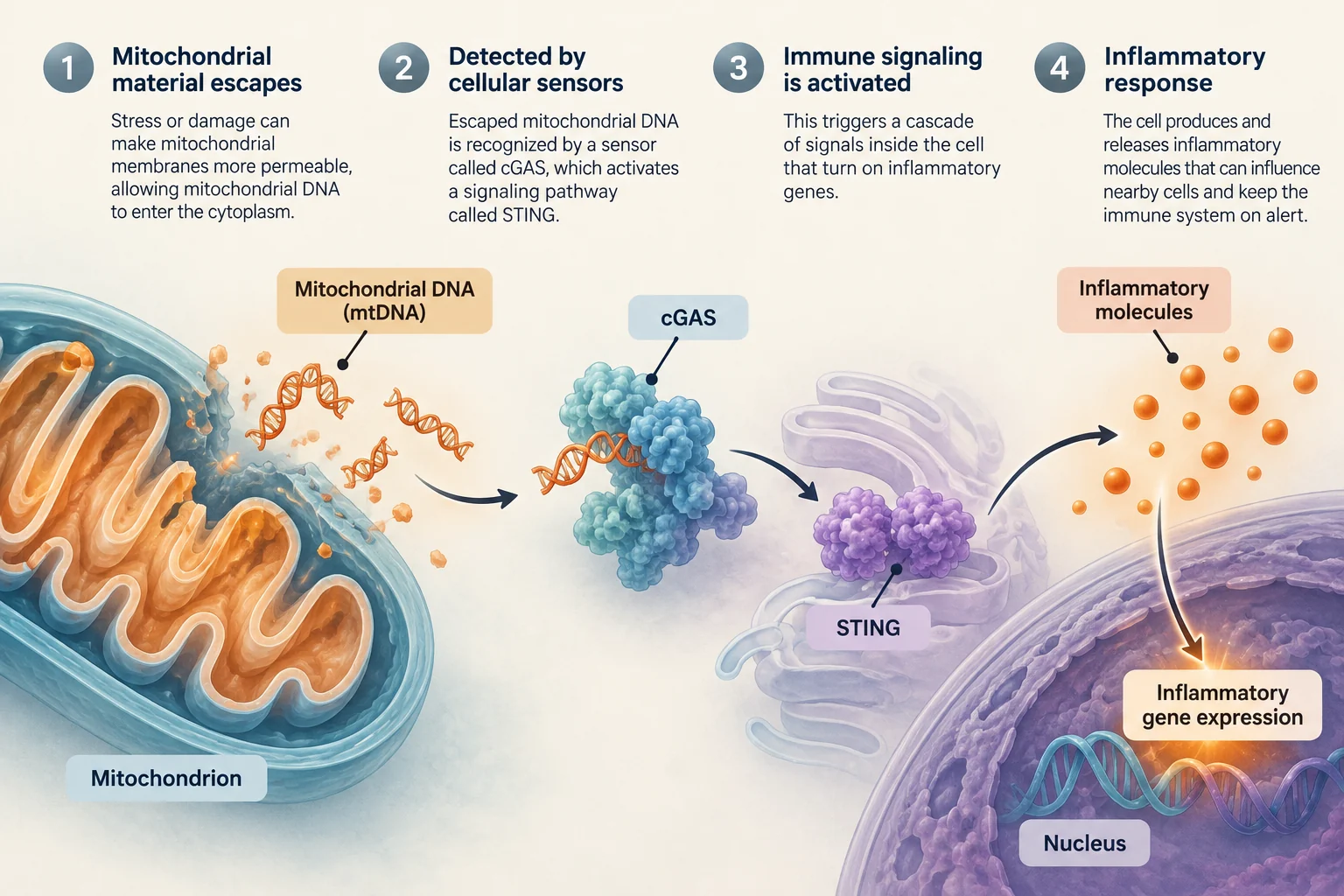
Normally, mitochondrial DNA, or mtDNA, is held inside mitochondria. When mtDNA reaches the cell’s surrounding interior, known as the cytoplasm, cellular sensors can detect it as an unusual signal. One such system, called cGAS–STING, can activate genes involved in innate immune responses. The cell may react even though no outside pathogen has entered the body.
Research published in Nature in 2023 connected this process to senescence. The investigators found that changes in the membranes of a subset of mitochondria could allow mtDNA to escape, helping drive inflammatory signals from senescent cells. In aged mice, interfering with that release reduced inflammatory measures and improved several measures of healthier aging. [1]
DNA is not the only mitochondrial material involved. A 2025 study found that mitochondrial RNA could also accumulate in the cytoplasm of senescent cells and activate a different group of immune sensors. This adds another route by which mitochondrial stress can influence the inflammatory messages a cell sends. [2]
The important distinction is where the signal comes from. These pathways do not require an infection. They can begin with material that belongs inside a mitochondrion appearing somewhere the cell interprets it as a warning.
The surprising second role of mitochondrial metabolism
Leaked mitochondrial material helps explain how an inflammatory alarm can start. But it does not fully explain how a senescent cell continues producing inflammatory signals.
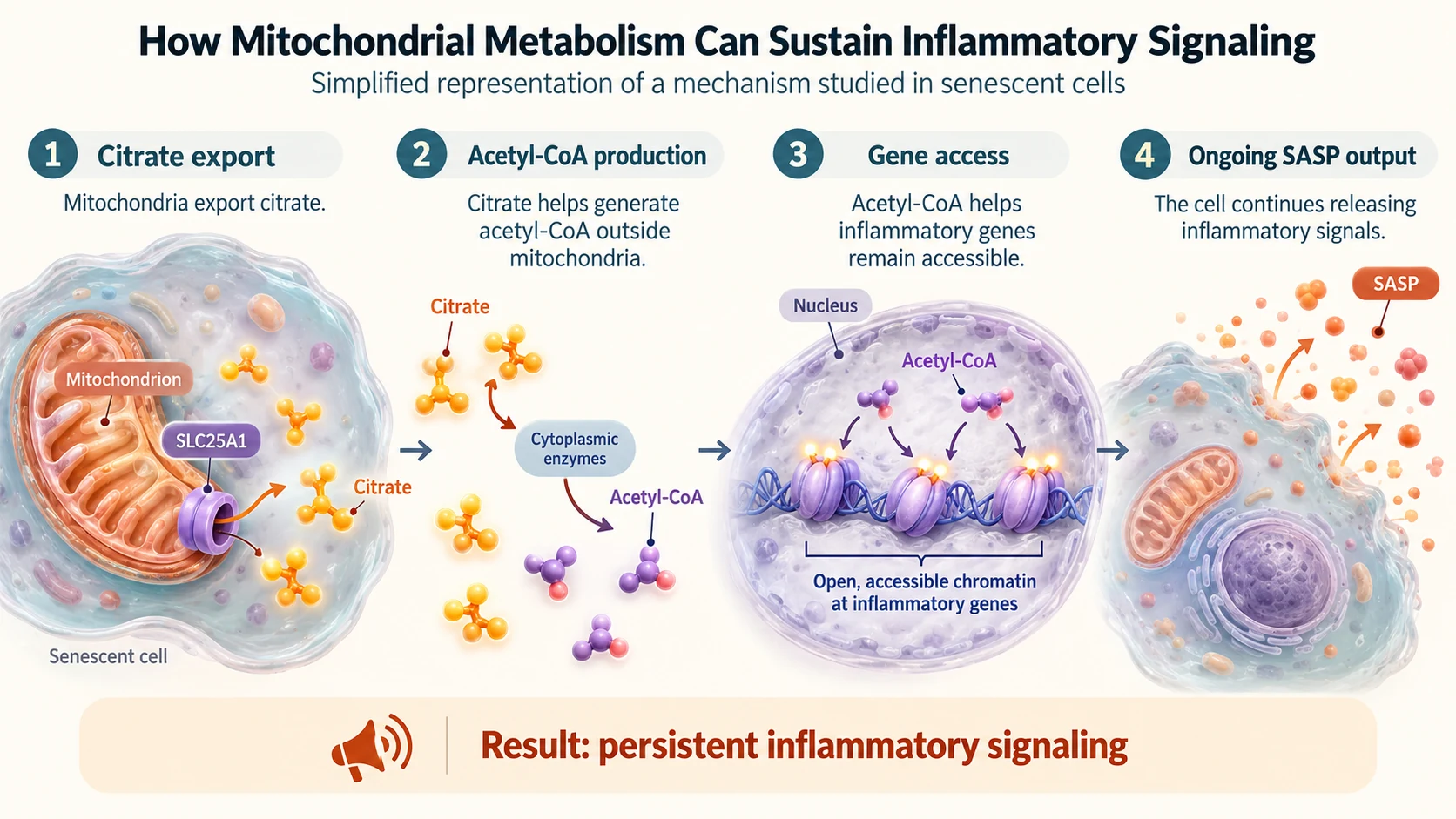
A study published in Nature on July 29, 2026, identified another part of the process. Researchers found that mitochondrial metabolism in senescent cells helped supply a molecule called acetyl-CoA. Cells use acetyl-CoA for many normal purposes, including chemical modifications that affect how accessible genes are to the machinery that reads them. [3]
Picture DNA as a set of instructions stored in a tightly organized library. An alarm may tell the cell which instructions to read, but the relevant pages also have to be accessible. In the study, mitochondrial metabolism helped create the conditions that allowed genes responsible for inflammatory signals to remain available for reading.
The team examined a protein called SLC25A1, which transports citrate out of mitochondria. Citrate can then contribute to acetyl-CoA production outside the mitochondria. When researchers blocked this transport step in their experimental systems, the inflammatory secretions of senescent cells declined, even though the cells remained senescent.
They also tested an experimental inhibitor in aged mice. After treatment, the mice showed lower measures of SASP-related inflammation and improvements on tests related to frailty and muscle function. These were findings in mice, not a clinical trial or a treatment recommendation for people.
This is the striking part of the discovery: mitochondria do not simply release warning signals when stressed; their ongoing metabolic activity can also help maintain the cell’s ability to express inflammatory genes. The study found a way to reduce that inflammatory output without necessarily removing the senescent cells themselves.
It is an important shift in how we think about mitochondria during aging. The problem is not always that a mitochondrion has stopped making energy. In certain senescent cells, active mitochondrial metabolism may be part of what sustains an unwanted message.
Why maintenance matters before an alarm becomes persistent
The findings point back to a familiar idea in mitochondrial biology: maintenance is about more than energy production.
Cells use mitophagy to selectively recycle mitochondria or mitochondrial material that is no longer useful. They also maintain mitochondrial membranes, repair components when possible, and replace what has been removed. Together, these processes belong to mitochondrial quality control.
When those systems work appropriately, they help limit the accumulation of compromised mitochondrial material. A 2024 study in aging mice connected mitophagy with reduced mitochondrial DNA in the cytoplasm and quieter cGAS–STING signaling in the retina. That does not mean more mitophagy is always better; it shows why selective removal is one part of maintaining control over cellular signals. [4]
Mitochondria also produce reactive oxygen species, but these are useful signaling molecules as well as potential sources of stress, as discussed in ROS Are Not the Enemy.
The broader point is that mitochondria influence immune signaling through several connected processes. Keeping mitochondrial membranes intact, recycling poorly functioning material, and maintaining a useful network all belong in the same conversation. They are not interchangeable with switching off a single inflammatory pathway.
What this means for everyday mitochondrial health
It is tempting to turn new research into a simple instruction: block the pathway, lower inflammation, feel better. But the real discovery is more interesting. Researchers have identified how mitochondrial activity can help sustain inflammation in aging cells, opening new possibilities for understanding how this process might be regulated.
Nor should the goal be to eliminate inflammation. Temporary inflammatory responses are part of the body’s defense and tissue repair. The biological concern here is signaling that remains active after it is useful, especially when cellular maintenance is no longer keeping pace.
For everyday health, the strongest practical starting points are still the basic of regular movement, adequate sleep, nutrition that meets the body’s needs, and time to recover. Physical activity helps shape mitochondrial adaptation, while sleep and nutrition support the wider conditions in which maintenance and repair take place. None of these habits is a direct substitute for the laboratory interventions used in the senescence studies.
Mitozz fits into the broader conversation about mitochondrial health through high-purity (−)-epicatechin, a plant-derived flavanol studied in mitochondrial signaling, structure, and related maintenance pathways. It belongs alongside movement, sleep, nutrition, and recovery as part of a wider approach to supporting mitochondrial function.
The bigger story is the message a cell keeps sending
Mitochondria are often judged by how much energy they produce. The senescence research adds another question: what signals are mitochondria helping a cell send, and why do those signals continue?
Mitochondrial DNA and RNA can act as internal alarm signals when they escape their usual location. Metabolic activity inside mitochondria can help keep inflammatory genes available for expression. And quality-control systems can influence what damaged material remains in the cell.
This is why mitochondrial maintenance deserves attention upstream of the inflammatory response. A healthy network needs to protect its contents, clear what is no longer useful, and renew its capacity over time.
For a closer look at that maintenance cycle, download the Mitochondrial Quality Control guide from the Mitozz Download Center.
Compartilhe este artigo do blog
Referências
- Victorelli S, et al. (2023). Apoptotic stress causes mtDNA release during senescence and drives the SASP. Nature.
- Victorelli S, et al. (2025). Mitochondrial RNA cytosolic leakage drives the SASP. Nature Communications.
- Martini H, et al. (2026). Mitochondrial metabolism and epigenetic crosstalk drive SASP. Nature.
- Jiménez-Loygorri JI, et al. (2024). Mitophagy curtails cytosolic mtDNA-dependent activation of cGAS/STING inflammation during aging. Nature Communications.
Compreender a saúde mitocondrial é um processo de longo prazo. É por isso que criamos o Mitozz : uma forma gratuita de continuar aprendendo sobre energia celular, saúde mitocondrial e os hábitos de vida que apoiam seu corpo ao longo do tempo. Você receberá conteúdo educativo com base científica, orientações práticas e novidades da Mitozz, tudo no seu próprio ritmo.
Inscreva-se no Mitozz da Mitozz
Obtenha informações com base científica sobre saúde mitocondrial, energia celular e hábitos de vida que contribuem para a saúde do seu corpo a longo prazo.
Aviso médico: As informações fornecidas neste artigo têm caráter exclusivamente educativo e informativo, não constituindo orientação médica. Não substituem o diagnóstico, o tratamento ou a orientação de um profissional de saúde. Consulte sempre um profissional de saúde qualificado antes de fazer alterações em sua dieta, rotina de exercícios, práticas de jejum ou uso de suplementos, especialmente se você tiver alguma condição médica, estiver grávida ou amamentando, ou estiver tomando medicamentos.
Isenção de responsabilidade da FDA: Estas declarações não foram avaliadas pela Food and Drug Administration. Elas não se destinam a diagnosticar, tratar, curar ou prevenir qualquer doença.