
It’s midafternoon. You have already answered dozens of messages, attended several meetings, and worked through difficult decisions. You are still feeling motivated, but something has changed. Concentrating takes more effort. Switching between tasks feels slower. Even straightforward decisions seem unusually demanding.
This experience is often called cognitive fatigue. It can occur despite a genuine desire to keep working and is not necessarily a problem with discipline or motivation.
There is a biological side to mental performance that deserves more attention. Thinking depends on active networks of brain cells that continuously consume energy, maintain chemical balance, and respond to new demands. Mitochondria play an important role in sustaining those processes.
Understanding this connection offers a different way to think about mental fatigue.
The brain remains metabolically active even when we are resting. Neurons continuously maintain electrical gradients, exchange chemical signals, and coordinate activity across networks.
These functions depend on adenosine triphosphate, or ATP, the molecule cells use to transfer energy to the processes that need it.
When one neuron communicates with another, several energy-dependent events occur. Electrical signals travel along the neuron, neurotransmitters are released at connections called synapses, and specialized proteins help restore the chemical conditions needed for the next signal.
Supporting cells, including astrocytes, also participate by helping manage neurotransmitters, supplying metabolic substrates, and maintaining the environment around neurons.
Much of this work depends on mitochondria, which help convert nutrients and oxygen into usable cellular energy. They also participate in calcium regulation, cellular signaling, and processes that maintain cell function and maintenance.
The important thing to understand is that the brain does not simply consume a fixed supply of energy until it runs out.
Even at rest, it spends considerable energy maintaining normal function. Demanding mental work changes activity across specific networks, but cognitive fatigue cannot be explained simply as the brain’s ATP supply becoming depleted.
Instead, mental performance depends on several interacting processes, including energy metabolism, neurotransmitter regulation, sleep, motivation, and the ability to maintain cognitive control.
A 2026 review in Nature Reviews Neuroscience describes two complementary ways mitochondria contribute to neural circuits: baseline support and activity-evoked support.
The distinction helps explain why the brain requires more than a continuous supply of ATP.
Even when a person is not performing a demanding task, neurons and their supporting cells must maintain the conditions necessary for normal activity.
Mitochondria contribute to these ongoing processes by supporting energy production, calcium balance, neurotransmitter-related functions, and cellular maintenance.
This baseline support helps preserve the structural and physiological properties that allow neural circuits to function.
Think of it as maintaining the conditions that make activity possible, rather than supplying energy only when a particular task begins.
When neural circuits become engaged, their local energy and signaling requirements can change.
Mitochondria help meet these demands near active synapses, where neurotransmitter release, ion transport, and changes associated with learning all require coordinated cellular activity.
Researchers increasingly view mitochondria as active participants in neural signaling rather than passive energy generators.
This means their location, responsiveness, and interactions with other cellular systems may matter alongside their overall capacity to produce ATP.
The 2026 review argues that distinguishing baseline support from activity-evoked support could help scientists understand differences in neural circuit function, learning, motivation, and behavior.
Cognitive fatigue often becomes noticeable during work that requires sustained attention, working memory, or repeated decisions.
These tasks depend partly on cognitive control, the ability to direct attention, hold information in mind, resist distractions, and adjust behavior when circumstances change.
As mental effort continues, maintaining that control can begin to feel more costly.
A 2022 study published in Current Biology investigated this effect by comparing participants assigned to more demanding and less demanding cognitive tasks over several hours.
The researchers observed changes in brain metabolites associated with demanding cognitive work. Participants in the higher-demand condition also showed a greater preference for choices requiring less effort or offering more immediate rewards.
The findings support the possibility that metabolic processes contribute to cognitive fatigue.
However, the study did not demonstrate that mitochondrial energy production had declined. It also did not establish that the observed metabolic changes were the direct cause of reduced cognitive control.
That distinction matters.
Cognitive fatigue may involve biological changes that make continued mental effort less appealing or more difficult. But the mechanisms remain under investigation, and no single explanation accounts for every experience of mental fatigue.
New research is making the relationship between brain energy metabolism and cognitive function easier to examine.
In 2025, researchers published a detailed map of mitochondrial characteristics across a human brain hemisphere in Nature.
They analyzed mitochondrial density, respiratory enzyme activity, and other markers of energy metabolism across hundreds of small tissue regions.
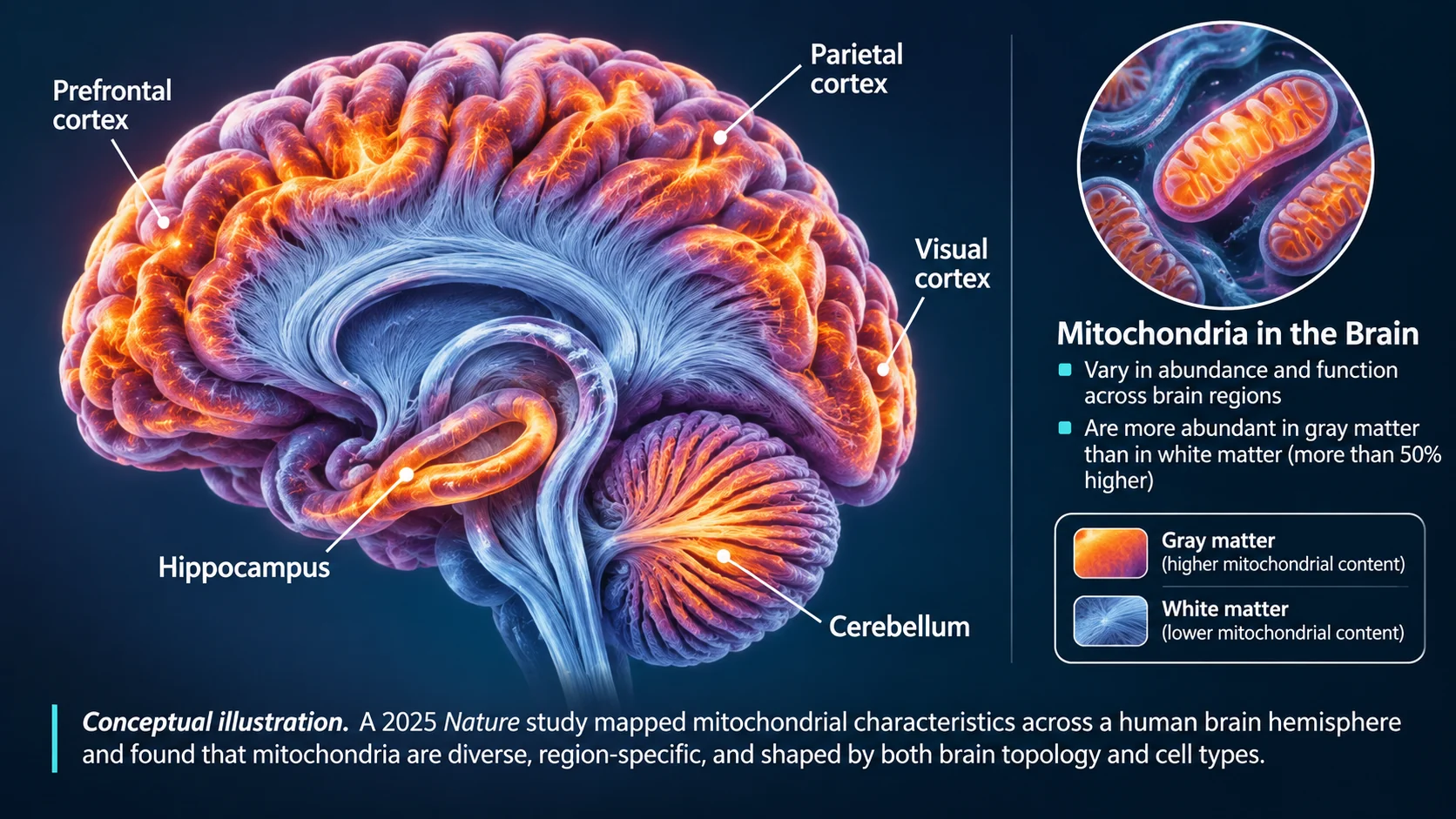
The results revealed considerable variation among brain regions and cell types.
This finding matters because the brain is not metabolically uniform. Different neural systems have different cellular structures and energy-related characteristics.
However, mapping these differences does not tell us whether a particular individual has adequate energy capacity for concentration or memory. It provides a biological foundation for future research rather than a clinical test for cognitive fatigue.
Another study, published online in 2024 and appearing in the April 2025 issue of GeroScience, examined 70 cognitively unimpaired older adults with subjective memory complaints and a family history of Alzheimer’s disease.
The researchers used phosphorus magnetic resonance spectroscopy to examine indirect markers of brain energy metabolism.
Some measures in a region of the left temporal lobe were associated with better recent-memory performance.
However, the researchers did not find the predicted relationship between frontal brain energy markers and executive function.
These mixed results are informative. They suggest that aspects of cerebral energy metabolism may relate to particular cognitive abilities, without supporting a simple claim that greater mitochondrial capacity produces better thinking across the board.
Together, these studies support three conclusions.
First, mitochondrial biology is directly relevant to the normal function of neurons and neural circuits.
Second, mitochondrial characteristics vary across the brain, and some human research has identified associations between energy-related measurements and cognitive performance.
Third, researchers have not established that reduced mitochondrial capacity is a common cause of ordinary cognitive fatigue or that increasing mitochondrial function will improve focus in otherwise healthy adults.
The distinction between biological plausibility and demonstrated human outcomes is essential.
A familiar decline in concentration during the afternoon may have several explanations.
Daily alertness is influenced by the circadian system, which helps regulate when we feel awake or sleepy. Sleep quality and accumulated sleep pressure also affect attention, reaction time, and decision-making.
Other contributors may include psychological stress, prolonged mental workload, insufficient food intake, medications, and frequent interruptions.
These factors can interact. For example, fragmented sleep may reduce alertness while a demanding work schedule increases the effort required to remain productive.
Mitochondria remain part of the underlying biology because brain cells continuously require energy. But a subjective feeling of mental exhaustion does not reveal how well those mitochondria are functioning.
There is currently no established way to diagnose mitochondrial dysfunction simply from afternoon brain fog, difficulty concentrating, or a perceived loss of mental stamina.
Persistent or worsening symptoms deserve appropriate medical evaluation rather than assumptions about their cellular cause. Sleep disorders, iron deficiency, thyroid conditions, medication effects, and other health problems can contribute to fatigue or cognitive complaints.
Understanding the cellular demands of thinking does not mean that better concentration requires a specialized intervention.
The most practical approach is to support the biological and environmental conditions that allow the brain to function normally.
Prioritize restorative sleep. Getting adequate sleep, maintaining a reasonably consistent schedule, and addressing sleep disruption support attention, learning, and decision-making. Sleep duration alone does not always reflect sleep quality.
Maintain regular physical activity. Exercise has established benefits for general health, sleep, and aspects of cognitive health. It also stimulates mitochondrial adaptations in skeletal muscle, although those effects should not be confused with proof of improved mitochondrial function in the human brain.
Reduce unnecessary task switching. Constant interruptions require repeated shifts in attention. Protecting uninterrupted periods for difficult work can make better use of the attention available without assuming that it changes mitochondrial capacity.
Make room for recovery and adequate nutrition. Breaks from demanding mental activity, sufficient food intake, and managing cumulative workload can support normal daily functioning.
These practices address different contributors to mental fatigue. Their usefulness does not depend on proving that mitochondria caused the original problem.
For a closer look at how cognitive fatigue affects demanding work, decision-making, and mental stamina, read Cognitive Fatigue in High Performers: A Mitochondrial Lens.
For a broader discussion of cellular energy, movement, and recovery, see Bio-Hacking Mitochondria.
Cognitive fatigue is not simply a failure to concentrate.
Mental performance relies on neural circuits that need continuous energy, carefully regulated signaling, and the ability to respond to changing demands.
Mitochondria are essential to this biology. Research is beginning to clarify how their baseline functions and responses during neural activity contribute to cognition.
But cognitive fatigue is more than a mitochondrial problem, just as it is more than a focus problem. Sleep, stress, motivation, workload, brain metabolism, and general health all influence how demanding mental work feels.
The useful lesson is not to assume that fading concentration means something is wrong with your mitochondria. It is to understand that sustained thinking depends on a biological system that deserves adequate sleep, movement, nutrition, and recovery.
As scientists learn more about the relationship between mitochondrial function and brain health, they are also investigating compounds that may influence the cellular processes involved in energy production and neuronal function.
One compound of interest is (−)-epicatechin, a naturally occurring flavanol found in cacao and other plants. Experimental studies have examined its effects on mitochondrial signaling, cellular energy regulation, blood vessel function, and neuronal activity.
Experimental studies have examined its effects on mitochondrial signaling, cellular energy regulation, blood vessel function, and neuronal activity.
In a 2021 study involving FMG Health Sciences’ founding scientists, Dr. Guillermo Ceballos and Dr. Francisco Villarreal, researchers investigated the effects of (−)-epicatechin on brain function in mice. They observed increases in markers associated with neuronal development, greater capillary density in the frontal cortex, and improvements in short-term spatial working memory. These findings suggest that (−)-epicatechin may influence biological processes relevant to brain health, although further human research is needed.
Research in humans has also examined (−)-epicatechin’s effects on mitochondrial-related pathways. A small eight-week pilot study reported changes in markers associated with mitochondrial biogenesis and cellular energy metabolism in skeletal muscle. Although these findings are encouraging at the biological level, they do not establish equivalent effects in the brain, and results from human supplementation studies have been mixed.
Mitozz was developed around this interest in mitochondrial biology. Formulated with 98% pure (−)-epicatechin, it provides a standardized source of a compound being investigated for its role in cellular energy and mitochondrial signaling.
For individuals interested in supporting long-term mitochondrial health, Mitozz is designed to complement the foundations of healthy cellular function, including regular movement, adequate nutrition, restorative sleep, and recovery.
While its potential effects on cognitive performance remain an open research question, (−)-epicatechin represents an interesting area of investigation into how cellular energy systems contribute to overall health.
For a broader introduction to how mitochondria support cellular energy and normal human physiology, read our Mitochondria 101 guide.
Compartilhe este artigo do blog
Compreender a saúde mitocondrial é um processo de longo prazo. É por isso que criamos o Mitozz : uma forma gratuita de continuar aprendendo sobre energia celular, saúde mitocondrial e os hábitos de vida que apoiam seu corpo ao longo do tempo. Você receberá conteúdo educativo com base científica, orientações práticas e novidades da Mitozz, tudo no seu próprio ritmo.
Obtenha informações com base científica sobre saúde mitocondrial, energia celular e hábitos de vida que contribuem para a saúde do seu corpo a longo prazo.
Aviso médico: As informações fornecidas neste artigo têm caráter exclusivamente educativo e informativo, não constituindo orientação médica. Não substituem o diagnóstico, o tratamento ou a orientação de um profissional de saúde. Consulte sempre um profissional de saúde qualificado antes de fazer alterações em sua dieta, rotina de exercícios, práticas de jejum ou uso de suplementos, especialmente se você tiver alguma condição médica, estiver grávida ou amamentando, ou estiver tomando medicamentos.
Isenção de responsabilidade da FDA: Estas declarações não foram avaliadas pela Food and Drug Administration. Elas não se destinam a diagnosticar, tratar, curar ou prevenir qualquer doença.