
Every breath you take supplies your body with something essential for life: oxygen. Your lungs bring it into the bloodstream, your heart pumps it through your blood vessels, and your cells use it to produce energy.
But what happens after oxygen reaches our cells is just as important as how it gets there.
Having enough oxygen available doesn’t necessarily mean your cells can use it efficiently.
As we age, changes can occur not only in how oxygen reaches our tissues, but also in how those tissues respond to it. The mitochondria, the structures responsible for most of our cellular energy production, play an important role in that relationship.
Scientists are now investigating whether the gradual loss of coordination between oxygen delivery and oxygen utilization may be one factor contributing to biological aging.
This emerging perspective raises an interesting question: Could healthy aging depend partly on how well our bodies continue to use the oxygen we breathe?
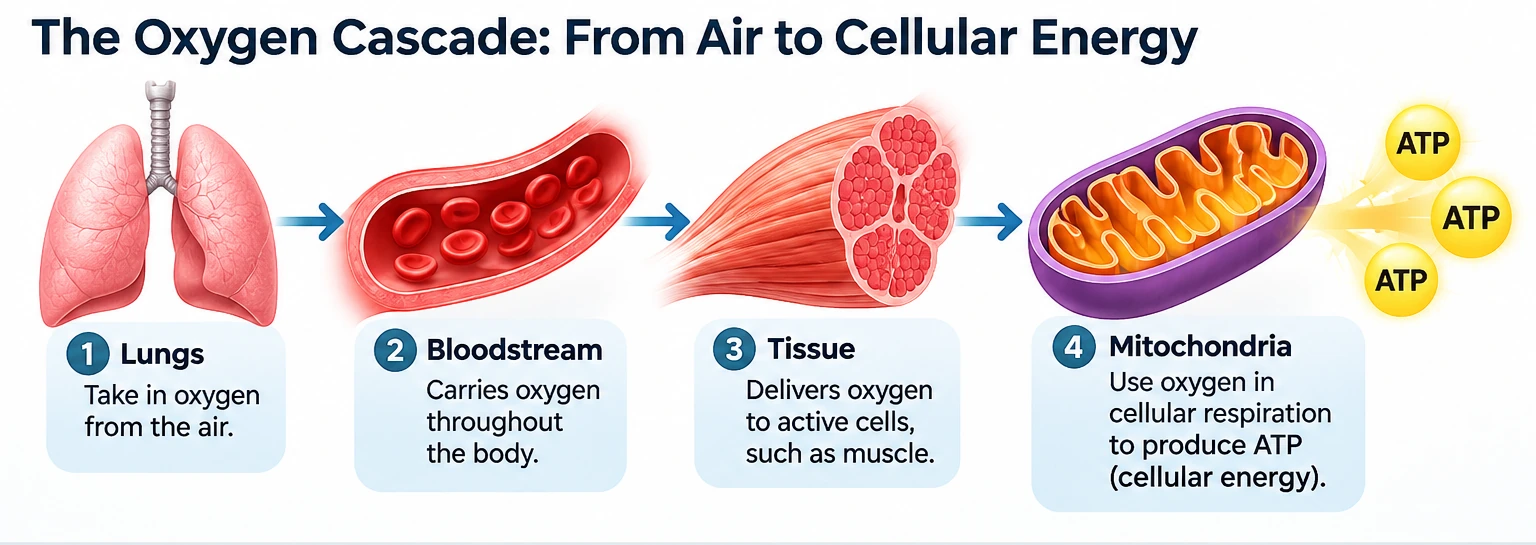
We tend to think of oxygen as something we either have enough of or don’t. In reality, oxygen must complete a carefully coordinated journey inside our bodies before it can help our cells produce energy.
Scientists call this process the oxygen cascade.
It begins when oxygen enters the lungs and passes into the bloodstream. From there, the cardiovascular system transports it through progressively smaller blood vessels until it reaches the surrounding tissues.
Oxygen then moves from the blood into cells, where mitochondria use it during a process called oxidative phosphorylation.
During this process, oxygen serves as the final electron acceptor in the mitochondrial electron transport chain. This allows mitochondria to sustain the production of ATP, the molecule that powers countless cellular activities.
Each stage depends on the others.
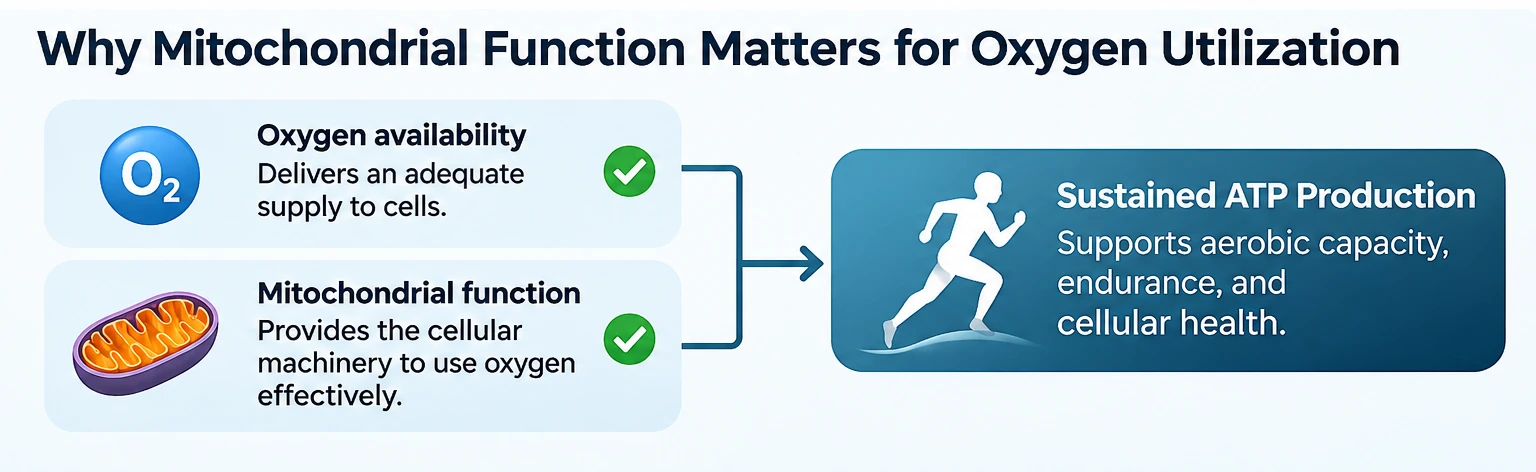
Mitochondria need a steady supply of oxygen to produce energy. But having enough oxygen doesn’t guarantee that mitochondria can use it effectively.
Both sides of the equation matter: getting oxygen to the cells and putting it to work once it arrives.
Aging doesn’t affect every part of the oxygen cascade equally and the changes vary considerably between each person.
Nevertheless, researchers have identified several age-related changes that can influence how effectively oxygen reaches tissues and contributes to cellular metabolism.
The lungs may become less efficient at exchanging gases. Blood vessels can become less responsive to changing demands, while alterations in small-vessel circulation may influence how oxygen is distributed within tissues.
At the cellular level, mitochondrial respiratory capacity and other aspects of mitochondrial function may also change.
These changes become particularly relevant when the body needs to respond to increased demand.
Consider what happens when you begin walking briskly or climbing stairs.
Your muscles require more energy, so your cardiovascular system increases oxygen delivery and your muscle cells increase oxygen consumption.
In a well-conditioned body, these processes adjust together. As physiological capacity declines, maintaining that coordination under increasing demands may become more difficult.
This does not mean that mitochondrial energy production inevitably deteriorates with every passing year. Physical activity, tissue type, health status, and individual biology all influence how mitochondrial function changes over time.
The broader issue is whether the body retains enough flexibility to respond when its needs change.
In August 2026, researchers associated with the National Institute on Aging and collaborating institutions published a review in Aging Cell proposing a framework called oxygenaging.
Their paper, Oxygenaging: A Physiological Framework for Geroscience, explores how aging may affect the body’s ability to deliver oxygen to tissues and use it effectively.
The researchers suggest that age-related changes in circulation, mitochondrial function, and cellular oxygen-sensing mechanisms may reduce the body’s ability to match oxygen availability with changing energy demands.
This matters because cells must do more than receive oxygen. They must also adjust their metabolism as conditions change, whether during physical activity, recovery, or everyday cellular function.
Oxygenaging is a proposed framework, not an established cause of aging. It brings together several known physiological processes, but further research is needed to determine how much these changes contribute to aging and whether targeting them can improve long-term health.
Having enough oxygen is only part of the equation. Mitochondria must also remain healthy and capable of using it to produce energy.
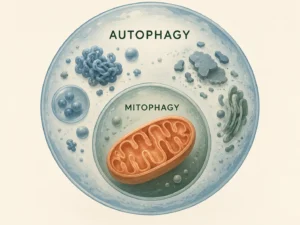
To maintain that capacity, cells continually monitor, repair, and recycle mitochondrial components. These processes, collectively known as mitochondrial quality control, help preserve normal mitochondrial function.
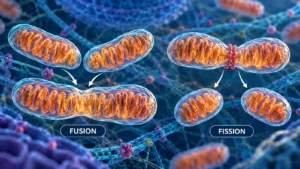
One important aspect of this maintenance involves mitochondria changing their shape and organization. We explain this process in more detail in Fusion and Fission: Why Mitochondria Have to Change Shape.
As we age, some mitochondrial maintenance processes may become less effective, potentially limiting how well cells respond to changing energy demands.
The key point is that oxygen availability alone does not determine how effectively cells produce energy. The condition and functional capacity of their mitochondria matter too.
The oxygenaging framework is still being investigated, but research has already identified several ways to support the body’s ability to deliver and use oxygen.
Regular physical activity is one of the most thoroughly studied approaches.
Aerobic exercise challenges the cardiovascular system to deliver more oxygen to working muscles. With consistent training, the body can adapt by improving cardiovascular fitness and increasing the oxidative capacity of skeletal muscle.
Resistance training also plays an important role in maintaining muscle strength and physical function as we age. Research suggests that exercise training can influence mitochondrial content and function in older adults, although the magnitude of these changes varies between individuals and training programs.
Nutrition, sleep, and adequate recovery also contribute to the physiological conditions that support normal cellular metabolism.
Certain compounds may also influence mitochondrial function through cellular pathways that operate independently of exercise.
One example is (−)-epicatechin, a naturally occurring flavanol studied for its effects on mitochondrial biology, circulation, and cellular metabolism.
In animal studies, (−)-epicatechin supplementation has increased markers of mitochondrial biogenesis, improved muscle fatigue resistance, and influenced mitochondrial structure, even without exercise.
Early human research has also reported changes in mitochondrial-related markers following (−)-epicatechin supplementation. However, larger controlled studies are needed to establish whether these findings translate into meaningful improvements in oxygen utilization or long-term health.
Mitozz, developed by FMG Health Sciences, contains 98% pure (−)-epicatechin and is designed to support normal mitochondrial function and cellular energy.
Healthy aging is not simply about getting enough oxygen. It also depends on how effectively our cells can use it and how well our bodies adapt when energy demands change.
The oxygenaging framework brings these processes together, offering researchers a new way to investigate declining physiological resilience.
The goal is not to maximize oxygen consumption, but to preserve the body’s capacity to use oxygen effectively when it matters.
To learn more about the processes that help preserve mitochondrial function, download our free book, Mitochondrial Quality Control, from the Mitozz Download Center.
Compartilhe este artigo do blog
Compreender a saúde mitocondrial é um processo de longo prazo. É por isso que criamos o Mitozz : uma forma gratuita de continuar aprendendo sobre energia celular, saúde mitocondrial e os hábitos de vida que apoiam seu corpo ao longo do tempo. Você receberá conteúdo educativo com base científica, orientações práticas e novidades da Mitozz, tudo no seu próprio ritmo.
Obtenha informações com base científica sobre saúde mitocondrial, energia celular e hábitos de vida que contribuem para a saúde do seu corpo a longo prazo.
Aviso médico: As informações fornecidas neste artigo têm caráter exclusivamente educativo e informativo, não constituindo orientação médica. Não substituem o diagnóstico, o tratamento ou a orientação de um profissional de saúde. Consulte sempre um profissional de saúde qualificado antes de fazer alterações em sua dieta, rotina de exercícios, práticas de jejum ou uso de suplementos, especialmente se você tiver alguma condição médica, estiver grávida ou amamentando, ou estiver tomando medicamentos.
Isenção de responsabilidade da FDA: Estas declarações não foram avaliadas pela Food and Drug Administration. Elas não se destinam a diagnosticar, tratar, curar ou prevenir qualquer doença.