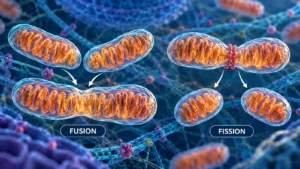

Every movement you make, every thought you form, and every heartbeat depends on energy. Much of that energy is produced by tiny structures inside your cells called mitochondria.
Mitochondria are often described as the body’s power plants. It’s a useful comparison, but their work goes far beyond producing energy. They also help cells respond to stress, regulate important signals, and adjust to changing demands.
Understanding what mitochondria actually do can help explain why exercise, nutrition, sleep, and recovery matter for long-term health.
Your body obtains energy from carbohydrates, fats, and other nutrients. Cells process these nutrients through several metabolic pathways, many of which involve mitochondria.
The result is the production of ATP (adenosine triphosphate), a molecule that transfers energy to processes throughout the body.
ATP powers muscle contractions, nerve signaling, cellular transport, and countless other activities required to keep you alive.
Inside mitochondria, a process called oxidative phosphorylation uses energy derived from nutrients and oxygen to produce ATP.
For a more detailed introduction, visit Mitochondria 101.
Mitochondria are active participants in how cells function, communicate, and respond to changing conditions.
They help regulate calcium signaling, which influences muscle contraction and other cellular activities. They participate in pathways that determine how cells respond to damage and stress.
They also produce small amounts of reactive oxygen species (ROS).
Although ROS are frequently described as harmful, they have normal biological functions. In controlled amounts, they help cells communicate and adapt. Problems arise when oxidant production and cellular defenses become unbalanced, potentially damaging proteins, lipids, and DNA.
This distinction matters because healthy mitochondrial function does not mean eliminating all oxidative activity.
For more on this subject, see ROS Are Not the Enemy: How Cells Turn Stress Into Adaptation.
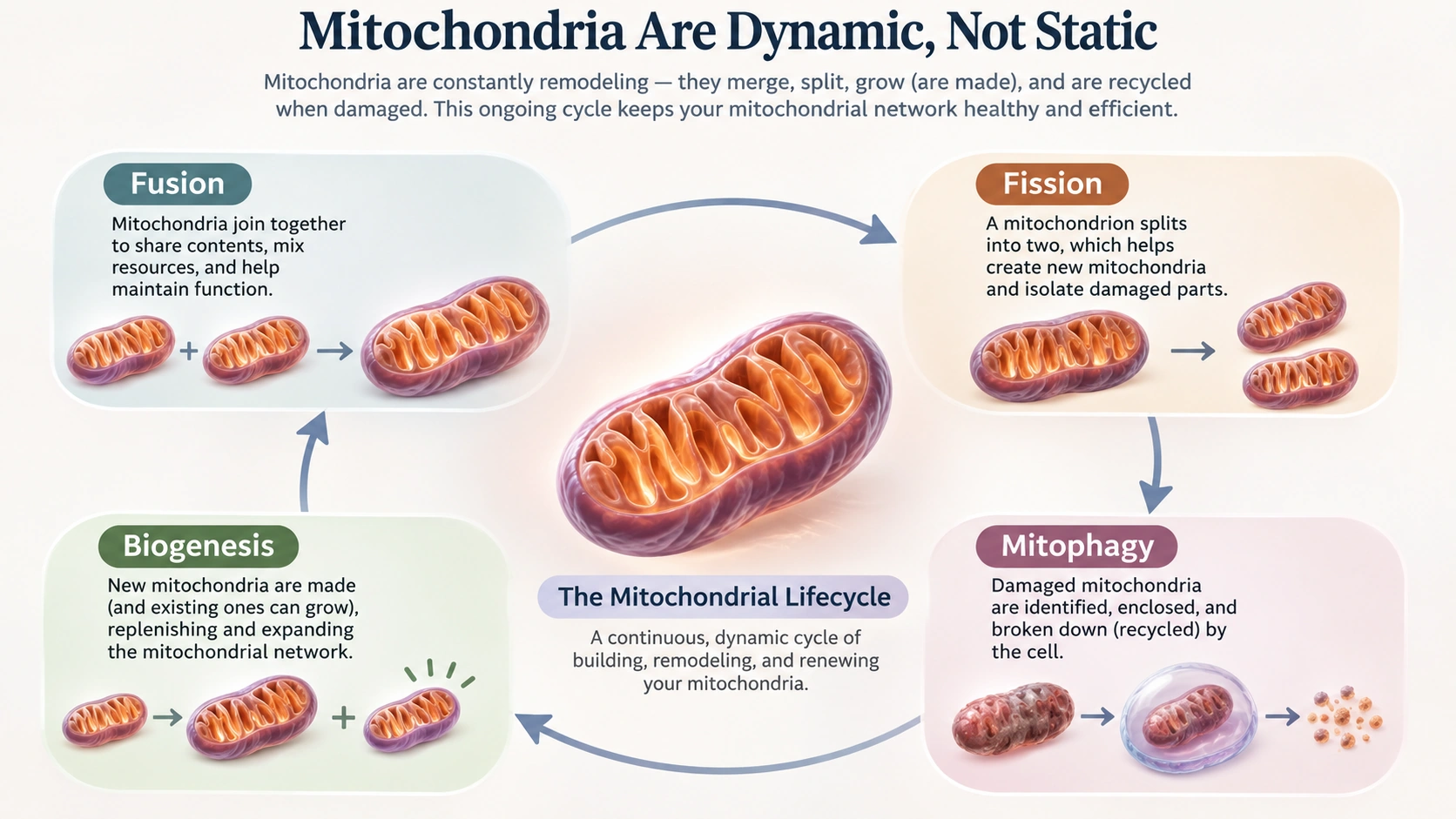
Mitochondria are not permanent structures that remain unchanged throughout your life.
Cells continually maintain and remodel their mitochondrial networks.
Two important processes are:
Mitochondrial biogenesis: The process through which cells increase their mitochondrial components and capacity.
Mitophagy: A cellular quality-control process that helps remove mitochondria or mitochondrial components that are damaged or no longer needed.
These processes work alongside mitochondrial fusion, fission, protein maintenance, and other mechanisms to help cells respond to changing energy demands.
Aging can affect these processes, but mitochondrial aging is not simply a universal decline in energy production.
Research published in 2026 describes mitochondrial aging in terms of the ability to maintain function, adapt to challenges, and recover afterward. Different tissues and individuals may experience different changes.
Some practices have much stronger human evidence than others.
Exercise is one of the best-supported ways to improve mitochondrial capacity, particularly in skeletal muscle.
A systematic review and meta-regression published online in 2024 found that endurance training, high-intensity interval training, and sprint interval training can all increase markers of mitochondrial content.
This means there is no single exercise intensity required to stimulate mitochondrial adaptation.
For general health, the World Health Organization recommends 150–300 minutes of moderate aerobic activity per week, or an equivalent amount of vigorous activity, together with muscle-strengthening exercise at least twice weekly.
Start at a level appropriate for your health and gradually increase activity as your capacity improves.
Sleep supports metabolic regulation, cognitive performance, immune function, and physical recovery.
Most adults require at least seven to nine hours of sleep per night, although individual needs vary.
Sleep disruption is associated with changes in metabolic function and physiological stress. However, it would be an oversimplification to say that sleeping automatically repairs damaged mitochondria.
Consistent sleep and adequate recovery support the broader conditions in which healthy cellular function takes place.
Mitochondria depend on a steady supply of nutrients and the enzymes and cellular structures required to process them.
A balanced diet that provides adequate energy, protein, vitamins, minerals, and other nutrients supports normal metabolism.
Fruits, vegetables, legumes, whole grains, and other minimally processed foods can contribute to overall metabolic health.
There is no established dietary formula that directly optimizes mitochondrial function in every person, and consuming more antioxidants is not necessarily better.
Scientists have investigated (−)-epicatechin, a naturally occurring flavanol found in cacao, because of its effects on cellular signaling pathways related to metabolism, mitochondrial function, and vascular biology.
Experimental studies have identified several potentially interesting mechanisms.
In one small, uncontrolled pilot study, seven adults with Becker muscular dystrophy received (−)-epicatechin for eight weeks. Researchers observed changes in several mitochondrial and muscle-related biomarkers, along with some exercise-test measures.
Mitozz, developed by FMG Health Sciences, contains 98% pure (−)-epicatechin as its active ingredient.
For a closer look at the evidence, read (−)-Epicatechin and Mitochondrial Function
Your mitochondria are far more than tiny power plants. They are part of a remarkable biological system that helps your cells produce energy, respond to challenges, and maintain their ability to function.
Perhaps the most encouraging discovery is that mitochondria are remarkably adaptable. Their capacity can change in response to physical activity, nutritional conditions, and other demands. Even as we age, our cells retain an ability to respond and adapt.
This adaptability is also what makes compounds such as (−)-epicatechin so interesting. Research has identified effects on cellular signaling pathways involved in mitochondrial biogenesis, vascular function, and cellular maintenance, opening new possibilities for understanding how mitochondrial health can be supported.
The message is an encouraging one: our cellular energy systems are not fixed. Through regular movement, good nutrition, adequate rest, and a growing understanding of mitochondrial biology, we have meaningful opportunities to support the cellular processes that keep us active, capable, and resilient throughout life.
Compartilhe este artigo do blog
Compreender a saúde mitocondrial é um processo de longo prazo. É por isso que criamos o Mitozz : uma forma gratuita de continuar aprendendo sobre energia celular, saúde mitocondrial e os hábitos de vida que apoiam seu corpo ao longo do tempo. Você receberá conteúdo educativo com base científica, orientações práticas e novidades da Mitozz, tudo no seu próprio ritmo.
Obtenha informações com base científica sobre saúde mitocondrial, energia celular e hábitos de vida que contribuem para a saúde do seu corpo a longo prazo.
Aviso médico: As informações fornecidas neste artigo têm caráter exclusivamente educativo e informativo, não constituindo orientação médica. Não substituem o diagnóstico, o tratamento ou a orientação de um profissional de saúde. Consulte sempre um profissional de saúde qualificado antes de fazer alterações em sua dieta, rotina de exercícios, práticas de jejum ou uso de suplementos, especialmente se você tiver alguma condição médica, estiver grávida ou amamentando, ou estiver tomando medicamentos.
Isenção de responsabilidade da FDA: Estas declarações não foram avaliadas pela Food and Drug Administration. Elas não se destinam a diagnosticar, tratar, curar ou prevenir qualquer doença.